


Magali Clavie: “Belgium wants a more coordinated and effective European framework against illegal gambling”
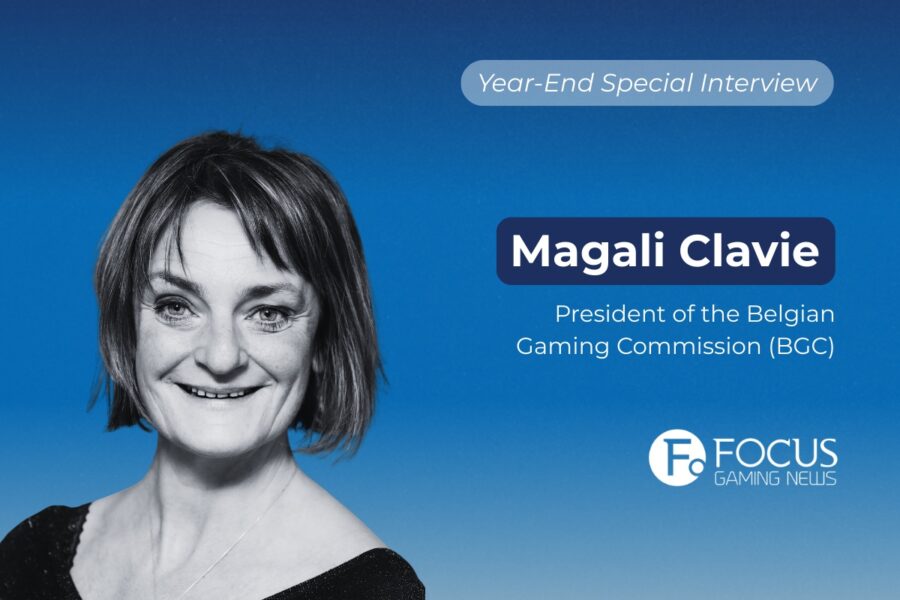

The President of the Belgian Gaming Commission and vice chair of GREF tells Focus Gaming News about the regulator’s achievements in 2025 and challenges to come in 2026.
Exclusive interview.- Magali Clavie’s five years as president of the Belgian Gaming Commission (Kansspelcommissie/BGC) have coincided with major changes in gambling regulation in the country. From a ban on gambling ads in 2023 to last year’s increase in the minimum age for gambling to 21 and now new IP-blocking powers against unlicensed gambling sites, Belgium has been progressively tightening restrictions.
Clavie also currently serves as vice chair of the Gambling Regulators’ European Forum (GREF), in which she plays a role in facilitating discussions among European regulators to share learnings. As we approach the end of 2025, we asked Clavie how she views the developments of the past year and what challenges remain for gambling regulation in Belgium and wider Europe.
Reflecting on 2025, what do you consider the most significant regulatory development in Belgium?
The coalition agreement of the new federal government, published on January 31, 2025, provides for the transfer of the Gaming Commission to the Minister of Economy, who will become the sole competent authority. After 25 years, this change is intended to provide new momentum and will allow for a thorough evaluation.
This will be implemented in 2026, and 2025 was therefore the transition year in this context. The same agreement provides for a reform of the Commission, which offers new opportunities.
In 2025, we also had to verify compliance with the new rules. For example, our national exclusion system has been updated. Our law now provides a framework for which identification methods players can use, and the way operators need to verify them. The minimum age for participating in games of chance was also raised and harmonised to 21
Also, in September 2025, the new Commission members were appointed by the government.
What do you hope to achieve in GREF during your term as vice chair?
It is clear that the fight against illegal websites is a challenge in all countries and can only be waged through international cooperation.
That is why Belgium, within the GREF, wants to focus on establishing a more coordinated and operationally effective European framework in which regulators can act quickly and consistently across borders. Tackling illegal content online cannot be the sole responsibility of regulators alone.
Tech platforms often have advanced tools that allow them to evaluate the content on their platform a lot easier than we can. The European Digital Services Act has already provided regulators and online platforms with an important set of tools to act against illegal content. But more could still be done on a European level. For example, by expanding the digital services act and providing an increased level of diligence for any content that may be related to games of chance.
Another group we need to talk about, are payment service providers. When fighting against illegal online gambling, they are in an even more powerful position: if they were to prohibit illegal gambling-related transactions – i.e. payments to merchants offering gambling services that do not possess a license in the jurisdiction of the player – they could effectively block payments before they can even turn into wagers.
“Tech platforms often have advanced tools that allow them to evaluate the content on their platform a lot easier than we can.”
Magali Clavie, president of the BGC.
What do you think was the most disruptive trend of 2025?
The most disruptive trend this year for us in Belgium, has been the ever-increasing ease with which anyone can anonymously create large amounts of content online. Unlicensed gambling sites appear faster than ever, and illegal operators use advanced methods to quickly move or duplicate their platform, effectively circumventing blocking measures.
The use of AI tools makes it easier than ever for malicious actors to appear legitimate and mislead players. As regulators we need to be mindful of this.
“The most disruptive trend this year for us in Belgium, has been the ever-increasing ease with which anyone can anonymously create large amounts of content online.”
Magali Clavie, president of the BGC.
Amid pressure from unlicensed cross-border operators, what progress has the Belgian Gaming Commission made towards channelling players to the legal, regulated market?
As already stated, in the world of online gambling, illegal offerings are growing at an alarming rate. The risks are considerable. First of all, there is no guarantee whatsoever: promised winnings are not always paid out and players who are duped have no recourse. In addition, there is no protection whatsoever.
Players with debts or an active exclusion can be admitted without any checks, regardless of their financial or psychological situation. Illegal providers do not verify age, identity or vulnerability. This lack of supervision also creates a breeding ground for money laundering, as the usual checks simply do not exist.
In our view, an important part of the approach lies in reducing the visibility of these illegal websites. These platforms invest heavily in sponsored advertisements on social media: this is prohibited, but it increases their visibility and wrongly gives the impression that they are legitimate.
Quite often the illegal websites even use the name or logo of legal operators. This strategy is particularly effective. Players – often beginners or insufficiently informed – quickly assume that they are dealing with a recognised provider. And because legal operators do comply with the ban on sponsored advertising, they are much less visible than their illegal competitors.
Fortunately, the Commission has a direct line of communication with Meta, which allows us to quickly remove such illegal advertising. The figures show the scale of the problem: this year alone, we have forwarded 7,000 reports to take these illegal advertisements offline.
Nevertheless, it remains a constant race against illegal providers: as soon as one website is tackled, another one immediately appears. The well-known blacklist – currently accounting for around 700 platforms – continues to grow.
On the other hand, however, there is a robust and strictly regulated legal offering. Belgium has almost 80 operators with an official licence, which are subject to regular checks or investigations following complaints from players. This means that the regulated channel remains the only safe and reliable choice for consumers.
What are emerging challenges do you anticipate for 2026, and how is the Belgian Gaming Commission preparing for them?
A project we are keeping a close look at, is the upcoming European Digital Fairness Act. This regulation will cover several practices that are not gambling but could regardless cause harm to consumers if unregulated.
One important case for us is a practice on the frontier between videogames and gambling: the so-called paid random items, and in particular loot boxes. These randomised rewards have been a topic of discussion in Belgium for a long time.
Last year, the Gaming Commission published a report concluding that gambling law is not the right place to regulate these practices. Instead, European Consumer Protection law seems to be the most adequate framework, supported by self-regulation tools from the industry. We were delighted that Europe is addressing this issue and the upcoming Digital Fairness Act seems to be moving in the same direction as our recommendation and look forward to learning more about its contents soon.
At the Belgian level, the Minister for the Economy has also announced an evaluation of our law. This is a good thing because its text dates back to the last century and gambling has evolved considerably since then.
By Focus Gaming News Editorial Team