Prediction Markets in the US: Data, Regulation and Growth 2026

Focus Gaming News analyses the rise of prediction markets in the US: their rapid growth, the new federal rules on the table and the states pushing back against the vertical.
Key takeaways
- The prediction market vertical grew 256% between January and December 2025, with branded demand increasing more than fivefold since August 2025 alone, according to Blask data.
- In March 2026, Polymarket and Kalshi jointly accounted for approximately 94% of all branded demand in the US, with Robinhood as the fastest-growing challenger at +983.4% year-on-year.
- Kalshi closed a Series F funding round in May 2026 at a $22bn valuation, backed by Coatue, Sequoia, a16z and Morgan Stanley.
- The CFTC has initiated legal actions against 8 states — Arizona, Connecticut, Illinois, New York, New Mexico, Rhode Island, Wisconsin and Kentucky — arguing that event contracts qualify as federal financial derivatives, not state-regulated gambling.
- Minnesota became the first US state to make operating a prediction market a felony (effective August 1, 2026); the CFTC sued Minnesota the next day.
Special report.- Few verticals have divided the US gaming industry as prediction markets. In only two years, platforms that allow users to trade on the outcomes of real-world events have grown from a curiosity into a multi-billion-dollar vertical and triggered a constitutional dispute between federal and state regulators that legal experts believe could end up before the Supreme Court.
In this special report, Focus Gaming News analyses what prediction markets are and why they have grown so quickly, the Commodities Futures Trading Commission (CFTC)’s proposed rules for the vertical, the states moving to ban these platforms, and how the industry is positioning itself amid the legal battle over who has the authority to regulate them.
What prediction markets are
Prediction markets allow users to buy and sell contracts tied to the outcome of future events: elections, sporting results, economic indicators, even awards shows. Each contract pays out if the event occurs, and its price fluctuates with the market’s collective assessment of the probability. Operators structure these products as “event contracts”, a category of financial derivative, rather than as bets.
There’s a conflict in the US over who regulates them. If event contracts are derivatives, they correspond to the CFTC’s oversight. If they are bets, they would be subject to more than 30 state gaming regimes, each with its own licensing, taxes and safeguards.
In an interview with Focus Gaming News, Jeremy Locke, president of the North American Gaming Regulators Association (NAGRA), said prediction markets operate as designated contract markets. “These platforms allow users to trade on the outcomes of events – including sporting events – through instruments known as ‘futures contracts.’ The operators claim these contracts fall under the jurisdiction of the CFTC, meaning state-level regulation does not apply.”
In practice, “many of these contracts function much like traditional sports or event wagers,” Locke said. “Participants can place bets on outcomes such as the money line, point spread, totals across a variety of sports or novel events. Individuals as young as 18 can join. Unlike state-regulated betting, these markets appear to lack the same consumer protection measures that states typically require for products with addictive potential.”
From election spike to structural growth
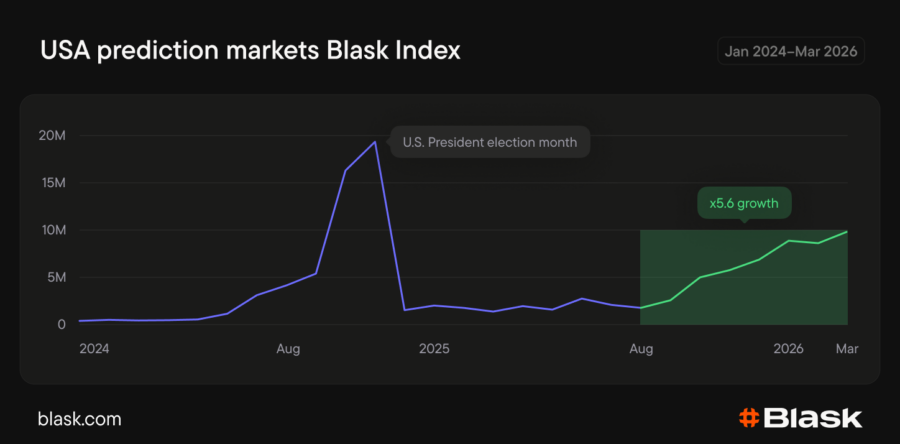
The prediction market’s breakout moment was the last US presidential election, which drove branded demand to an all-time high in November 2024, according to Blask, an AI-powered platform for igaming and gambling market analytics. Once the political cycle concluded, interest fell, and many analysts assumed the boom had passed. However, it had not.
Blask data shows the vertical grew by 256 per cent between January and December 2025, and branded demand has increased more than fivefold since August 2025 alone.
Blask said: “Unlike the sharp, short-lived surge seen in 2024, the current rally has developed steadily over eight consecutive months without a comparable macro trigger. This shift suggests a structural evolution of the category, moving from episodic attention toward more consistent user engagement. At the same time, the competitive landscape has consolidated rather than diversified.”
Current demand still sits around 49 per cent below the election-cycle peak, but the growth is now driven by sports rather than politics.
Growth has consolidated rather than diversified the market. In March 2026, Polymarket and Kalshi jointly accounted for approximately 94 per cent of all branded demand in the US, and both strengthened their positions as the category grew. State-level data reinforces the dominance: in Kansas, Polymarket controlled 95.5 per cent of branded demand against Kalshi’s 3.5 per cent, while Louisiana showed the closest competition, at 59 per cent and 35.3 per cent respectively. Demand was also geographically concentrated, with California accounting for 15.9 per cent of the national total and New York 10.8 per cent.
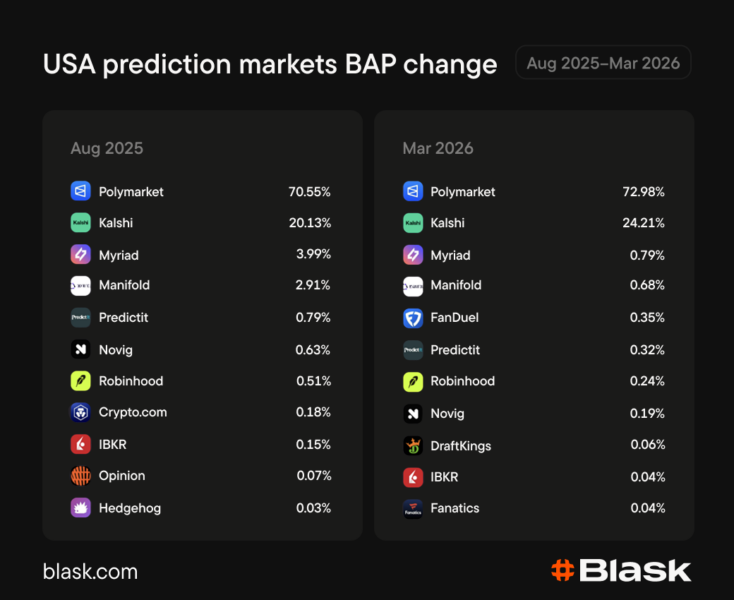
Challengers remain marginal; the rest of the market holds just 6 per cent of branded demand. The fastest-growing entrant is Robinhood, up 983.4 per cent year-on-year from a share of just 0.24 per cent, while Blask’s March ranking also registers the arrival of FanDuel, DraftKings and Fanatics.
Elsewhere, across the UK, Ireland, Canada and Australia, Kalshi’s share of Polymarket vs Kalshi remains below 6 per cent. But in some of these markets, betting on non-sporting events has been legal through licensed bookmakers for decades.
Despite their growth, prediction markets remain a mid-tier niche in every market Blask tracks, ranking around 15th to 20th in its index, well behind online casinos, lotteries and traditional betting. Capital markets have nonetheless taken notice. Kalshi closed a Series F funding round in May at a $22bn valuation, led by Coatue with participation from Sequoia, a16z and Morgan Stanley.
The CFTC changes course
For 15 years, the CFTC’s posture was that contracts resembling gambling had no place on federally regulated exchanges. That position reversed after the change of administration last January, when the agency adopted a permissive stance and platforms began self-certifying sports event contracts.
The shift was formalised on June 10, when the CFTC published a 267-page notice of proposed rulemaking, the first comprehensive federal framework for the vertical. The proposal would permit sports contracts covering final scores, point differentials, win-loss results, tournament advancement and statistical performance, while prohibiting markets considered vulnerable to manipulation: specific in-game plays, player injuries, officiating decisions and pre-collegiate sports, along with contracts tied to war, terrorism and assassinations.
Michael S. Selig, the CFTC’s chairman, said, the body would “protect the integrity of our regulated markets without standing in the way of responsible innovation” and that the proposal “gives the Commission a durable, transparent framework to identify the contracts Congress directed us to scrutinise while letting legitimate markets move forward.”
The proposal drew immediate criticism from the gaming industry. Bill Miller, president of the American Gaming Association (AGA), described it as “a remarkable attempt to redefine what constitutes sports betting”.
The states push back
States escalated enforcement. Minnesota became the first US state to outlaw prediction markets after governor Tim Walz signed the ban into law in May. The measure, which makes operating, hosting or promoting a prediction market in the state a felony, is scheduled to take effect on August 1, 2026. The CFTC sued Minnesota one day after the bill was signed, seeking a preliminary injunction to block it.
Bills to ban or restrict certain event contracts have been introduced in Vermont (House Bill 913), New Jersey (S-3692) and Hawaii (House Bill 2198), while a New York Senate subcommittee voted to advance S9414. In Congress, senators Adam Schiff (D-California) and John Curtis (R-Utah) introduced the Prediction Markets Are Gambling Act in March as “the first bipartisan bill seeking to regulate prediction markets”. This would amend the Commodity Exchange Act to cover amateur, collegiate, and professional sports.
The text clarifies that it would not preempt any state law or rule that regulates or prohibits such games. The AGA called the bill “a critical step in reaffirming Congressional intent that all gaming, including sports betting, is not a federal commodity, and is governed by state and tribal law.”
The CFTC has initiated legal actions against eight states over their efforts to restrict the vertical: Arizona, Connecticut, Illinois, New York, New Mexico, Rhode Island, Wisconsin and Kentucky. The agency’s argument is that event contracts qualify as “swaps” under the Commodity Exchange Act, placing them within the CFTC’s exclusive jurisdiction and preempting state gambling laws.
Courts are divided. A federal court in Arizona granted the CFTC a preliminary injunction blocking the state from criminally prosecuting operators, and the Third Circuit ruled that states cannot enforce gambling laws against platforms offering election and event contracts. Courts in Nevada, Maryland and Ohio, however, have ruled in favour of the states. A bipartisan group of 41 state attorneys general has told the CFTC that prediction market contracts are indistinguishable from sports betting and fall within states’ traditional police powers.
The industry advances anyway
Despite the legal challenges, the industry is evolving. DraftKings, FanDuel and Fanatics have all launched or announced event contract products, hedging against the possibility that the vertical erodes their state-licensed sportsbook business, a presence now visible in Blask’s own rankings. Professional sport has followed: Major League Baseball signed a memorandum of understanding with the CFTC and named Polymarket its official prediction market exchange, a striking endorsement from a league that spent decades opposing sports gambling.
The debate took centre stage at SBC Summit Americas, held from June 9 to 11 in Fort Lauderdale, Florida, where a dedicated Prediction Markets Forum examined how sportsbooks are entering the sector and the compliance and integrity questions the vertical raises.
By Focus Gaming News Editorial Team