


Blask Index falls across every major US brand category in H1 2026

Exclusive Blask Index data shared with Focus Gaming News shows traditional sportsbooks and casinos, prediction markets, and sweepstakes all lost demand between January and May 2026 — and only one of the three fully recovered by June.
Special report.- igaming demand measured by the Blask Index declined across every major brand category between January and May 2026. Traditional sportsbooks and casinos, prediction markets, and sweepstakes all peaked early in the year, then lost ground for most of the subsequent four months. Only sweepstakes recovered fully by June — and that recovery rested almost entirely on one brand.
The Blask Index has shown a consistent seasonal pattern for traditional operators every year since 2016: a post-Super Bowl drop followed by a long trough until the NFL season returns. Prediction markets and sweepstakes followed a similar arc in the first half of 2026, but with sharper swings and a different June outcome.
This report examines the three segments using two Blask metrics for January–June 2026: the Blask Index, a real-time measure of market demand volume for igaming brands in a given country, based on normalised search data, and Brand’s Accumulated Power (BAP), a brand’s percentage share of total market demand in a specific country and period.
The scale of the demand slide
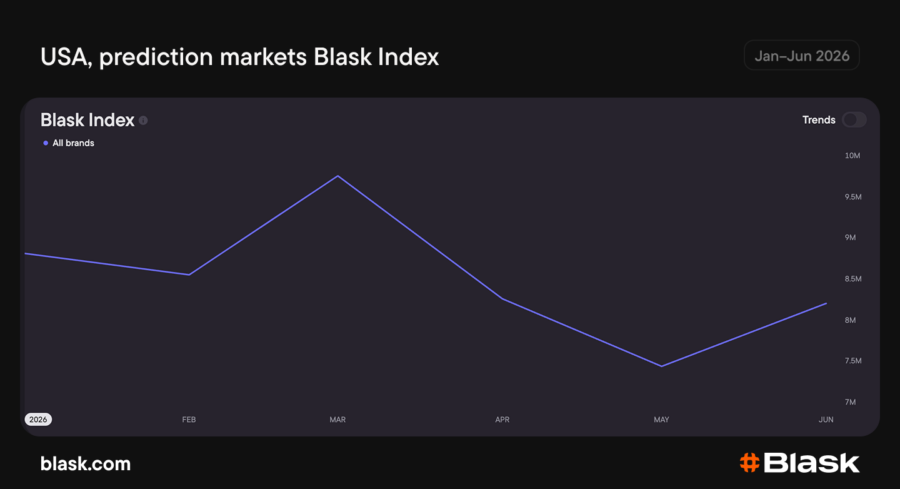
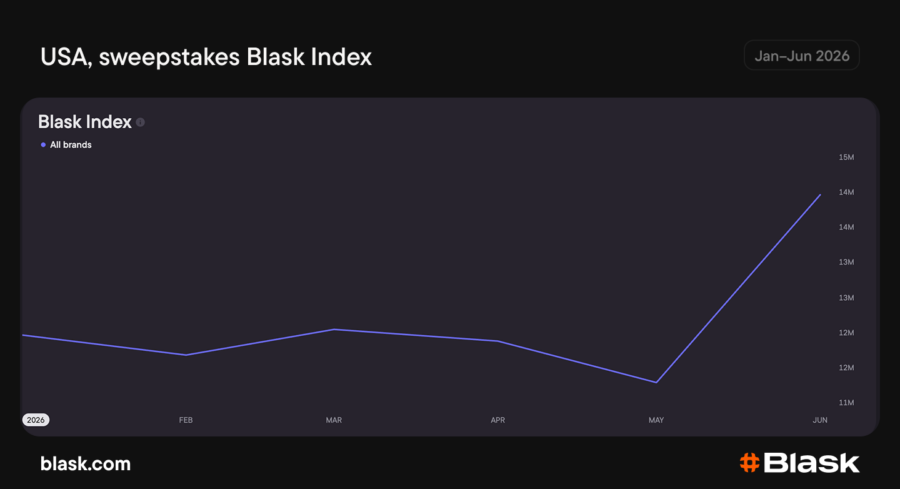
All three categories recorded their highest Blask Index of the half in January 2026, then moved broadly downward until May. Traditional sportsbooks and casinos fell 16.9 per cent from January to May and closed June still 15.4 per cent below the January starting point. Prediction markets declined 15.5 per cent from January to May, and a 10.3 per cent rebound in June still left the category 6.9 per cent lower than January. Sweepstakes dropped a more modest 5.6 per cent by May, then surged to finish the half 16.7 per cent above January.
Traditional brands remained the largest by demand volume throughout, followed by sweepstakes and then prediction markets. The percentage moves show traditional operators suffered the steadiest and deepest erosion, while sweepstakes produced the only clear recovery — one concentrated in a single brand. The Blask Index is designed as a proxy for real-time player interest rather than reported revenue or handle.
Traditional brands: the steepest and most consistent decline
The traditional segment’s trajectory was almost linear after the Super Bowl. February alone accounted for the bulk of the decline, with the index falling 16.8 per cent as the post-championship wagering rush faded. March produced a modest 4.4 per cent rebound. April then erased that gain and more, dropping 9.6 per cent to the lowest point of the half. May and June each posted small increases, but neither was large enough to close the gap.
Nearly the entire leaderboard moved lower. Bovada, the largest brand by demand, was down 14.6 per cent from January to June. BetOnline and DraftKings fell 13.6 per cent and 14.4 per cent respectively. BetRivers, MyBookie and Rainbet all recorded declines exceeding 25 per cent. Bet365 was the clearest outlier, rising 37.6 per cent over the same period.

Prediction markets: a sharp drop, then a partial rebound
Prediction-market demand was more volatile. After a relatively steady start, March delivered a 14 per cent jump. April and May then gave almost all of that gain back. June’s 10.3 per cent rebound left the category still 6.9 per cent below its January level.
Concentration is extreme: Polymarket and Kalshi together held 97.4 per cent of category BAP in June 2026, leaving every other prediction-market brand competing for a residual share of less than 3 per cent. Movements in the two leaders therefore dominate the category numbers.
Polymarket, the larger of the two, saw its Blask Index fall 13.8 per cent from January to June, with most of the decline concentrated by May. Kalshi followed a different path: its index dropped 35 per cent by May, then jumped more than 77 per cent in June alone. That single-month surge was enough for Kalshi to finish the half 15.3 per cent higher than January — the only major prediction-market brand to end H1 in positive territory.
Sweepstakes: the only category to end the half higher — because of one brand
Sweepstakes demand tracked the other two categories through May, down 5.6 per cent from January. Chumba Casino, LuckyLand Slots and Stake were all between 9 per cent and 49 per cent lower by May. Sportzino fell 67 per cent in May alone before a partial June recovery.
June changed the headline outcome. Crown Coins recorded a 445 per cent increase between January and June, moving from a mid-pack position to become the largest brand in the category by Blask Index. That single brand’s growth was large enough to lift the entire category 16.7 per cent above its January level — even though most other sweepstakes operators, including the previous leader Chumba Casino, remained lower than they started the year.
The sweepstakes recovery is therefore real at the aggregate level and highly concentrated at the brand level.
Persistent challenges
Several structural issues remain visible in the data. Prediction markets are already a near-duopoly, and sweepstakes’ entire June recovery was driven by a single brand — any material setback at either of those leaders would move the category numbers significantly. The traditional segment’s seasonal pattern also shows little sign of breaking: Blask data going back to 2016 shows the segment consistently loses momentum between the Super Bowl and the return of the NFL season.
The sweepstakes recovery, in particular, is fragile. A 445 per cent move by one brand can mask continued weakness elsewhere, and if Crown Coins’ growth slows or reverses, the category could quickly return to its January–May trajectory. It is also worth noting that the Blask Index is a demand proxy, not a revenue figure — softness in search-based interest does not automatically translate into proportional declines in deposits or net gaming revenue, and a rebound in the index does not guarantee operators will capture the incremental demand at previous margins.
Outlook
Heading into the second half of 2026, three questions will shape whether the H1 pattern continues: whether traditional operators can generate demand growth before the NFL season returns or the seasonal trough simply lengthens; whether Kalshi’s June surge in prediction markets proves durable and whether Polymarket can stabilise its own decline; and whether Crown Coins’ dominance in sweepstakes marks a lasting shift in category leadership or a one-off spike.
For operators, broad-based demand is not currently expanding: growth will have to come from share gains, improved unit economics, or product launches that create new demand rather than redistributing existing interest.