Tim Miller: “Turning to simplistic but blunt approaches like ever-increasing tax hikes or blanket prohibitions will not make for better regulation”
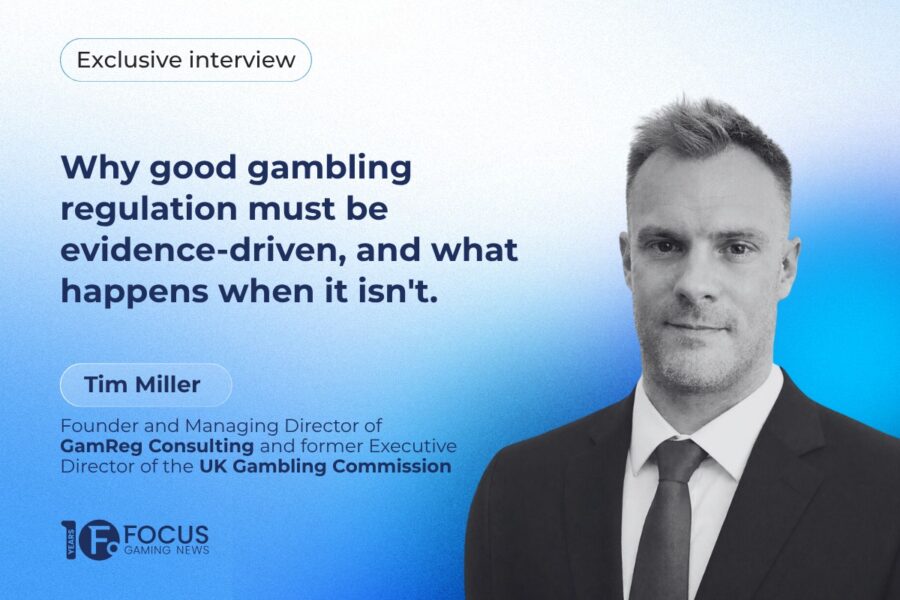
In an exclusive interview with Focus Gaming News, Tim Miller discusses launching GamReg Consulting after a decade at the UKGC, the threat of illegal markets, and evidence-driven reform.
Exclusive interview.- Tim Miller has left the UK Gambling Commission after around a decade, including as executive director of research and policy, to launch GamReg Consulting, a firm that advises governments and regulators rather than operators.
In an exclusive interview with Focus Gaming News, Miller said the venture will help build stronger regulatory frameworks and connect regulators’ ambitions with the technology and insight needed to deliver them, starting with a partnership with Gaming Compliance International. He said the principle behind the work, and the central lesson from his decade in regulation, is to stay evidence-driven rather than react to political or industry pressure.
Having spent around a decade at the UK Gambling Commission, including as Executive Director of Research and Policy, what motivated you to launch GamReg Consulting at this point in your career?
Working at the UKGC was the best role of my career so far, but after ten years I was ready for the next challenge. However, stepping away from gambling regulation entirely didn’t feel right. Establishing GamReg Consulting allows me to take that experience of regulating one of the most diverse gambling markets in the world and use it to support the development of effective and proportionate regulatory systems in other jurisdictions. Importantly, it ensures that I can maintain my independent perspective that is so essential to good regulation.
In a few sentences, how would you describe GamReg Consulting’s core mission to governments, regulators and industry stakeholders who are hearing about it for the first time?
There are lots of consultancies that support the industry in meeting their regulatory obligations. I wanted to build something different that is focused on regulators and regulatory systems. Our work will help to build stronger, more resilient gambling frameworks, tackle illegal markets and apply lessons from other jurisdictions to deliver regulation that works in practice. By also working with companies that support regulators we will help connect regulatory ambitions with the technology, systems and insight needed to achieve it.
“Our work will help to build stronger, more resilient gambling frameworks, tackle illegal markets and apply lessons from other jurisdictions to deliver regulation that works in practice.”
Tim Miller, founder and managing director of GamReg Consulting.
What types of projects or partnerships do you expect GamReg Consulting to focus on in its first year, and what would “success” look like for you?
Some of my initial focus will be on partnerships that bridge the divide between technology suppliers and regulators. Working with companies like Gaming Compliance International, I’ll be able to help inform product development and innovation in a way that will better meet the needs of regulators, which, in turn, will lead to regulatory approaches that are better for both consumers and industry.
A successful Year 1 for GamReg Consulting would be pointing to clear examples where my input and insights have helped governments or regulators deliver change that better protects consumers, commands industry confidence and works in the real world
What are the biggest lessons you’ve learnt from working inside a national regulator that you now want to bring to regulators and governments internationally?
The single biggest lesson is ‘be evidence-driven’. Regulators can be subject to all sorts of noise and intense lobbying from industry, campaigners and the media. If regulators allow themselves to be buffeted by that pressure, then they risk making knee-jerk reforms that won’t actually deliver the expected regulatory outcomes and could have unintended consequences. Building a strong evidence base, using that evidence to shape decision-making, and then relying upon further evidence to evaluate any regulatory changes is the best road to regulatory success.
“Regulators can be subject to all sorts of noise and intense lobbying from industry, campaigners and the media.”
Tim Miller, founder and managing director of GamReg Consulting.
After 25 years in regulation, how do you think the relationship between regulators and industry has evolved—for better or worse?
Generally, I’ve found the relationship between the two has improved over the last ten years. When I started at the UKGC I saw many examples of outrageously poor practice by operators and attempts by some to defend the indefensible. Now I have found that there is a greater shared understanding of the need for high standards of consumer protection and a willingness to work together to deliver it. That doesn’t mean that all compliance failures are a thing of the past. But it does mean that regulator and regulated can have more open engagement about standards in a far less adversarial environment.
Many jurisdictions are currently revisiting their gambling frameworks. What common pitfalls do you see when countries attempt rapid reform of their regulatory systems?
In jurisdictions around the world, there is huge political and public pressure to address the harms that can come from gambling. It is essential that consumers are well protected and that industry takes those obligations seriously. Much of my time at the UKGC was focused on developing appropriate regulatory approaches to gambling-related harm. However, there is a real risk that governments reach for what might appear to be the easy fix. Turning to simplistic but blunt approaches like ever-increasing tax hikes or blanket prohibitions will not make for better regulation. Reforms need to be evidence-led, outcomes-focused and technology-driven.
There is a recurring debate that tougher regulation can unintentionally push consumers towards unlicensed or offshore operators. Based on your experience, how real is that risk, and how should regulators respond to it?
Research shows that there are a multitude of factors that lead to consumers going to the illegal market. Yes, there can be a risk that disproportionate regulatory requirements could displace people to unlicensed options. Equally we see evidence that some industry practices, such as restricting successful bettors also pushes people towards illegal options. However, the biggest single risk factor that currently exists is the illegal market directly targeting the most vulnerable of consumers, such as those that have self-excluded. The level of exploitation that is being used by some illegal operators means that regulators need to ensure they take a joined-up approach by working with international colleagues, law enforcement and tech companies to fight back against the criminal gangs behind many of these sites.
Looking ahead, what do you see as the most pressing regulatory challenges for gambling markets globally?
The regulatory challenge that will unite all jurisdictions is the threat of the illegal market. No legitimate, licensed market is safe from being targeted by unscrupulous, criminal operators. In the same way that global authorities come together to tackle trans-national crimes like human trafficking, all of those with an interest in ensuring safe, fair and crime-free gambling markets need to collaborate on this international challenge.
By Focus Gaming News Editorial Team