



Max Tesla, Blask: “A client rebuilding their workflow around your data says you’re still right this quarter”
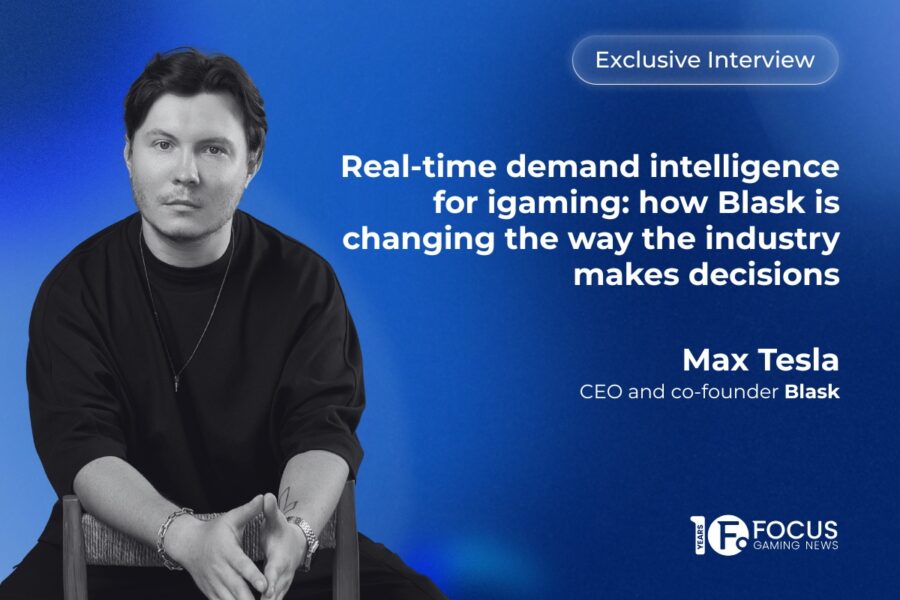

Max Tesla, CEO and Co-Founder of Blask, discusses solving igaming market intelligence gaps and navigating shifts in regulated markets.
Exclusive interview.- Reliable market intelligence has become one of the industry’s most valuable competitive assets as operators expand into new jurisdictions, regulations evolve and competition intensifies across both established and emerging markets.
In this exclusive interview with Focus Gaming News, Max Tesla, CEO and co-founder of Blask, explains why traditional approaches to market intelligence are no longer sufficient and how real-time demand analytics are changing the way operators, affiliates and suppliers evaluate opportunities.
What specific gap in igaming market intelligence were you aiming to solve when you launched Blask?
igaming never lacked data. The gap was that almost none of it was external, independent, or fast enough to act on before a decision needed to be made. Operators had CRM. Affiliates had traffic tools built for generic SEO, useless for a regulated vertical with offshore brands, mirror domains, and licensing status baked into every call. Regulators had self-reported filings that showed up months after the market had already moved.
Dmitry Belianin and I started building in 2022. We spent over a year in development before anyone outside the company touched the product, launching publicly in May 2024. We could have shipped a dashboard sooner. A market intelligence product that’s directionally right but six weeks stale doesn’t help anyone make a decision today.
Search behaviour works as a leading signal for demand. Strip the complaint traffic, consolidate the mirror domains, filter for actual brand intent, and you get a demand curve for any brand in any market, refreshed hourly, visible months before it shows up in anyone’s P&L. That’s what we built.
You have described analytics as “a basic condition for survival” in igaming. What do you see as the biggest risk for operators or providers that still treat data as an afterthought?
Operators lose the year between when demand shifts and when the revenue report confirms it. That’s the risk.
UK 2025: Bet365 and William Hill had almost identical Competitive Earning Baselines, both around $1.3bn. The top line makes them look like peers. Bet365’s demand grew 15.18 per cent year over year. William Hill’s fell 12.63 per cent. A 28-point gap in market attention sits between two brands the financials call equal.
William Hill’s leadership will see that divergence eventually, when it lands as a revenue miss a year after the signal was already visible to anyone tracking demand instead of waiting for the filing. Treating data as an afterthought costs you the twelve months you needed to fix a problem you couldn’t see yet.
Are there any findings from your data that have surprised you or challenged common assumptions in igaming, particularly around regulated versus offshore markets or emerging regions?
Brazil surprised me most. Before regulation, offshore and international brands held roughly 93 per cent of market demand. Within weeks of licensing taking effect in January 2025, licensed local operators had flipped that to 94–95 per cent. If you’d modelled Brazil as a slow transition, you’d have been wrong in a way that cost real budget.
Nigeria is the counterintuitive one. One operator holds close to 75 per cent share. Switching between operators sits close to zero. The market looks huge and stays structurally closed to any new entrant. Go build somewhere else.
Bangladesh works as the mirror image. Nobody was watching that market. Marlerino group spotted the Blask Index rising, routed traffic to the operators with the strongest acquisition scores, and turned it into $8,560 in revenue and 190 FTDs in month one, without a new budget.
One pattern keeps repeating across every regulated-versus-offshore question. People assume the split tracks enforcement. It tracks speed. Regulation triggers a demand cliff in both directions, faster than any compliance team can brief a board.
How do you measure success for a Blask customer beyond simple usage metrics? What does “good” look like in terms of business impact?
Usage tells you whether someone logs in. 80 per cent of our active base opens Blask weekly. That number sets a floor. It doesn’t tell me anything by itself.
“Good” is a client’s own numbers moving because of a call they made with our data instead of a hunch. A performance network redirected traffic towards the operators with the highest APS growth in a new market and saw a 25 per cent monthly revenue uplift. An affiliate saved $10,000–$30,000 per influencer test cycle by using the Index to separate a real converter from a streamer who generated noise. Each result ties to one traceable decision.
A client can log in every day and still change nothing downstream. Budget stays where it was. No deal gets priced differently. High session counts don’t fix that. The metric that matters: whether a decision happened earlier, cheaper, or more accurately than it would have without us.
You have just introduced a modular subscription model that allows customers to build plans country by country and module by module. What problem were you solving with this move away from fixed pricing plans?
Fixed plans assume every customer’s footprint looks the same. It doesn’t. An operator licensed in three states doesn’t need 124 countries. A game provider might need Games analytics in exactly the two markets where their titles are live and nothing else. We were charging people for a shape of the business they didn’t have.
One flat price hides a scale problem too. The US market carries a different order of value than the other 123 countries combined. Folding it into the same tier as a market a fraction of its size never made sense. A single flat number for market access stops making sense anywhere in the model once you look at it that way.
We rebuilt pricing around the unit customers actually think in: country and module. Market Analytics, Game Analytics, sub-national add-ons like US or Australian state-level breakdowns. Each priced on what it’s worth instead of bundled into an assumption. You pay for the footprint you run today, not the one we guessed you’d grow into.
Blask has recently won Rising Star and Innovator of the Year at the 2026 iGB Affiliate Awards. Beyond these awards, what feedback from the wider industry has been most valuable to you?
Awards tell you a panel liked what you did last year. The feedback that changes the roadmap comes from client workshops. We ran more than 80 of them in 2025. Every feature we shipped traces back to a specific question a client asked that we couldn’t answer yet.
“Why did the Index move?” became Market Explanation. “Which games should I actually write about right now?” became Blask Games. Affiliates working US markets told us country-level data was useless because US igaming runs as fifty separate regulatory environments. That became a state-level breakdown.
TAG Media’s MD runs APS live on partner calls to price CPA deals in real time. His line stuck with me: “We can find out almost anything we want to know within a few clicks.” That’s someone telling you the product changed how they negotiate. A trophy says you did something right last year. A client rebuilding their workflow around your data says you’re still right this quarter.
Looking five years ahead, where do you see the biggest shifts or disruptions in the igaming industry?
Markets stop being countries and start being regulatory units. The US already proved this. It runs as fifty separate regulatory markets, and treating it as one was always the wrong resolution. I expect Canada to fragment the same way by province, Australia by state, and eventually enough other geographies that country-level data starts to feel as blunt as global data feels today.
Prediction markets show this most clearly. The same demand signal runs into four different regulatory postures depending on the border. The US is still working it out at the federal level. Canada holds a structural ban wrapped in provincial ambiguity. The UK is growing under a framework that predates the product. Australia hasn’t drawn a line yet. In five years that doesn’t stay this fragmented. It consolidates, and probably ends up overlapping with gambling regulation in ways nobody’s drawn cleanly yet.
The bigger structural shift underneath all of it is the collapse of information asymmetry. Operators, affiliates, and regulators have each worked off a partial, mostly self-reported view of the same market. Once independently verifiable demand signals become the default, that partial view disappears. Affiliates verify operator claims. Operators verify affiliate traffic. Regulators benchmark licensees against market norms instead of what licensees choose to disclose. That will squeeze out the affiliates and operators who were competing on information advantage rather than execution.
AI is a tool here, not the disruption. It makes markets fragmenting this fast legible enough to act on. We use it because it’s the fastest way to do that, not because “AI” is the story. The real disruption is granularity. More jurisdictions generate more signal, and that leaves less room for anyone to claim they don’t have the data for a given market.
By Focus Gaming News Editorial Team