



Eight years after PASPA, US sports betting must stay competitive

Executives from the AGA and the Sports Betting Alliance explain how state-led models, tax choices and the fight against illegal operators will shape what comes next.
Key takeaways:
- The US Supreme Court struck down PASPA on May 14, 2018 in Murphy v. NCAA, ruling that the federal ban on state authorisation of sports betting violated the anticommandeering rule, which stops Congress from giving direct orders to state governments.
- According to the AGA’s Dave Forman, 39 states and Washington, D.C. have legalised sports betting, 33 of them offering online betting, while 11 states have not authorised it in any form as of October 2026. Nebraska, which allows only retail betting, votes on November 3 on extending it online.
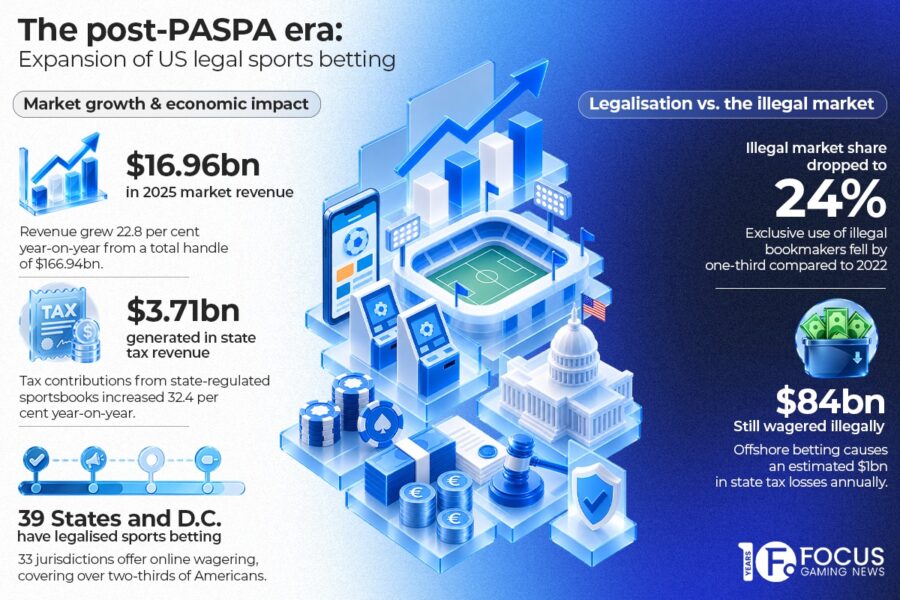
- US sports betting revenue reached $16.96bn in 2025, up 22.8 per cent year-on-year, on a handle of $166.94bn, and state-regulated sportsbooks generated $3.71bn in taxes, up 32.4 per cent, according to the AGA.
- An AGA analysis estimated that Americans wagered $84bn with illegal bookmakers and offshore sportsbooks. The illegal share of the total market fell from 36 per cent to 24 per cent compared with 2022, and SBA president Joe Maloney says reasonable taxes and efficient licensing are needed to keep the legal market competitive.
Special report.- On May 14, 2018, the US Supreme Court decided the Professional and Amateur Sports Protection Act (PASPA), which directed states not to authorise sports betting, violated the anti-commandeering doctrine of the Tenth Amendment. Eight years later, the industry faces a different challenge: making the markets built after that decision competitive, sustainable and responsible.
This is the seventh in a series of special articles analysing how the gambling industry has evolved over the past decade, the challenges it has faced and what the future holds. In this special report, Focus Gaming News examines how the fall of PASPA reshaped US sports betting, the different markets states have built and the future of the sector.
What did the Supreme Court decide in Murphy v. NCAA?
The legal dispute centred on the PASPA, passed in 1992. New Jersey challenged the Act after attempting to change its own sports betting laws. The National Collegiate Athletic Association (NCAA) and major professional sports leagues opposed the state’s efforts, and the litigation eventually reached the Supreme Court.
The Court stated that PASPA’s provision prohibiting the state licensing of sports gambling violated the anticommandeering rule, which stops Congress from issuing direct orders to state governments. Justice Samuel Alito wrote that the provision “unequivocally dictates what a state legislature may and may not do”. The Court added: “The legalisation of sports gambling requires an important policy choice, but the choice is not ours to make. Congress can regulate sports gambling directly, but if it elects not to do so, each State is free to act on its own.”
Joe Maloney, president of the Sports Betting Alliance (SBA), told Focus Gaming News: “In a word, I would say the impact has been monumental, effectively clearing a path for states to choose to replace the federal prohibition with legal, regulated markets tailored to their own needs.”
The Murphy v. NCAA decision made regulation possible for an activity that already had an audience. “Sports betting will always find a way to exist in some capacity, and the decision allowed millions of Americans who already bet on sports for entertainment to do so in a regulated environment with consumer protections, responsible gaming tools, age verification requirements, and regulatory oversight,” Maloney said.
What did the US sports betting market look like before 2018?
Before 2018, Nevada operated the only long-standing single-game sports betting market. Meanwhile, Delaware, Montana, and Oregon offered limited parlay or lottery-based products under the PASPA exceptions. In the remaining states, sports betting took place through illegal bookmakers and offshore operators.
“Prior to the decision, sports betting activity took place largely in the shadows, through illegal and offshore operators that paid no tax benefits to states and provided no responsible gaming protections,” Maloney recalls.
How states responded after Murphy
Delaware became the first state outside Nevada to allow regulated betting after Murphy, from June 5, 2018. New Jersey followed on June 14, three days after Governor Phil Murphy signed the state’s sports wagering legislation. Mississippi followed in August 1, 2018, West Virginia on August 30, 2018, and then Pennsylvania and Rhode Island.
In the years that followed, other states authorised sports betting through ordinary legislation, constitutional amendments, or ballot measures. Some required operators to partner with existing casinos or racetracks. Others permitted broader online licensing.
When each US state launched legal sports betting
| State | First legal bet | Market |
|---|---|---|
| Delaware | June 2018 | Online and retail |
| New Jersey | June 2018 | Online and retail |
| Mississippi | August 2018 | Retail only |
| West Virginia | August 2018 | Online and retail |
| New Mexico | October 2018 | Retail only (tribal) |
| Pennsylvania | November 2018 | Online and retail |
| Rhode Island | November 2018 | Online and retail |
| Arkansas | July 2019 | Online and retail |
| New York | July 2019 | Online and retail |
| Iowa | August 2019 | Online and retail |
| Oregon | August 2019 | Online (lottery) and tribal retail |
| Indiana | September 2019 | Online and retail |
| New Hampshire | December 2019 | Online and retail |
| Illinois | March 2020 | Online and retail |
| Michigan | March 2020 | Online and retail |
| Montana | March 2020 | Retail only (lottery) |
| Colorado | May 2020 | Online and retail |
| District of Columbia | May 2020 | Online and retail |
| Tennessee | November 2020 | Online only |
| Virginia | January 2021 | Online and retail |
| North Carolina | March 2021 | Online and retail |
| Arizona | September 2021 | Online and retail |
| South Dakota | September 2021 | Retail only |
| Washington | September 2021 | Retail only (tribal) |
| Wyoming | September 2021 | Online only |
| Connecticut | October 2021 | Online and retail |
| Louisiana | October 2021 | Online and retail |
| Wisconsin | November 2021 | Retail only (tribal) |
| North Dakota | 2021 | Retail only (tribal) |
| Maryland | December 2021 | Online and retail |
| Kansas | September 2022 | Online and retail |
| Massachusetts | January 2023 | Online and retail |
| Ohio | January 2023 | Online and retail |
| Nebraska | June 2023 | Retail only |
| Kentucky | September 2023 | Online and retail |
| Florida | November 2023 | Online and retail (tribal) |
| Maine | November 2023 | Online and retail |
| Vermont | January 2024 | Online only |
| Missouri | December 2025 | Online and retail |
Source: Track360, US sports betting legal states tracker (July 2026). Dates refer to the first legal wager, retail or online. Florida’s date refers to the November 2023 relaunch.
In dialogue with Focus Gaming News, Dave Forman, vice president of research at the American Gaming Association (AGA), said: “What began in Nevada has now grown to 39 states and Washington, D.C., that have chosen to legalise sports betting, with 33 offering online betting. More than two-thirds of Americans now live where sports betting is legal in some form.”
How state models differ
Early markets often tied mobile licenses to existing gaming facilities. Later markets, including Tennessee and Virginia, allowed more open online entry. Florida’s market operates under a tribal compact with Hard Rock. The state-by-state approach allows each state to decide whether to legalise, what forms to offer, and how to regulate and tax based on the needs and values of its communities. Today, 8,400 regulators oversee legal gaming nationwide.
Tennessee took a different route, establishing an online sports betting market without commercial casinos. New Hampshire, meanwhile, operates through its state lottery and a contracted sportsbook partner.
Tax rates on gross gaming revenue vary considerably by jurisdiction. At the steepest end, New York imposes a 51 per cent tax on online sports betting revenue, while Pennsylvania applies a comparatively moderate 36 per cent. Illinois stands out with its progressive taxation framework that incorporates a per-wager fee component. A number of states have implemented rate increases during 2025 and 2026.
Forman sees that flexibility as a strength. “The state-by-state approach works incredibly well for the gaming industry,” he said. “It allows each state to decide whether to legalise sports betting, what forms to offer, and how to regulate and tax it based on the needs and values of its communities.”
Maloney is also in favour of local decision-making, while acknowledging the complexity it creates. “States have different political environments, regulatory priorities, and needs, and the model has allowed local policymakers to make informed decisions about what is best for their states and to build systems that reflect those realities.
“And while state-specific decisions can create complexity in how sports betting activity is taxed and treated from a regulatory perspective, what remains paramount are the embedded consumer protections. The key lesson is that while states may take different paths to legalisation, the strongest frameworks share common principles that prioritise consumer protection, competitive markets, and enforcement against illegal operators.”
How large is the market now in the US?
In 2025, sports betting revenue was $16.96bn, up 22.8 per cent in year-on-year terms, from a total handle of $166.94bn, up 11 per cent, according to the AGA’s full-year reporting. State-regulated sportsbooks generated $3.71bn in taxes, up 32.4 per cent year-over-year.
US sports betting revenue, 2018 to 2025
| Year | Revenue | Change on previous year |
|---|---|---|
| 2018 | $430.7m | – |
| 2019 | $908.9m | up 111 per cent |
| 2020 | $1.55bn | up 70 per cent |
| 2021 | $4.29bn | up 177.1 per cent |
| 2022 | $7.5bn | up 75 per cent |
| 2023 | $10.92bn | up 44.5 per cent |
| 2024 | $13.71bn | up 25.4 per cent |
| 2025 | $16.96bn | up 22.8 per cent |
Source: American Gaming Association, annual commercial gaming revenue reports (2018–2025). Year-on-year changes as reported by the AGA, which revises earlier figures; changes for 2020 and 2022 are approximate.
The fight against the illegal sports betting market
Last August, an analysis from the AGA found that Americans wagered an estimated $84bn with illegal bookies and offshore sportsbooks, generating $5bn in revenue and causing $1bn in tax losses. Compared to 2022, the share of sports bettors exclusively using illegal sites fell by a third and illegal sportsbooks’ share of the total US sports betting market fell from 36 per cent to 24 per cent. One in ten sports bettors still wager exclusively with illegal sources.
Asked what principles states should follow on taxation and regulation to channel players into the legal market, Maloney said: “The most important principle is striking the right balance between generating revenue that states use to fund education, infrastructure, and other priorities, while also ensuring legal operators can effectively compete with the illegal market.
“When taxes, fees, or product restrictions become overly burdensome, they can result in less competitive odds, higher costs, fewer legal offerings, and ultimately a less attractive experience for consumers. Illegal offshore operators face none of the same tax or regulatory obligations, giving them the opportunity to attract customers away from the legal market.
“States should focus on building competitive and sustainable legal markets with reasonable tax rates, efficient licensing structures, strong consumer protections, and robust enforcement against illegal operators. The goal should be to make the legal, regulated market the obvious choice for consumers.”
Forman added that the AGA engages with policymakers and law enforcement in states that have not legalised sports betting “to support efforts to combat illegal operators that bypass state laws and prey on their citizens.”
Competition across US sports betting markets
The expansion of sports betting has resulted in major operators now being active across many states. Maloney argues that maintaining competition is essential for the long-term success of the regulated market.
“Competition drives innovation for better products, improves the customer experience, and encourages greater investment in responsible gaming tools and protections,” he said.
“Like any growing industry, the sports betting market will continue to evolve. But it is crucial to maintain an environment in which consumers have choices and operators compete within a regulatory framework that enables them to compete against illegal operators eschewing the regulated market. When legal sportsbooks are competing for customers, consumers benefit and the regulated market is better positioned to compete with illegal offshore operators.”
Consumer protection and market sustainability
Both Forman and Maloney agree that consumer protection is one of the most important aspects of a regulated sports betting industry.
Forman said: “We’ve seen how collaboration among licensed operators, sports leagues, state regulators and law enforcement can detect suspicious activity and enable swift enforcement, demonstrating how the legal system protects sports integrity and holds bad actors accountable.
“We’ll continue advocating for policies that protect consumers, uphold sports integrity and preserve the strength of the legal market.”
Maloney added: “Responsible gaming has become a defining priority and one of the clearest advantages of the legal, regulated industry. Every day, operators, researchers, and responsible gaming organisations collaborate to strengthen consumer protections.
“Several tools have already proven effective and should be considered foundational components of any regulated market. These include age and identity verification, self-exclusion programs, deposit and wagering limits, and widespread access to support resources for the small number of individuals who need it. The industry is also taking steps beyond regulatory requirements. For example, every SBA member has voluntarily ended the use of credit cards for deposits nationwide.
“Operators are developing increasingly sophisticated tools to identify potentially problematic betting behaviour and provide customers with resources and interventions when appropriate. Consumer protection requires continuous improvement, transparency, and a willingness to adopt new approaches and technologies as they become available and are proven effective.”
For Forman, every element of the regulatory framework plays an important role – from anti-money laundering and responsible gaming to age verification and integrity monitoring. “Over nearly a decade, states and tribes have built a comprehensive system that protects consumers, holds operators accountable, safeguards athletes and game integrity, and ensures tax revenue supports local communities. The illegal market provides none of these protections and instead exposes consumers to unnecessary risks,” he concluded.
The future of the US sports betting market
As of October 2026, only 11 states have not authorised sports betting in any form: Alabama, Alaska, California, Georgia, Hawaii, Idaho, Minnesota, Oklahoma, South Carolina, Texas and Utah.
In Alabama, State Rep. Chris Blackshear sponsored in 2024 an amendment that would have authorised a lottery, casinos and sports betting, along with a state gaming commission. The proposal passed the House but was scaled back in the Senate and failed by one vote. The regulation of gambling would require voter approval of a constitutional amendment. In February, senator Merika Coleman introduced Senate Bill 257, which was referred to the Senate Tourism Committee. It would amend Section 65 of the Alabama Constitution of 2022 to let the legislature authorise a state lottery, casino gaming and sports betting, create a gaming commission and allow the governor to negotiate a tribal gaming compact. However, the bill did not advance, and the session ended on March 27 without any gambling expansion.
In Hawaii, a bill proposing to legalise online sports betting with a minimum of six platforms did not move ahead. In Minnesota, SF 4139 would have let the state’s tribes run mobile betting in partnership with sportsbooks, but it stalled. In Georgia, HB 910 would have authorised online sports betting under the Georgia Lottery, but it did not advance. On March 6, the House voted down a constitutional amendment, HR 450, by 63 votes to 98, short of the 120 needed.
Nebraska only allows retail betting. On November 3, voters will decide whether to expand sports betting to the internet.
Maloney said: “States jumping in now can take the best lessons from markets across the country and build competitive, sustainable regulatory frameworks that protect consumers, generate tax revenue, and bring more existing betting activity out of the illegal market. “
Forman said: “We expect growth to moderate, although the broader US gaming market continues to expand as consumers interact with the industry across different verticals.
“Land-based casinos remain incredibly strong, with more than half of Americans visiting a casino last year, while igaming continues to gain adoption in the states where it is legal. We expect these forms of regulated gaming to continue evolving alongside one another.
“Looking ahead, it is critical to preserve the state- and tribal-regulated framework. States and tribes have the authority to decide whether and how to legalise sports betting in their jurisdictions, and the AGA will continue working to protect the integrity of that system so legal gaming can grow – and consumers can engage – responsibly.”
As for whether we could ever see a situation in which every US state has regulated online sports betting, Maloney notes the difficulty in predicting state legislative measures, but the broad trend is clear. “Consumers increasingly prefer and expect access to legal betting options, and more states are choosing to bring an activity that already exists into a legal, regulated marketplace,” he said. “As states watch neighbouring jurisdictions successfully implement legal markets, policymakers increasingly recognise the benefits of stronger consumer protections, responsible gaming tools, transparency, and tax revenue.”
This article is the seventh instalment of a series produced by Focus Gaming News to mark its tenth anniversary. Over the course of 2026, the articles will examine the most defining moments that shaped the global igaming industry between 2016 and 2026, from regulatory changes and market openings to technological shifts and the rise of new regions. Each piece will be accompanied by exclusive interviews with the executives, regulators and analysts who were part of these changes.
Frequently asked questions (FAQs)
- What did the US sports betting market look like before 2018? Nevada was the only state with a long-standing single-game sports betting market. Delaware, Montana and Oregon offered limited parlay or lottery-based products under PASPA exceptions. In the remaining states, betting took place through illegal bookmakers and offshore operators.
- Which states launched sports betting first after Murphy v. NCAA? Delaware was the first state outside Nevada to accept bets, on June 5, 2018. New Jersey followed on June 14, three days after Governor Phil Murphy signed its legislation. Mississippi launched on August 1 and West Virginia on August 30.
- Which US states have not legalised sports betting? As of October 2026, 11 states have not authorised it in any form: Alabama, Alaska, California, Georgia, Hawaii, Idaho, Minnesota, Oklahoma, South Carolina, Texas and Utah. Bills in Alabama, Hawaii, Minnesota and Georgia did not advance.
- Which responsible gambling tools does the SBA consider foundational? The SBA’s Joe Maloney points to age and identity verification, self-exclusion programmes, deposit and wagering limits, and widespread access to support resources. He also says every SBA member has voluntarily ended credit card deposits nationwide.