



European online gambling tax rates by country
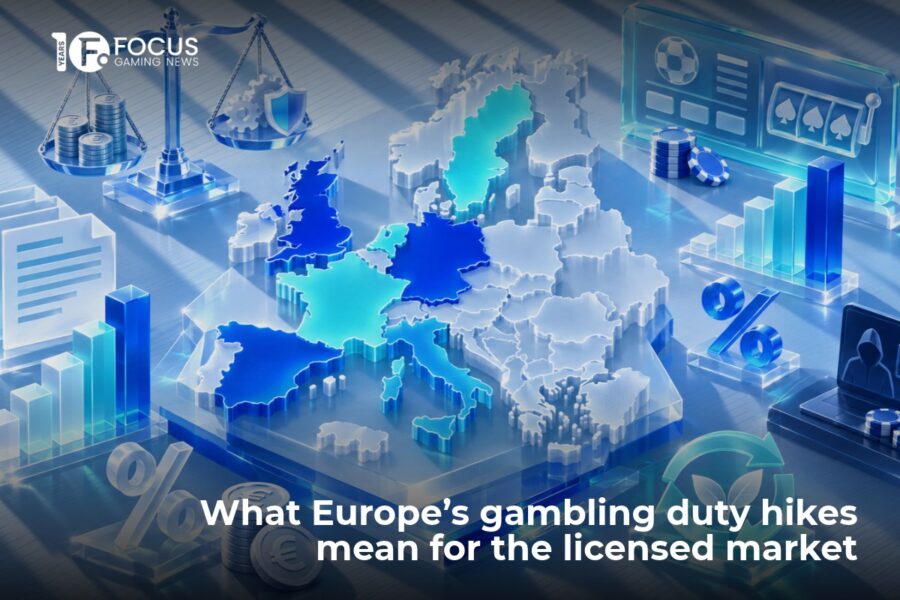
From the UK’s planned 40 per cent duty to Germany’s stake-based tax, rates vary widely, and industry groups say competitiveness is key to keeping players in licensed markets.
Key takeaways:
- European jurisdictions are moving towards higher online gambling taxes and stricter oversight, driven by fiscal pressures across EU member states and the UK.
- The UK plans to raise Remote Gaming Duty from 21 per cent to 40 per cent and the tax on remote sports betting from 15 per cent to 25 per cent.
- Germany taxes stakes at 5.3 per cent, and the text says channelisation for legal online slots has fallen to an estimated 20 to 40 per cent in key segments.
- The Dutch GGR tax has risen from 28 per cent to 34.2 per cent, with further hikes scheduled up to 37.8 per cent, and government gambling tax revenues declined in subsequent quarters.
- Industry estimates say unlicensed online gambling targeting European consumers exceeds EUR90bn in annual turnover, with more than EUR20bn in uncollected tax.
European online gambling markets are shifting towards higher taxes and stricter oversight, as fiscal pressures across the EU and the UK drive substantial rate increases. Industry groups such as the EGBA warn that excessive taxation erodes channelisation to licensed operators and pushes players towards unlicensed sites, while governments point to higher revenue and harm reduction. Country examples include planned UK increases, Germany’s stake-based tax, rising Dutch and Swedish rates, and stable Spanish revenues under a 20 per cent GGR tax.
Special report.- The European online gambling market is going through a major structural shift towards higher taxes and stricter regulatory oversight. Fiscal pressures across EU member states and the United Kingdom have led governments to opt for substantial tax increases.
Industry experts and trade associations, such as the European Gaming and Betting Association (EGBA), warn of a critical trade-off: excessive taxation directly erodes player channelling and fuels the black market. When licensed operators absorb high tax rates or pass them on via lower Return to Player (RTP) ratios and reduced promotional bonuses, players may migrate to unlicensed offshore platforms that offer higher odds, no deposit limits, and tax-free payouts.
Across the entire EU and UK region, industry estimates highlight that unlicensed online gambling targeting European consumers exceeds €90bn in annual turnover, depriving governments of more than €20bn in uncollected tax revenues.
Country by country
United Kingdom
The United Kingdom taxes online casino gross gaming revenue (GGR) through Remote Gaming Duty, which rose from 21 per cent to 40 per cent in April 2026. The tax rate applied to remote sports betting under General Betting Duty will increase from 15 to 25 per cent from April 2027
According to HM Treasury and HM Revenue & Customs (HMRC), the fiscal objective of this year’s hike was to generate over £1bn annually in additional tax revenues to support public finances. Government reports argue that remote gaming carries lower operational overhead costs and presents higher potential harm compared to retail operations or horse racing betting, justifying a differentiated duty structure.
The policy stance posits that raising duties on online casino products disincentivises aggressive commercial expansion of high-velocity games while capturing a higher fair share of revenue for the public purse. To offset the impact, licensed operators have been considering cutting marketing budgets lowering return to player (RTP) rates on online slots from 96 per cent down towards 88-91 per cent and also making significant costs cuts, including layoffs.
Germany
Germany’s federal tax framework was established by the amended Race Betting and Lotteries Act (Rennwett- und Lotteriegesetz) and is supervised nationally by the gambling regulator GGL. It imposes a federal Turnover Tax of 5.3 per cent on every wager placed on virtual slot machines, online poker, and sports betting. Because this turnover model taxes the total stake rather than operator profit, this can translate into an effective tax burden that exceeds 50 to 60 per cent of an operator’s GRR.
Reports have suggested that channelisation for legal online slots in Germany may be as low as between 20 and 40 per cent. Operators argue that the tax rate has forced them to reduce slot RTPs drastically to avoid operating at a net loss, while unlicensed black-market sites can offer 96 per cent RTPs while avoiding Germany’s mandatory deposit caps, spin limits, and compulsory 5-second delays between spins.
France
In France, online gambling is regulated by the ANJ. The tax model levies duties on sports betting and poker based on turnover, combined with state, social security, and sports agency surcharges. When adding social security levies (CSG) and contributions to the National Sports Agency (ANS), online sports betting faces a cumulative effective tax rate of approximately 59.3 per cent. Online casino gaming remains unregulated.
In recent budget debates, the French Ministry of Economy and Finance considered legislative amendments to legalise and tax online casinos. Government estimates projected that the move could generate over €1bn annually in direct tax revenues for the state treasury while bringing millions of existing French players under safety regulations, but the proposal faced significant opposition from land-based casinos.
Netherlands
The Netherlands regulates online gambling under the Remote Gambling Act (Koa), with oversight provided by Kansspelautoriteit (KSA) and tax collection managed by the Tax and Customs Administration (Belastingdienst). The tax rate on GGR was hiked from 30.5 per cent to 34.2 per cent from January 1 2025 and to 37.8 per cent from January 1 2026.
Data from the Dutch Ministry of Finance revealed an unexpected economic outcome following the initial tax increase. Despite the rate rise, tax revenues from the gambling sector actually declined in subsequent quarters. Meanwhile, analyses suggests that the higher tax rate led to lower marketing spend and the exit of smaller licensed operators from the market.
Sweden
Swedish regulated online gambling is governed by the Swedish Gambling Act (Spellag) and overseen by the Spelinspektionen. Tax is administered by the Skatteverket. The market launched in 2019 with a GGR tax rate of 18 per cent. The Swedish Ministry of Finance passed a statutory amendment that increased the tax rate to 22 per cent in 2024.
The Ministry of Finance projected that the four-percentage-point increases would generate SEK540m (US$50m) in additional annual tax revenues for the national budget without significantly disrupting market health. Official post-implementation data showed an initial rise in overall tax collection, but the Swedish Trade Association for Online Gambling (BOS) has raised concerns amid reports that channelisation for online casino games stands at 72-75 per cent, well below the government’s target of 90 per cent.
Spain
Spain regulates its digital gambling market under Law 13/2011 on Gambling Regulation, with administrative oversight from the Directorate General for the Regulation of Gambling (DGOJ) attached to the Ministry of Consumer Affairs. The GGR tax model entails a baseline national rate of 20 per cent on all online gambling products. Operators that establish their physical, fiscal, and operational headquarters within the Spanish autonomous cities of Ceuta or Melilla benefit from a 50 per cent tax reduction, lowering their effective GGR tax rate to 10 per cent.
Quarterly reports published by the DGOJ suggest that this has created one of the most stable legal online gambling environments in Southern Europe. DGOJ figures indicate that annual GGR consistently exceeds €1.2bn and generates over €200m in direct tax revenues for national and regional treasuries.
Italy
Italy’s online gambling market is overseen by the Customs and Monopolies Agency (Agenzia delle Dogane e dei Monopoli – ADM). GGR is taxed at a rate of 25.5 per cent on online casino games and 24.5 per cent on online sports betting. In Italy’s latest Budget Law, the Ministry of Economy and Finance (MEF) predicts that the gambling industry will contribute €700m in tax revenues across 2026 and 2027. Revenue generated from gambling, finance and fuel taxes is expected to help fund government spending measures and tax reductions worth €26bn in 2027 and €27bn in 2028.
International overview
Across Europe, the regulated market generates between €43bn and €47bn in annual GGR and over €11bn in direct taxes, but future stability relies heavily on maintaining competitive tax policies that preserve player channelisation.
Industry leadership continuously highlights the direct relationship between tax policy and illegal market growth. Maarten Haijer, Secretary General of the EGBA, has noted that high taxation without taking into account the competitive landscape only serves to drive players to illegal offshore operators, warning that when a regulated market is taxed out of competitiveness, player protection disappears alongside government tax revenues.
Frequently asked questions (FAQs)
- What are the online gambling tax rates in Europe? Rates vary by country. The UK plans 40 per cent on remote gaming and 25 per cent on remote betting. Spain applies 20 per cent, Italy 25.5 per cent on casino and 24.5 per cent on sports betting, Sweden 22 per cent and the Netherlands 34.2 per cent, with scheduled increases up to 37.8 per cent.
- How do higher taxes affect the black market, according to industry groups? Industry groups such as the EGBA warn that excessive taxation erodes channelisation and fuels the black market. They say operators may lower RTPs or reduce bonuses, pushing players towards unlicensed offshore sites. EGBA Secretary General Maarten Haijer said player protection disappears alongside tax revenues.