


Tony O’Mahony, Relax Gaming: “We want games to feel like they take players somewhere, rather than just cycling through spins”
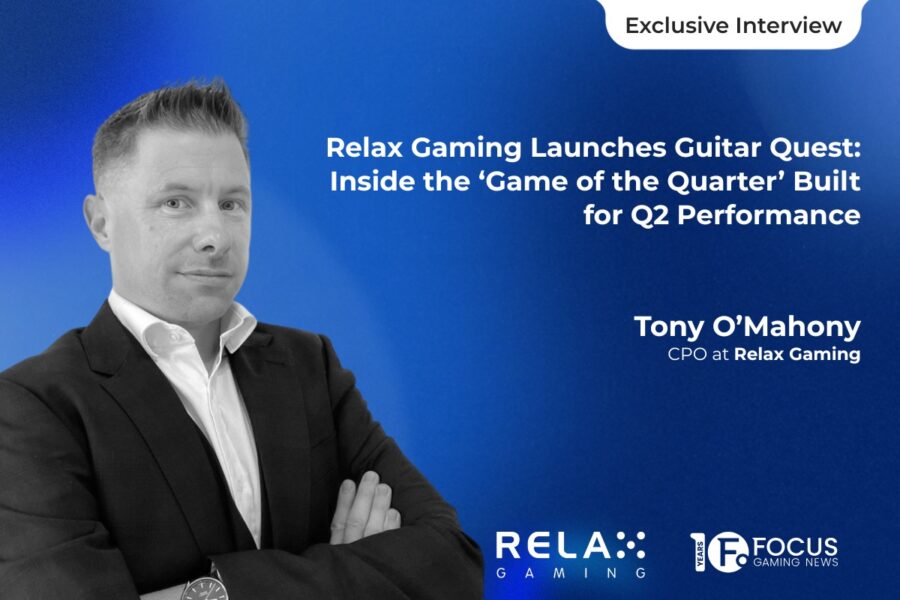
Tony O’Mahony, Chief Product Officer at Relax Gaming, spoke to Focus Gaming News about the development of Guitar Quest.
Exclusive interview.- In an increasingly crowded slots market, standing out requires more than polished visuals or familiar mechanics. For studios looking to create true “event-level” releases, the challenge lies in building experiences that resonate emotionally with players while delivering the depth and progression needed to sustain long-term engagement. That balance between creativity and commercial performance sits at the heart of Relax Gaming’s latest headline release, Guitar Quest.
In this exclusive interview with Focus Gaming News, Tony O’Mahony, chief product officer at Relax Gaming, discusses how Guitar Quest evolved from an ambitious creative concept into the company’s designated Game of the Quarter. He explains how the studio approached the challenge of integrating music directly into gameplay progression, why the title’s Solo Mode mechanic became central to the experience, and how player data and creative instinct combined throughout development.
Guitar Quest has been positioned as your Game of the Quarter. At what point did the team realise this would be more than just another release?
We knew fairly early on. The first playable version of Solo Mode had a real energy to it, an immediate wow factor you could feel straight away.
Internally, people kept coming back to it, which says a lot. When teams that see new games every day are still excited by a prototype, it is a very good sign.
The real turning point came when the base game caught up with the concept. Once the core was solid and everything worked together, it stopped feeling like just a clever idea and started feeling like a strong commercial title, transforming the experience from a one-trick pony into something with genuine hit potential.
Every successful title starts with a tension. What problem or opportunity were you trying to solve with Guitar Quest?
Music themes are instantly recognisable and emotionally powerful. But in slots, they can sometimes sit on the surface as strong visuals and sound, without much connection to how the game plays.
We wanted to change that. The opportunity was to make music part of the mechanic, not just the artwork. The key question became this: how do we make music part of the progression rather than just building toward a crescendo?
That is where Guitar Quest came from. We wanted a game that escalates on every level – not just in what you see, but in what you hear, with the soundtrack building as the intensity rises, almost as if the player is climbing toward something. That became a defining part of the overall experience.
How much of the concept was driven by creative instinct versus hard player data?
It is always a blend, but in this case, the initial spark was instinctive. When our game product owner, Oscar Persson, presented the idea of tying musical progression directly to feature escalation, it felt different straight away. There was a sense he was onto something special.
Once we had that core idea, the focus shifted to execution. It was important that the game felt right, and that is where player data came in – shaping the pacing, balancing the mechanics and refining the overall flow.
Data is crucial because it mitigates risk and helps indicate commercial potential. Instinct, on the other hand, is what creates differentiation. You need both working together.
“Data is crucial because it mitigates risk and helps indicate commercial potential.”
Tony O’Mahony, chief product officer at Relax Gaming.
What was the most debated design decision during development?
Timing, without question. We wanted that high-energy, exhilarating rock video game-style, but it still had to function as an engaging slot. There were a lot of discussions about how far to push the intensity.
It is vital to find the right balance. Too much and it becomes chaotic. Too little and you lose the spark. Getting that mix right took time, but it was worth it.
From a mechanics perspective, what element are you personally most proud of?
The Solo Mode feature is the crown jewel here and really is the key mechanic. Rather than feeling like a traditional bonus that simply interrupts the base game, it builds. Each stage raises the energy and the potential, creating a genuine sense of momentum.
It is not just another feature layered on top. It is a distinctive and truly unique part of the overall experience and central to what makes the game feel different.
In today’s market, is the theme still king, or are players more mechanics-driven?
Theme still plays a big role. It is what catches the attention and gives a game its identity. But it is a bit more nuanced than that. Simply put, themes get people to try a game, and mechanics are what bring them back.
Players today understand mechanics far more than they did a few years ago. They are more informed and more selective. They talk about volatility, feature buys and progression systems openly, and they know what suits their style of play.
So yes, theme absolutely matters – it creates that emotional entry point. But the reality is you need both. The strongest formula today is a compelling, IP-style theme combined with a genuinely differentiated mechanical core.
How should operators think about positioning this title in Q2? Is it built for acquisition, retention, or high-value segments?
We see it as a strong all-rounder, so we would expect adoption to be very high. The game has instant recognition and broad appeal, so it is the kind of title that can lead to a promotion and draw players in.
That said, it is not just about the initial click. Oscar and the team put a huge amount of focus into the mechanics and overall gameplay to make sure it has real depth. The progression and Solo Mode give players a reason to keep coming back.
For Q2, I would position it as a headline feature with proper campaign support behind it. This is not just another game launch to quietly drop into the lobby. If you make Guitar Quest the focal point of your activity, it has the presence and gameplay strength to really energise your base.
“[Guitar Quest] is not just another game launch to quietly drop into the lobby.”
Tony O’Mahony, chief product officer at Relax Gaming.
Does Guitar Quest signal a broader direction for Relax Gaming’s 2026 roadmap?
Yes, it does in a couple of clear ways.
First, we are putting more focus on experiential mechanics. We want games to feel like they take players somewhere, rather than just cycling through spins. That sense of progression and momentum is important to us.
Second, we are being more intentional and deliberate about “event-level” launches. Fewer releases that we really believe in, but with bigger statements and the confidence to support them properly.
Guitar Quest reflects that mindset. It is a strong creative concept, but it is also built with commercial performance in mind, and that balance is very much where we are heading.
By Focus Gaming News Editorial Team