


Special report: A timeline of how Brazil built its igaming regulatory framework


Focus Gaming News examines how LatAm’s largest country regulated the igaming industry.
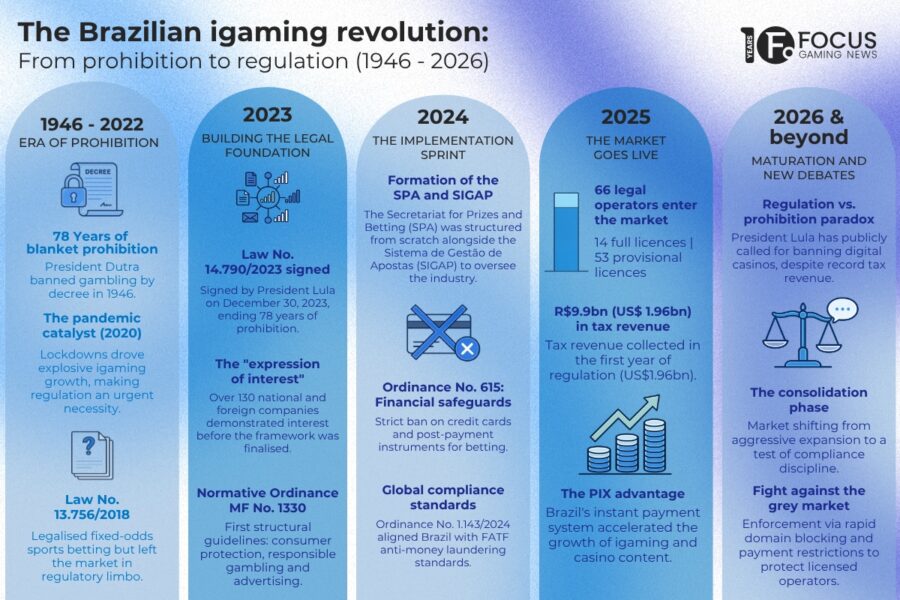
Special report.- On December 30, 2023, President Luiz Inácio Lula da Silva signed Law No. 14.790/2023, putting an end to 78 years of blanket gambling prohibition in Brazil. It was not an impulsive act; behind that signature lay years of parliamentary debate, a pandemic that accelerated the growth of the illegal market and an unequivocal reality: millions of Brazilians were betting every day on unlicensed platforms, with no protection and no money going to the government.
This is the second in a series of special articles analysing how the gambling industry has evolved over the past decade, the challenges it has faced and what the future holds. In this special report, Focus Gaming News examines how Brazil has become one of the most important markets in the igaming industry.
78 years of prohibition: the context
In 1946, then-president Eurico Gaspar Dutra banned gambling in the country by decree, a ban that remained in force for almost eight decades. However, the measure never worked entirely. Over time, Brazilians found ways to bet: first through the “jogo do bicho” (an illegal lottery format based on numbers representing animals), then in neighbouring countries such as Uruguay and Paraguay, and eventually, with the arrival of the internet, on offshore platforms operating abroad without any local restrictions.
The sports betting market was the fastest-growing segment of the last decade in the country. The combination of a unique football culture, ever-expanding mobile penetration and the expansion of betting apps turned Brazil into one of the largest markets in the world.
Estimates of the size of the illegal market before regulation varied considerably depending on the source, but all agreed that it was huge, and this gave rise to two major problems: not a single cent of that money was taxed in Brazil, and players lacked any formal protection.
The road to legalisation
The process that led to the legalisation and regulation of the igaming market was lengthy and complex. Before the approval of Law No. 14.790/2023, Brazil had already taken its first formal step in 2018 with the passing of Law No. 13.756/2018, which established fixed-odds sports betting as a lottery modality. This law authorised bets on real sporting events where the potential winnings are known at the time the bet is placed. However, this law only established the category, leaving the task of issuing detailed regulations to the Ministry of Finance. These regulations were never issued within the original four-year deadline. In practice, this left the market in a legal limbo, authorised in principle but operating without a specific regulatory framework or supervisory mechanisms.
In parallel, more comprehensive bills to regulate gambling circulated in Congress for years, driven by sectors that saw regulation as a way to generate tax revenue and tackle the illegal market. However, there was strong pressure from various sectors to prevent the bills from moving forward until the Covid-19 pandemic arrived in 2020 and changed everything: with people locked inside their homes, igaming platforms experienced explosive growth in Brazil, making the need for a regulatory framework even more evident.
The year 2023 was decisive in enabling the implementation of the regulated fixed-odds betting market in Brazil. Although Law No. 14.790/2023 was not signed until December of that year, the work of structuring the regulatory framework had begun months earlier and intensified following the publication of Provisional Measure 1.182 on July 25, 2023.
In this context, the Ministry of Finance began building the institutional and regulatory foundations needed for the future opening of the regulated market. In October 2023, the first structural regulatory act — Normative Ordinance MF No. 1.330 — was published, establishing the general guidelines, including consumer protection, data protection, responsible gambling and advertising. A prior expression of interest was also held, with the participation of more than 130 national and foreign companies, demonstrating the high level of economic interest in the Brazilian market.
Authorities also started to develop the Sistema de Gestão de Apostas (SIGAP), the structuring of the future Secretariat for Prizes and Betting (SPA) and the drafting of the rules that would form the 2024 Regulatory Agenda.
At that point, however, there was no reliable and validated estimate of the market’s true size. Looking back at that period, Simone Vicentini, a specialist in constitutional and administrative law and former deputy secretary of the SPA, said: “Since the enactment of Law No. 13.756/2018, which legalised fixed-odds sports betting, the activity had been developing without specific regulation, which encouraged rapid and disorganised growth, without adequate mechanisms for state supervision, tax collection or player protection. The creation of the regulatory framework through Law No. 14.790/2023 was aimed precisely at bringing transparency, legal certainty, integrity and effective control mechanisms to a sector that was already moving significant sums in the country.”
Udo Seckelmann, partner in the Gambling & Crypto practice at Bichara e Motta Advogados, shared his view of the most critical decisions the SPA had to make during that initial period: “From a legal perspective, the most critical decisions were directly linked to building a solid compliance framework. The SPA chose to establish, from the outset, detailed requirements on matters such as anti-money laundering, user identification (KYC), responsible gambling and sporting integrity. This raised the standard of the Brazilian market and required operators to structure highly sophisticated operations aligned with international best practices.”
Reflecting on that initial work, Vicentini recalled: “We started from a broad comparative study of the world’s leading regulated markets, identifying good practices, supervisory models, consumer protection mechanisms and anti-money laundering frameworks. Based on these references, a regulatory model compatible with the Brazilian reality and the limits set by Law No. 14.790/2023 was developed.
“At the same time, it was necessary to structure a new administrative unit practically from scratch, which entailed institutional, budgetary, technological and personnel management challenges. In just over a year, it was necessary to regulate a complex sector, build systems, define authorisation requirements, establish inspection and sanction mechanisms, and prepare for the launch of the regulated market.
“Given the magnitude of the task and the limited number of staff available, the challenges were considerable. Even so, it was possible to deliver, within the planned schedule, a broad and sufficiently robust regulatory framework to allow the regulated market to begin operations on January 1, 2025.”
January 2025: Brazil’s igaming market formally launches
The regulatory framework for online gambling in Brazil came into effect on January 1, 2025, with 14 full licences, awarded to operators that had completed all requirements on time, and 52 provisional licences for those still in the process of fulfilling certain aspects of the regulatory framework. In total, 66 operators entered the Brazilian market legally on that day.
The profile of the first licensees was a mix of international companies with experience in multiple regulated jurisdictions, regional operators with an established presence in LatAm and some local companies.
Focus Gaming News spoke with Celina Guedes, regional director for Brazil at EGT, Andre Medeiros, country manager for Brazil at Brazino777, Carla Dualib, regional business development manager (Latin America) at SOFTSWISS, and a spokesperson for 1xBet about which aspects of the Brazilian market attracted their attention most when developing a strategy for the country, the difficulties they encountered when developing local products and solutions, and their views on the current state of the sector and how they believe it will evolve in the coming years.
Guedes said what attracted EGT’s attention most in Brazil was “the enormous long-term potential of the market and the diversity of opportunities across both igaming and land-based gaming segments.”
She added: “Brazil combines large-scale market potential with a rapidly evolving regulated environment, creating strong opportunities for sustainable growth and long-term investment. At the same time, the country’s size, regional diversity, and dynamic business landscape make it a market that requires localised strategies, technological flexibility, and a deep understanding of operator needs.”
Guedes also highlighted the rapid adoption of digital platforms and payment methods such as PIX, which “created an ideal environment for the fast growth of online gaming, sports betting, and casino content,” and the future potential of land-based gaming and video lottery terminal (VLT) operations. “Brazil has all the characteristics to become one of the leading gaming markets globally in the coming years — not only online, but also through gaming halls, route operations, casinos, and entertainment venues if regulation continues to evolve positively,” she said.
Medeiros underlined the country’s internal heterogeneity as the starting point for any strategy: “Brazil has national habits, but different regional behaviours, income realities, cultural references, and levels of digital maturity. For Brazino777, the strategy had to start with this understanding. That’s why we test campaigns differently across regions of Brazil, because what feels natural in one place may not have the same impact in another.”
Dualib said the Brazilian market stood out because it was “evolving rapidly, even by global igaming standards”. According to her, regulation was developing almost in real time, and information was often fragmented, changed quickly or was simply unavailable from a single centralised source.
She explained that this created a clear opportunity for SOFTSWISS. Rather than waiting for the market to stabilise, the company decided to move early, closely monitor regulatory developments, maintain direct communication with local stakeholders and prepare its products for certification ahead of many competitors. “Being proactive gave us an important strategic advantage,” Dualib said.
Dualib also pointed to Brazil’s passion for sports as a decisive factor when building a strategy for the market. In her view, sport forms part of the country’s national identity and emotional culture, and understanding that connection was essential for shaping both product and communication strategy. She also stressed the importance of local networking, saying Brazil is a market where relationships matter deeply and where continuous dialogue with operators, regulators and trade associations is just as important as technology itself.
In line with Medeiros, the 1xBet spokesperson emphasised Brazil’s internal cultural differences and the diversity of such a large country, and also highlighted Brazilians’ passion for betting: “Brazilians, in general, consider gambling part of their culture.”
On the challenge of developing products and solutions for the market, Guedes said it was “both exciting and challenging because the market has very unique characteristics compared to other regulated jurisdictions” and explained that one of the biggest initial challenges was understanding the local consumer journey in depth — from payment preferences and betting behaviour to communication tone and user expectations.
On the operational side, according to Guedes, the evolving regulatory framework required flexibility and constant adaptation. “The market was moving quickly, and companies needed to be prepared to adjust compliance, marketing, and operational strategies almost in real time,” she said, adding: “We overcame these challenges by building strong local partnerships, investing in Brazilian talent, listening closely to user feedback, and maintaining a very agile approach internally. Having teams that truly understand the local culture made a huge difference.”
Dualib echoed that view and said one of the biggest challenges was the constant regulatory evolution and the lack of synchronised information. “Requirements were changing quickly, sometimes with limited clarification, and the market itself was evolving in parallel with regulation,” she explained.
According to Dualib, the challenge was not only technological but also operational, requiring teams capable of reacting quickly and working in a highly coordinated way to implement changes almost in real time. “Honestly, this is still ongoing today. Even after more than a year of regulated operations, the market continues evolving,” she said.
She added that this was one of the reasons SOFTSWISS became “the first technology provider to join ANJL”. For the company, it was important not only to participate in the market commercially but also to contribute to industry dialogue and help build a more mature and sustainable ecosystem together with regulators and operators.
Medeiros said the biggest challenge is that Brazilian players are the ones who define the standard. According to him, the experience has to be simple, payments have to be clear, support has to understand the local context, and the brand has to feel familiar without feeling forced. “Initially, the challenge was connecting all of those details into one consistent experience. Product, payments, support, compliance and communication cannot work separately in Brazil. The way to overcome that is to treat localisation as an operating discipline, not a translation project,” he said.
On this point, the 1xBet representative said the main challenge was finding something in common within a country as multicultural as Brazil, and that thing is undoubtedly football. “Understanding that this sport is a true national passion is the first step towards winning over the Brazilian public,” he said. Another major challenge, he added, was understanding how and where betting-oriented audiences in Brazil consume football content, so as to effectively communicate the key advantages of the platform to potential players.
Dualib also pointed to education and perception as important challenges. In her view, there is still considerable misunderstanding around regulated igaming in Brazil, and part of SOFTSWISS’ role is to help explain the industry in a more balanced and transparent way — not only from a commercial perspective, but also from the standpoint of player protection, responsible gambling and long-term market sustainability.
Drawing on his experience advising various operators now licensed in Brazil, Seckelmann said: “The most complex compliance challenge was, without doubt, the simultaneous adaptation to multiple regulatory fronts in a short period of time. Operators had to structure internal KYC, AML, sporting integrity, responsible gambling and governance policies and practices, often adjusting global systems to comply with Brazilian specificities. This required significant technological investment alongside the meticulous implementation of the regulations.”
The illegal market challenge
One of the most important debates surrounding the opening of the Brazilian igaming market — and one that continues to this day — is that of the illegal market. Regulation does not automatically result in unlicensed operators disappearing: in every market where igaming has been regulated, the fight against illegal gambling has never really ended.
Brazil was no exception. At the time of the opening, hundreds of unlicensed platforms were still actively operating and attracting Brazilian players. The SPA implemented site-blocking mechanisms and payment restrictions for unlicensed operators from the outset, but the effectiveness of these measures depended on the speed and consistency of their application — something that, in a market of Brazil’s size, represented a considerable logistical challenge.
Seckelmann explained that “enforcement against unlicensed operators is still in a consolidation phase, but there has already been relevant progress, especially in the use of measures such as rapid domain blocking and payment restrictions. These tools are legally sound and, if applied consistently and correctly, tend to reduce the presence of the illegal market significantly over time.”
According to the Bichara e Motta partner, success in this fight is key for the regulated market: “Maintaining a competitive regulatory environment is essential, as excessively burdensome markets tend to incentivise migration towards unlicensed operators.”
Vicentini added: “Player protection was always at the centre of the regulatory construction of the Brazilian fixed-odds betting market. The reason is simple: from the outset it was clear that the legitimacy and sustainability of the regulated market would depend on the capacity to protect consumers and guarantee the integrity of the sector. Betting involves inherent risks related to consumer behaviour, possible over-indebtedness, the misuse of the activity for illicit purposes and information asymmetry between operators and bettors. It was therefore understood that building a safe, transparent and reliable regulated environment had to take precedence over any revenue or economic objective.”
Marketing and gambling ads added another layer of complexity. Shirt gambling sponsorship in football clubs had proliferated in the years before regulation, creating brand visibility that did not disappear automatically with the opening of the legal market. The debate over the regulation of gambling advertising quickly became a topic of discussion on Brazil’s political and media agenda.
Debates and the presentation of bills to step up efforts against illegal gambling, player protection, advertising restrictions, and the handling of influencers who promote gambling on their social media channels continue to this day.
Vicentini said: “From the earliest rules, the aim was to ensure that the economic exploitation of the activity was accompanied by effective user protection mechanisms, including responsible advertising rules, information duties, compliance with the Consumer Protection Code and the General Data Protection Law.
“This approach was further developed through various subsequent regulatory acts. Among them, SPA/MF Ordinance No. 615 of April 2024 stands out, establishing rules for payment transactions and incorporating important player protection mechanisms, including a ban on the use of credit cards and any post-payment instruments for placing bets — a measure aligned with international best practices for preventing over-indebtedness and promoting responsible gambling.
“For its part, SPA/MF Ordinance No. 1.231 of July 2024 regulated in detail the rights and duties of operators and bettors, identification and authentication procedures, responsible gambling mechanisms, rewards programmes, registration requirements and measures aimed at fraud prevention and consumer protection.
“With regard to the prevention of money laundering, terrorist financing and other related offences, SPA/MF Ordinance No. 1.143/2024 established a robust set of obligations on governance, risk assessment, customer identification, transaction monitoring and suspicious activity reporting, incorporating internationally recognised practices aligned with the standards of bodies such as the Financial Action Task Force (FATF).”
The current state of the industry
Almost a year and a half has passed since the launch of regulated online gambling in Brazil.
Sharing her view on the industry, Guedes said: “The market is becoming increasingly competitive. We are seeing a natural consolidation process where brands with stronger compliance, better technology, and long-term investment strategies are standing out. Customer acquisition costs have increased significantly, making brand positioning and retention more important than ever.”
“Another interesting development is the growing professionalisation of the ecosystem. Operators are investing more heavily in data, responsible gaming, customer experience, and localised content strategies. The Brazilian audience is also becoming more educated and demanding, which pushes the industry towards higher standards overall.”
Medeiros added: “The Brazilian market is becoming more professional, but also more realistic. The first wave was full of excitement: big numbers, big campaigns, big expectations. Now operators are seeing the real cost of building a sustainable business here.”
“Regulation does not only bring legitimacy, it also changes the economics of the market: higher compliance standards, more pressure on marketing, stronger expectations around payments, support and responsible gaming. So the conversation is moving from ‘how big can Brazil be?’ to ‘who can operate well enough to stay competitive here?'”
“For me, this is a necessary phase. Brazil still has enormous potential, but the market is becoming a test of discipline and efficiency.”
Dualib said the market has made enormous progress in a short period, but still faces important debates ahead. In her view, political discussions around taxation and even the future of regulated gambling remain active, but the key issue should be broader than taxes alone.
“A regulated market exists first of all to protect players,” she said. “It creates transparency, accountability, responsible gaming mechanisms, certified technology, and safer conditions for consumers.” Dualib warned that one of the greatest risks for any emerging regulated market is pushing players back towards unlicensed platforms through excessive restrictions or overregulation, something she noted has happened in other jurisdictions around the world.
The 1xBet spokesperson stressed that the Brazilian market has been regulated with consideration for the successful practices implemented in other jurisdictions, which he described as a positive step forward. “Going forward, the continued development of the regulated market will depend on clear legal and tax frameworks, as well as effective measures to combat illegal gambling in the country,” he added.
What remains to be resolved
The Brazilian market remains, in many respects, a work in progress. Debates are ongoing, and although all signs point to the industry continuing to consolidate, not everything has been finalised.
In March, Lula himself shook things up when he publicly declared, on International Women’s Day, that he wants to ban digital casinos again. In his speech, the president said, “It’s the money for food, rent, children’s school that disappears on the mobile phone screen”, and, in a subsequent interview, said that if it were up to him, he would have already shut down all online betting sites currently operating in the country.
Lula’s statements triggered a major political debate, with voices both for and against. In April, Workers’ Party congressman Pedro Uczai introduced Bill PL-1808/2026 in Congress, seeking the nationwide prohibition of all online gambling.
On the other hand, the industry itself, along with experts and specialist lawyers, spoke out against Lula’s and Uczai’s proposals, arguing that a ban would cause not only economic but also social harm by reopening the door to the illegal market.
Seckelmann considered that the main regulatory challenge for Brazil will undoubtedly be the fight against the illegal market. “It is a structural problem in recently regulated jurisdictions, as is the case in Brazil. Although the country already has relevant instruments, their effectiveness will depend on the consistent and coordinated application of these measures over time. It will also be essential that regulatory decisions are increasingly based on empirical data and market evidence, rather than short-term political pressures. Moves driven by populism tend to generate instability and legal uncertainty, which drives away investment and weakens the regulated market itself. A predictable environment, grounded in data and international experience, is a key condition for the sector’s long-term success.”
The political paradox is also hard to ignore. The same government that is considering banning the market collected R$9.9bn (US$1.96bn) in gambling-related taxes in 2025.
According to analysts and experts, the most likely short-term scenario is not an outright ban but stricter regulation: tighter advertising restrictions, lower betting limits and an expansion of the ban to recipients of social welfare programmes. In May, the “Novo Desenrola Brasil” programme also came into force through a provisional measure, which establishes a 12-month ban on online gambling for people who join this new public debt refinancing scheme.
Guedes offered an optimistic view of the sector’s future: “I believe Brazil has the potential to become one of the most important regulated gaming markets globally over the next few years. We will likely see stronger consolidation among operators, increased technological sophistication, and a greater focus on sustainable growth rather than aggressive short-term expansion.
“Artificial intelligence, personalisation, CRM automation, and data-driven engagement strategies will play a much bigger role moving forward. Companies that truly understand player behaviour and can deliver personalised, responsible experiences will have a significant competitive advantage.
However, Guedes warned that the industry would also face important challenges. “Regulatory evolution will continue to require adaptation, especially around advertising rules, responsible gaming, taxation, and compliance standards. Balancing growth with consumer protection will be critical for the long-term sustainability of the market.”
She added: “Another major challenge will be differentiation. As competition intensifies, simply offering a betting platform will no longer be enough. Brands will need to build stronger emotional connections with users through entertainment, content, partnerships, and customer experience.”
Dualib also said Brazil is currently navigating what she described as “a turbulence period”, which she sees as natural for a young regulated market of this scale. Over the next few years, she expects the market to become significantly more mature and structured, with stronger responsible gambling practices, more certified content, tighter compliance standards and deeper cooperation between operators, technology providers, regulators and industry associations.
“Responsible gaming will become especially important,” she said. “We already see increasing adoption of player protection tools and much more serious conversations around sustainability and player wellbeing.”
At the same time, Dualib argued that the market still needs to strike the right balance between regulation and commercial viability. “The ultimate goal should not simply be stricter regulation,” she said, “it should be building a healthy ecosystem where regulated operators remain competitive, and players stay inside the legal market.” She added that industry collaboration will be essential because “no single company can solve these challenges alone”.
Medeiros said the easy part is over and that it will now be more expensive to compete, harder to acquire players and harder to retain them if the product is not good. He also raised the issue of the illegal market, noting that licensed casinos must invest in compliance, responsible gambling, taxes, controls and proper customer support — “and that is the right thing to do” — but warned that if illegal operators continue reaching players without the same rules, “the market becomes unfair and players are less protected.”
“So the next few years will be about proving that the regulated market can be both safer and attractive. Players will not choose legal brands only because they are legal. They will choose them only if the experience is better,” he said.
The 1xBet spokesperson sees Brazil’s future as a maturation process: “The coming years are expected to become a period of market maturation. The regulatory framework, society, and users will develop a deeper understanding of the role of the industry, and this process will create conditions for sustainable growth. Patience during this period, along with strong efforts in the field of responsible gaming, will be essential for building a fair and prosperous market.”
For her part, the former deputy secretary of the SPA said the regulated environment must remain competitive, safe and economically viable for both operators and consumers. She also stressed that, looking ahead, it will be essential to “strengthen the SPA’s institutional capacity, expanding its technological resources, infrastructure and staffing in line with the scale of the Brazilian market.”
Vicentini also addressed the illegal market, saying the fight against illegal operators will remain “an indispensable condition for the success of the Brazilian regulatory model,” and added: “This implies enforcement, institutional cooperation, blocking of irregular operations, consumer awareness and the strengthening of supervision, control and sanction mechanisms.”
Finally, Vicentini said it is essential to preserve the regulatory balance. “Consumer protection must remain a priority, but always accompanied by evidence-based assessments. Not every restrictive measure necessarily produces better results. The great challenge will be to find the balance between protection, competitiveness, revenue collection, innovation, channelling towards the regulated market and the long-term sustainability of the sector,” she said.
With general elections scheduled for October 2026, the debate over igaming has become a campaign issue, and the Brazilian market faces a moment of uncertainty. However, what was achieved from January 2025 onwards has undoubtedly marked a before and after in the industry not only in Latin America, but worldwide, and that will be difficult to ignore.
This article is the second instalment of a series produced by Focus Gaming News to mark its tenth anniversary. Over the course of 2026, the articles will examine the most defining moments that shaped the global igaming industry between 2016 and 2026, from regulatory changes and market openings to technological shifts and the rise of new regions. Each piece will be accompanied by exclusive interviews with the executives, regulators and analysts who were part of these changes.
See also:
Special report 1: The evolution of the European igaming market: from monopolies to a regulated industry
By Focus Gaming News Editorial Team