

Banning online casinos in Brazil: President Lula’s proposal faces legal and economic barriers, experts say
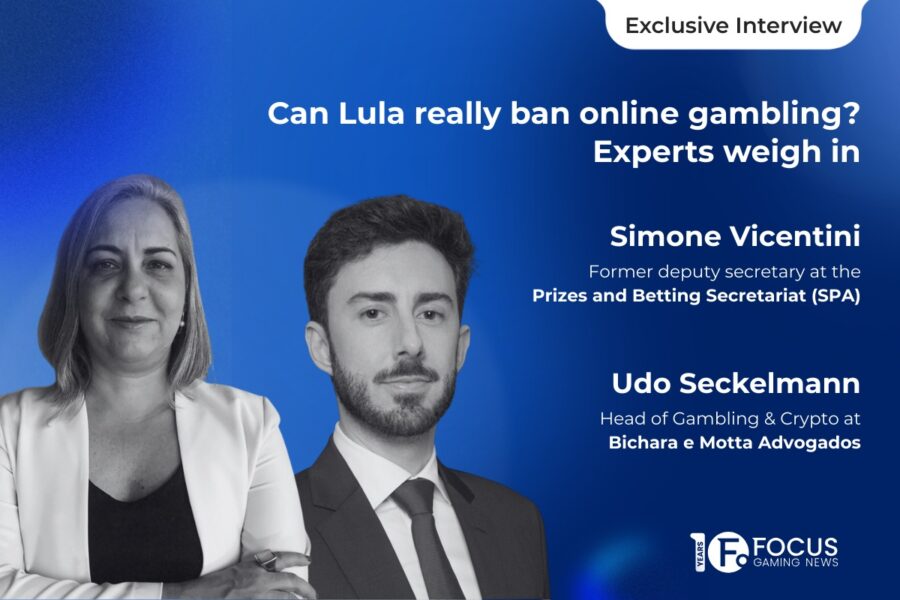

Specialists consulted by Focus Gaming News shared their opinions regarding President Lula’s proposal to ban online casinos in Brazil.
Exclusive interview.- President Luiz Inácio Lula da Silva‘s proposal to ban online casinos in Brazil, defended in a recent national address, faces legal obstacles and could generate significant regulatory and economic impact, according to specialists consulted by Focus Gaming News.
During a speech marking International Women’s Day, Lula said his intention was to work with Congress on legislation to ban so-called “digital casinos”, citing damage to Brazilian household finances and the rise of gambling addiction.
For Simone Vicentini, specialist in Constitutional and Administrative Law and former deputy secretary of the Secretariat of Prizes and Betting (SPA), any attempt at prohibition must necessarily go through the legislature.
“Any amendment to the provisions of Law 14,790/23 must necessarily be submitted for approval by the National Congress. Even if the government were to issue a provisional measure on the matter, the proposal would need to be approved by Congress within sixty days, extendable once for the same period, or it would lapse,” she said.
She also drew attention to a contradiction within the recent legislative process itself. “It is worth noting that Provisional Measure 1,182, issued in July 2025, originally proposed the regulation of sports betting only, yet the government enacted it without vetoes, including the online gaming provisions approved by Congress. There is therefore no justification for a subsequent prohibition of online gaming, targeting a sector that invested and established itself in the country based on a regulatory framework just created by the Brazilian State itself,” she added.
Along the same lines, lawyer Udo Seckelmann, Partner for Gambling & Crypto at Bichara e Motta Advogados, reinforced the Executive’s limitations.
“A ban on fixed-odds betting could not occur simply by administrative decision of the Executive, as the sector was structured by federal law (Law No. 14,790/2023). In theory, the government could attempt to issue a provisional measure, but even then, the measure would need to be converted into law by Congress to become permanent. Therefore, a change of this magnitude would inevitably require a legislative debate,” he explained.
Market impact and legal risk
A potential ban also raises concerns about the future of companies already authorised to operate in the country. The regulated market came into force in January 2025, following a process that involved technical and financial requirements and the payment of multi-million-real licensing fees.
According to Vicentini, an abrupt policy reversal would carry a high risk of legal disputes. “The regulated market formally began on January 1, 2025, with dozens of companies authorised following a lengthy and robust administrative process, subject to technical, financial and suitability requirements, with payment of R$30m per authorisation for a five-year term. These companies have therefore invested substantial resources in the Brazilian regulated market, generate employment and income, and pay their taxes,” she said.
The former SPA deputy secretary also highlighted that the debate touches on fundamental principles of regulatory law. “This does not mean, technically, that there is an absolute ‘acquired right’ to regulatory immutability; but it does mean that revoking onerous, active authorisations without a transitional framework, without specific legislation, and without significant litigation is far from legally straightforward. The debate would turn on legal certainty, legitimate expectations, regulatory predictability, and potential state liability, depending on how the measure is designed,” she pointed out.
Lawyer Udo Seckelmann also warned of the effects on Brazil’s international standing. “A change of this magnitude would raise serious legal certainty concerns. Companies made significant investments on the basis of a regulatory framework approved by the Brazilian State itself. Abruptly reversing this model would generate legal disputes and affect the international perception of the country’s regulatory stability,” he said.
A ban could strengthen the illegal market
Another point raised by the specialists is the possible effect contrary to the government’s stated intentions. For Vicentini, prohibition would not necessarily protect bettors.
“A ban does not protect the bettor — on the contrary, it leaves them at the mercy of the illegal market, without the necessary state oversight, without any measures to prevent problem or compulsive gambling, without action against money laundering and all manner of fraud, and without compliance with consumer legislation, data protection, and the other safeguards that only a heavily regulated and supervised market can provide,” she argued.
“Much like the proposed blanket ban on welfare recipients placing bets, prohibiting online gaming would — beyond its high litigation potential — end up strengthening the illegal online gaming market, which is precisely the opposite of what is intended,” Vicentini added.
Seckelmann reinforced this concern when assessing the practical scenario. “In practice, I consider a full ban highly unlikely. Brazil has just structured a regulated market, with significant tax revenues and supervisory mechanisms in place. Reversing that model now would require a congressional majority and would almost certainly push bettors back into the illegal market,” he asserted.
The trend is towards tighter regulation, not prohibition
In the specialists’ assessment, the most likely outcome is not an outright ban but rather a tightening of the existing rules.
“Today, I see greater chances of ‘regulatory tightening’ than of an outright ban. The political rhetoric may harden against so-called ‘digital casinos’, particularly in an election year, but converting that into a sweeping prohibition would require complex legislative manoeuvring, with high legal, fiscal, and reputational costs for the government itself,” said Vicentini, also highlighting the economic dimension at play.
“Another relevant consideration is fiscal and regulatory in nature: the Brazilian State has just consolidated a regulated market, collected billions in licensing fees, and has been drawing on sector revenues in budgetary and public security discussions — all of which reduces the practical incentive for a full reversal and creates space for an intermediate solution: more restriction, more oversight, and higher regulatory costs, without necessarily dismantling the model altogether,” she concluded.
By Focus Gaming News Editorial Team