


FIFA World Cup 2026: A game-changing event for iGaming and affiliate marketing across Latin America


Press release.- The FIFA World Cup 2026, hosted by the US, Canada, and Mexico, was more than the biggest football tournament of the four-year cycle. It became a clear indicator of how quickly the igaming industry is changing, particularly in Latin America, where regulation is evolving and match-driven traffic is growing quickly.
For operators and affiliates, the tournament highlighted both strengths and weaknesses across acquisition, payments, and platform performance. From player behaviour to platform performance and advertising strategy, nearly every part of the funnel came under pressure.
Looking at the tournament so far, several trends stand out—and many of them are likely to influence the market long after the final whistle.
1. Clean Venue Policy: Shifting Advertising from Stadiums to Smartphones
The World Cup’s clean venue policy left little room for unauthorised commercial activity inside stadiums and official fan zones. Sports betting brands that were not part of the tournament’s official sponsorship structure had to rely on digital channels instead.
Industry analysts point to two immediate consequences:
- Budgets moved online. Mobile ads, push notifications, PWA and WebView apps, and messaging communities became the primary ways to reach fans during matches. Chats and prediction groups where supporters discuss the action in real time proved especially valuable.
- The smartphone turned into the key touchpoint. With physical brand presence at stadiums off limits, speed and reliability proved critical. Users place bets directly from the stands or while watching on a TV screen in a bar, which made mobile stability and fast-loading sportsbook interfaces essential.
2. Psychology of Micro-Moments: Shifting Timings and Driving Live Engagement
World Cup betting activity in LATAM moved away from long pre-match research and towards short, emotional decision windows.
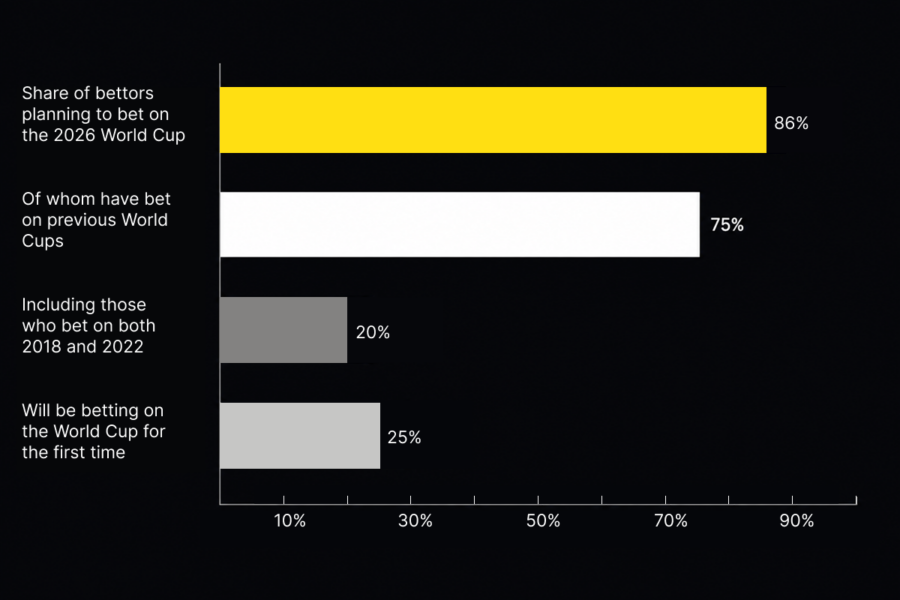
According to the Optimove LATAM Betting Intentions Report, more than 75% of Latin American bettors planned to bet on FIFA World Cup 2026, while over 56% intended to place live bets during the broadcast. Around 44% make betting decisions impulsively, reacting to what is happening on the pitch.
The traditional “day before the match” betting window weakened. Deposits and wagers concentrated around a few short periods:
- Window 1 (15–20 minutes before kick-off): bettors reacted to confirmed lineups and final pre-match information.
- Window 2 (15-minute half-time break): one of the busiest moments for live betting and cross-selling into fast-paced games and slots.
- Window 3 (key in-match events): VAR decisions, penalties, red cards, and unexpected goals triggered sharp spikes in activity.
Affiliate teams and operators that could not respond to these moments in real time risked losing a large share of potential conversions.
3. Payment Systems Vertical Load: Why Infrastructure Is Key
The tournament amplified what payment providers describe as “vertical traffic”: sudden surges of users trying to deposit at the same time. During high-profile matches, which involved key Latin American national teams, local payment systems such as PIX (Brazil), SPEI and OXXO (Mexico) faced heavy pressure.
According to LATAM payment providers, operators without backup payment channels could see up to 30–40% of transactions rejected at peak moments. When a deposit fails, the player often leaves immediately. For affiliates, every failed payment is traffic that never converts.
How Royal Partners Addresses This Challenge
For affiliates working with Royal Partners, the emphasis is on infrastructure built for peak demand. The Royal Partners portfolio includes sportsbook-enabled brands adapted to major LATAM markets:
- Brazil (BR): FRESH, SOL, JET, IZZI, LEGZO, STARDA, DRIP, MONRO, 1GO, LEX, GIZBO, FLAGMAN.
- Chile (CL): FRESH, SOL, JET, IZZI, LEGZO, STARDA, DRIP, MONRO, 1GO.
- Mexico (MX): FRESH, SOL, JET, IZZI, LEGZO.
- Peru (PE): FRESH, SOL, JET, IZZI.
- Ecuador (EC): STARDA, SOL.
These brands support local payment methods such as PIX and SPEI, and their mobile versions are built to handle match-day traffic spikes while maintaining fast load times.
4. Ad Creatives Evolution: Combating Banner Blindness
Classic football creatives (balls, trophies, and national flags) delivered weaker CTRs during the FIFA World Cup 2026 because users saw too many similar ads.
To overcome banner blindness, advertisers shifted towards more contextual formats:
- Situational marketing: creatives built around match memes, controversial referee decisions, and unexpected results.
- Streaming and UGC formats: content that captured live emotions and made viewers feel part of the conversation. Royal Partners also offers tailored packages for streamer partnerships: from exclusive promo codes to ready-made traffic redirection mechanics (e.g., from streaming platforms to Telegram).
- Compliance-focused offers: In a regulatory environment (ref.: strict decrees from the Brazilian regulator SPA/MF), advertisers are replacing “easy money” messaging with messaging built around fair play, free bets, and personalised welcome packages.
What has the LatAm market learnt?
The FIFA World Cup 2026 tested the LATAM igaming market in three areas: regulation, technology, and media buying.
The main lesson is that traffic alone is no longer enough. Operators and affiliates also need stable onboarding, reliable payment processing, fast mobile products, and creative strategies that can react to live events.
For affiliates working in the LATAM region, the definition of a strong partnership is changing. High payouts and lower acquisition costs still matter, but long-term success increasingly depends on infrastructure, transparency, and the ability to handle peak demand during major sports events.
As the LATAM market matures, infrastructure and user experience are becoming just as important as acquisition costs. Royal Partners’ portfolio, with integrated sportsbooks, mobile optimisation, and local payment support, is positioned to help teams manage those peak periods while maintaining conversion performance and user experience.
By Focus Gaming News Editorial Team