


What does push mean on Dabble? Understanding push bets and refunds


Contents:
- Dabble push meaning: what happens when a bet pushes?
- What is a push in betting? A general explanation
- What causes a push in sports betting?
- Example of a push in betting: real-world scenarios
- Example 1 – push on a point spread
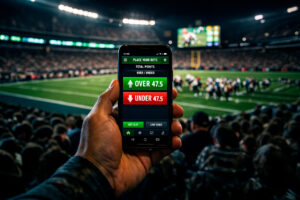
- Example 2 – push on totals (over/under)
- Example 3 – push in player props
- How does a push work on Dabble specifically?
- Push vs void bet
- Does a push count as a loss or a win?
- Why sportsbooks include the possibility of a push
- How to avoid pushes in betting
- Buy Half-Points (The Hook)
- Bet Alternative Lines
- Focus on 3-Way Markets
- FAQs
- Do pushes occur in player props?
- How can I avoid betting on lines that might push?
- How does a push affect same game parlays?
If you are new to sports betting or Daily Fantasy Sports (DFS), you will likely run into many situations where contests or events will end, but the actual outcome of the game will not affect your final result as a winner or loser. This final situation is called a push. While it may seem irrelevant or boring, understanding pushes and why they occur is crucial to protecting your bankroll and deciding which contests to enter. A push occurs when the house or sportsbook ensures that the actual outcome of an event will not result in the bettor having a winning or losing margin. In games such as NFL spread, NHL totals or NBA player props, a push occurs to prevent a house edge in the event of a tie.
So a push on Dabble is the explanation for bets and refunds. It is very important to understand the DFS model that we operate in here. Dabble is not a sportsbook, so a push on a single bet is not refunded in the same way as you would be used to with a traditional sportsbook. Rather, it impacts your scoring and multipliers in a different way.
A guide to the push in relation to the push in sports betting with maths examples and also a guide to how Dabble handles the push to maximise contest fun. A push is an outcome of a game in which the margin by which the favourite wins is equal to the margin by which the bookmaker favoured the favourite. The margin of victory for a team is the difference between the points earned by that team and the points earned by the opposing team. The following are a few simple examples to illustrate the concept of the push in the context of sports betting.
Dabble push meaning: what happens when a bet pushes?
You are making a prediction for the likely difference between a player’s stat and a projected value. So “Dabble push meaning: what happens with a push in a bet?” isn’t about getting money back on a bet. A tie is declared when the estimated stat lands on the projected line.
A tied selection is worth 0.5 points in Dabble, which is a little different to a traditional sportsbook parlay where a push reduces the number of legs that are in play by one. In Dabble, the effect is more that the selection is ignored as if it didn’t exist, rather than ending a streak. So it isn’t lost like a streak ending selection, but it also doesn’t count towards the win multiplier like a fully winning selection does.
I’m entered in a challenge over at Vegas Sports Labs. In this contest, to be “all-in” on any given contest you have to pick winners in every game. I determined that in the case of a push, the pick will count, and the other picks must be winners. I submitted 5 picks, and in hindsight one of them ended up being a push, while the other 4 were winners. My original 5-pick entry was then downgraded to a 4-pick winner payout. The contest didn’t actually eliminate me from winning a prize, they just ruled that having 4 winners in a 5-pick contest is less difficult than having 5 winners.
What is a push in betting? A general explanation
I want to work out the Dabble specifics and I need to understand what a “push in betting” is. It’s quite simple, really. A bet that isn’t related to footy at all. A bet in the context of betting is when two accounts compete against each other with the margin or line between the two accounts being the determining factor of who wins or loses. A push is when the final margin or line between the two accounts is the same as the original margin or line. As there is no winner, there is also no loser.
No action in a single wager (single) sports bet means that the bet is voided and the original amount of the wager is paid in full as a refund to the player’s account. An example of a no action sports bet would be a $100 wager on a team -7 and the team wins by exactly 7 points. In this case, the $100 wager is refunded to the player’s account. The sportsbook sets the line and in the event of a team winning by the exact amount of points of the spread, the sportsbook and the player have no action.
What causes a push in sports betting?
A push is a term used in sports betting. The whole number line is the reason for this term. The majority of point spreads and totals are set on whole numbers (3, 7, 48, 200, etc). The reason a push occurs is because the whole number line does not have an opposite number. Point spreads and totals with a half-point (3.5, 7.5, 48.5, etc) do not occur as a push because no one scores half a point in professional sports.
Common causes include:
- Integer Lines: Whole number point spreads or totals. Example: Over 44 points.
- NFL Exact Stat Matches / Player Props: A running back rushing for exactly 60 yards on a 60-yard line.
- Regulation Ties: In “Draw No Bet” markets, if a soccer match ends in a tie, the bet is considered a push.
Example of a push in betting: real-world scenarios
Abstract concepts can be quite difficult to get your head around. So here is an example of what a push in betting looks like by way of real-world scenarios for each market and how it works in sportsbooks and prediction apps such as Dabble.
Example 1 – push on a point spread
Week 10 NFL Betting Example: We are in Week 10 of the NFL season and I am looking at a wager on the Buffalo Bills -3 against the Miami Dolphins. Here is a brief explanation of the Bills -3: When I place a bet on the Bills -3 I am expecting them to win by more than 3 points.
- The Result: The Bills win the game 27-24.
- Why Was the Final Score 27 – 24? The margin of victory is exactly 3 points (27 minus 24).
- Outcome: Margin 3 points equals the spread. The game was a “push” and the winner and loser were the same team. The original wager is not the amount of profit earned, but rather the return of the investment, and therefore not a loss incurred. If the line was -3 1/2, the margin would have been in your favour and you would have lost. If the line was -2 1/2, the margin would have been in favour of the other team and you would have won.
Example 2 – push on totals (over/under)
In this example, we have an NBA game between the Los Angeles Lakers and the Golden State Warriors with a total of 220 points (Over/Under: 220).
- The Bet: You wager on the “Over.”
- The Result: The final score is 115-105.
- The Maths: 115 + 105 = 220 total points.
- The Outcome: The total landed exactly on the number. This is a push. No matter which way you choose to bet the Over or Under of 220, your original wager will be returned as this is a push and not an outcome that wins or loses the bet. Most bettors prefer lower totals with half points, such as 219.5, in order to have a more defined outcome.
Example 3 – push in player props
This one is a bit more relevant to Dabble users, but it applies to any sports market. I’ve been looking at a player prop for a star wide receiver, and was thinking that because he is in a high scoring offence, he should be favoured to go over his point total.
- The Line: Justin Jefferson projected for 80 receiving yards.
- The Pick: You select “More” (Over).
- The Result: Jefferson catches 6 passes for exactly 80 yards.
- Outcome: The push is a winner. The leg would be off in a regular sportsbook. The selection scores 0.5 points in Dabble. It will be excluded from your multiplier, but it will not eliminate your bet as a “Less” (like 79 yards) would.

See also: What does it mean to cover the spread? Understanding the concept in sports betting
How does a push work on Dabble specifically?
So we now know what a push is. Next, we will look at how a push plays out when scoring entries on Dabble using the points system. You can refer to the Points Scoring Guide if you’re not familiar with the points system. Remember that correct picks are 1 point, incorrect picks are 0 points and pushes/voids are 0.5 points.
A push will primarily affect your payout multiplier in Dabble. The Dabble entry payouts are paid out based on the correct number of legs in that entry. For example, a 3-leg entry might pay 6x, while a 2-leg entry pays 3x.
If you place a 3-leg entry and one leg pushes:
- Leg 1: Correct (Win)
- Leg 2: Correct (Win)
- Leg 3: Push (Tie)
A push on a single entry is considered a 2-leg entry for payout purposes and is reduced to 2-leg multiplier. This is a good deal in an “All-In” contest because the entry was not a loss. In a “Hedge” entry (where you can afford to be wrong on one selection and still win) a push is usually considered to be a neutral factor but it does reduce the payout for the reduced risk of the entry.
Check your contest payout table for specifics. Here are the general rules that apply to all contests: a tie-out always results in a downgrade to the next smallest entry size. For most contests, this means a tie-out will reduce your entry size by one leg.
Push vs void bet
We call them by slightly different names, but a push and a void bet are really the same thing. We created the following table to help clarify the Push vs Void Bet. In the Dabble scoring rules, we give 0.5 points for a push, and 0.5 points for a void bet for different reasons.
| Feature | Push | Void Bet |
| Term | Definition: | A result that ties the betting line exactly. |
| Cause | Game play results (e.g., score lands on -3). | External factors (e.g., Player DNP, injury before game, rainout). |
| Dabble Scoring | 0.5 Points (Neutral). | 0.5 Points (Neutral). |
| Payout Impact | Downgrades multiplier (e.g. 3-pick becomes 2-pick) | Downgrades multiplier (e.g. 3-pick becomes 2-pick) |
| Predictability | Can be predicted/avoided by analysing lines. | Often unpredictable (last-minute scratch or weather). |
| Outcome | Bet is void if player does not start (Singles) or leg is removed (Parlay). | Bet is void if player does not start (Singles) or leg is removed (Parlay). |
Key Concept: Pushes and Voids – What’s the Difference? A push is result-based: the game took place and the point spread or point bet number was equal. A void is usually validity-based: the conditions of the wager (such as the player participating) were not met.
Does a push count as a loss or a win?
The big question for new bettors is: Does a push count as a loss or a win? The answer is neither.
In terms of bankroll, a push is a non-event. A push is a preservation of capital. If you were to lay $50 on an event and the game ended in a push, you would receive a $50 credit back. You wouldn’t be up any money, but you also wouldn’t be in the hole.
In parlays and accumulators a push is better than a loss.
- Loss: Terminates the entire parlay (unless insured/hedged).
- Push: Keeps the parlay alive, merely reducing the potential payout odds.
In Dabble, when a push scores 0.5 points, we call it a “half a win”, but really it reduces an entry to half its value, so what was a Triple becomes a Double.
Why sportsbooks include the possibility of a push
You may be wondering why the sportsbook offers a push and does not instead use half points to eliminate the option of a tie.
- Psychology: Whole numbers are cleaner and more attractive to bettors. A line of “Total Goals: 3” is much more attractive than “Total Goals: 2.75”.
- Management: The number of bets that a Sportsbook will allow to be made on an event is often easier to manage with whole numbers. If the true odds on a spread wager were 3, the Sportsbook may move the point spread to -2.5 or -3 so that they are not exposed to too many bets on one side of the line. This way they can be certain that all winning wagers will be paid in full.
- Market Liquidity: Pushes or refunds in Asian Handicap are highly sought after by large stakes players, as it allows them to mitigate risk and uncertainty in terms of their wager action, potential winnings and losses.
See also: What is moneyline in betting and how to bet the money line like a pro
How to avoid pushes in betting
A push is better than a loss, but watching your potential winnings disappear due to a tie can be frustrating to deal with. Learning how to avoid pushes in sports betting is crucial to your success, and it usually involves a bit of line shopping and market analysing.
Buy Half-Points (The Hook)
Buying the hook. One of the most common phrases you’ll hear in sportsbooks is “buy the hook.” So, in the example above, the New England Patriots are listed at -3. Most shops will let you “buy the hook” and take -2.5 instead. So, instead of having to worry about a push, you are now rooting for the Patriots to win by 3. While “buying the hook” can be a good way to avoid the chance of a push, keep in mind that buying down half a point almost always increases the vig you have to pay. So, if the original -110 line is -3, the -2.5 might be -130 instead.
Bet Alternative Lines
A market that is not the main line for a market is referred to as an Alternative Spread or Alt Line. If the main total for a market is not 44, we will have a market available for Over 43.5 or Over 44.5 to offer a Win/Loss option.
Focus on 3-Way Markets
In sports like soccer and hockey, 3-Way lines (Win/Draw/Loss) are used. In these situations, the draw is considered a separate bet. In a situation where a player has a draw on a 3-way team bet, the team will lose the match and the draw bet will lose. Any time a push is avoided, there is more risk involved.
FAQs
Do pushes occur in player props?
Yes, they do. NBA & NFL player props that feature whole number margins can see pushes (ex: 4 Rebounds, 2 Passing TDs). If a player ends up with the margin value that was set by the sportsbook (in this case the exact number) then there is no winner. Props with margins that include .5 (ex: 4.5 Rebounds) will not result in a push.
How can I avoid betting on lines that might push?
Why won’t the lines pull away from whole numbers? Can you avoid betting the number that might push? Don’t ever gamble whole numbers! Always gamble the point line that ends in .5. In sports betting, you have the option to buy points and eliminate favourite/bigger number from your consideration. In Dabble, you can take a portion of the favourite/bigger number and mitigate the risk with the smaller number and .5 line.
How does a push affect same game parlays?
In the unlikely event that there is a push in a particular leg, the standard rule is to void the leg and reprice the odds for the other legs in the Same Game Parlay (SGP). However, please check with the Bookmaker in relation to their house rules as some may consider the SGP to be a single bet. At Dabble, in the event of a push, the standard rule is to score 0.5 on the leg and move the entry to the lowest paying contingency.