What does over under mean in betting? A complete guide to totals betting

Contents:
- Over Under meaning in sports betting
- What is an Over Under Bet? (also known as totals betting)
- How totals differ from spread and moneyline bets
- How does Over Under work? Understanding the mechanics
- Over/Under bet example
- Example 1 – NBA totals bet
- Example 2 – NFL totals bet
- Example 3 – Soccer Over/Under 2.5 goals
- How to read Over Under odds and totals lines
- Over Under in different sports: how it varie
- NFL and college football totals
- NBA totals betting
- Baseball and low-scoring sports
- Soccer totals market
- Over Under strategy: how to bet totals smarter
- Over Under vs Spread
- When should you bet the over or the under?
- FAQs
- What is a hook in totals betting?
- Is Over Under betting easier than spread betting?
- How are totals lines calculated?
- Can you parlay Over Under bets?
- Are Over Under bets good for beginners?
Over Under is a term used to describe a wager placed on the estimated sum of points that will be scored in a particular event. A wager placed in this market is also referred to as a totals bet. The odds given for this market usually relate to the sum of points likely to be scored.
It eliminates the need to choose the winner of any event. We instead choose to focus on how the event is played out from a scoring and run rate perspective. This means that a low-scoring NFL game or a game dominated in points by one side in an NBA contest is perfect for this market. The Over Under market is fundamental to any type of sports betting strategy.
Over Under meaning in sports betting
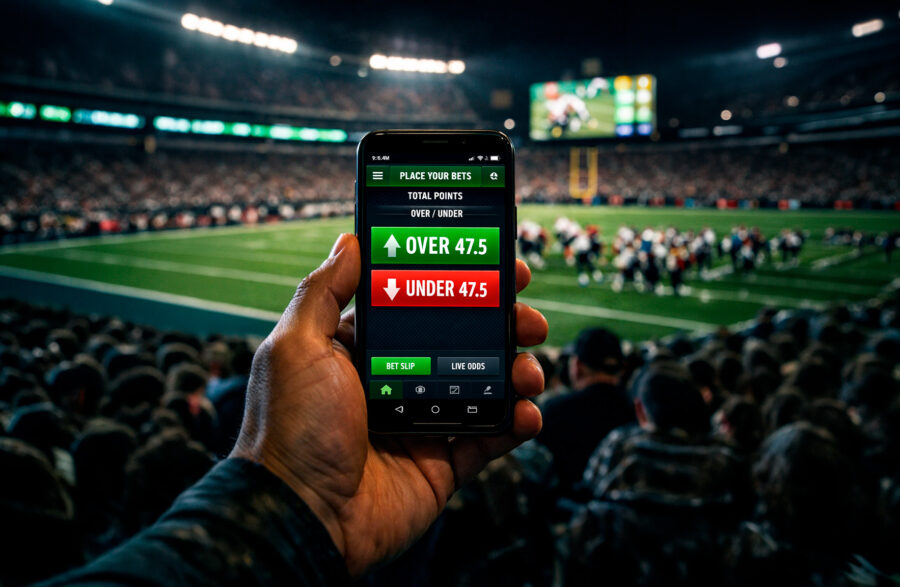
The Over Under in sports betting is a wager on the combined score of the two teams playing in a specific game. The sportsbook will release a number known as the “total.” You then decide whether the final score of the game will be over that number or under.
The teams involved in this market are irrelevant. So too is the outcome of the game and the margin of victory. In a point spread market, a team must outdistance its opponent by more points than the number given in the spread in order to win. In a market such as Totals (Over/Under), the total points scored by each team are important. Therefore, if you wager the Over in a 45.5-point game, a score of 23-24 will result in a win, as will a score of 10-40.
What is an Over Under Bet? (also known as totals betting)
An Over Under bet, commonly referred to as a totals bet, is formally a type of binary wager offered by a sportsbook that is related to a sportsbook’s projected statistic for a given game or event. The Over Under (or ‘total’) usually relates to the final score of the game, but it can also relate to individual halves or quarters of a game, or to specific statistics for individual players (e.g., total rebounds or passing yards).
It is one of the more popular wagers, allowing the gambler to stay in the game until the very end. Regardless of how one-sided the game may look, the Over/Under can change with a late field goal or with a touchdown late in the game, often while the opposing team is resting.
How totals differ from spread and moneyline bets
Mastering totals requires an understanding of them in relation to the other ‘Big Three’ wagers:
- Bet on the Moneyline: The moneyline is a simple bet whose purpose is to predict which team will emerge victorious. The actual score of the game does not matter when it comes to this particular wager.
- Point Spread: The point spread is the margin of victory. With point spread wagering, you are picking a team to WIN by more points than the point spread. The combined score of the teams is less important than the margin of victory.
- Totals (Over/Under): In this market you do not care who wins or by how much. You only care about the total points that will be scored in the game.
How does Over Under work? Understanding the mechanics
The rules for this bet are the same at just about every major US sportsbook (DraftKings, BetMGM).
- The Line: The oddsmaker will take into account estimated pace, offensive and defensive efficiency when setting the number. An example would be a number for an NBA game of 220.5.
- The Juice (Vig): The juice or vig is the standard charge for every bet. Most bets have a juice of -110, meaning that you have to lay $110 to win $100. That $10 is the vig.
- The Result:
- Over: Total score > Line.
- Under: Total score < Line.
- Push: If the line is a whole number (e.g. 47) and the score lands exactly on it (27-20), the bet is a tie and the stake is paid back to the client.
Over/Under bet example
Let’s look at real-world scenarios to clarify how these wagers are settled.
Example 1 – NBA totals bet
Matchup: Los Angeles Lakers vs. Boston Celtics
Total Set: 227.5
- Final Score: Game ends 115-110, the combined score is 225.
- Scenario A: The Under is the winner and the Over is the loser.
- Scenario B: The OT concludes in a 120-118 final and the combined score reads 238, which means the Over wins.
Note: Overtime scoring counts towards the total in almost all standard full-game wagers.
Example 2 – NFL totals bet
Matchup: Kansas City Chiefs vs. Buffalo Bills
Total Set: 48.0
- Scenario A: If the final score is 27-24 (Total: 51) then the Over wins.
- Scenario B: First Quarter: Cardinals 11, Seahawks 10. Cardinals Win. Second Quarter: Cardinals 14, Seahawks 17. Final: Cardinals 24.
- Scenario C (Push): The final score is 28-20 (Total: 48). This game matches the line exactly, it is a push and all money is refunded.
Example 3 – Soccer Over/Under 2.5 goals
Matchup: Manchester City vs. Arsenal
Total Set: 2.5 Goals
The first thing to remember when it comes to soccer is that goals are scored infrequently. The market’s average for almost every market is 2.5.
When it comes to football bets and the number of goals, there are many options to choose from. A common market that many people choose to focus on is the over/under for the amount of goals that are expected to be scored in a given match. This market sees the bookmaker set a number and you then decide whether the actual number of goals scored will be higher or lower than that figure.
- Betting Under 2.5: In this type of bet, the player only wins if there are two goals or less scored in a particular match. An example of this type of match would be a 0-0 draw, or 1-0 or 1-0 in favour of one of the teams.

How to read Over Under odds and totals lines
The total or Over/Under is the predicted combined score of both teams in a game. It is listed on the sportsbook board next to the point spread for the contest.
47.5 (-110) O / U
- Line 47.5: The line is 47.5. The 0.5 at the end of the measurement ensures there is no pressure on the line (no pushes).
- -110: This is the price. A $110 bet pays $100 profit.
Sometimes the sportsbook will adjust the price of the number of points they are offering, rather than the number itself. So, ‘Over 47.5 (-120)’ and ‘Under 47.5 (+100)’ would be an example of this. In this situation, the Over is a heavy favourite, and the price of choosing it has been made quite high, whereas the Under offers even odds, meaning you risk $100 to win $100.
Over Under in different sports: how it varie
The concept is the same, but the key numbers and ranges change dramatically from sport to sport.
NFL and college football totals
In football, lines typically range from 40 to 60 points.
- I am favouring the Under in this matchup: The weather is going to play a huge role in this game. Wind and snow are forecast, which could make it a chore for either team to perform effectively, so I’d recommend siding with the Under.
- Key Numbers: Scores are more likely to fall on certain numbers due to the value of touchdowns (7) and field goals (3). Common numbers include 41, 44 and 51.
- College Variance: NCAA totals can swell to 70s and 80s due to the larger differences between college players and the faster pace of college basketball.
NBA totals betting
The NBA is by far the most high-scoring of the four major sports, with most games seeing point totals in the 210 to 240 points range.
- Pace is King: The pace of possession will have a greater impact on the final number than any defensive metric. In general, a team that is looking to play up-tempo will want to have lines that are moving upwards.
- Blowout Risk: Games with a large point differential late in the 4th quarter can be problematic for Over plays. If a team is up by 20 or more points in the 4th quarter, it may choose to remove its starting players in order to protect the lead. The result is often a dramatic slowdown in scoring which can cause the point total to drift under the Over.
Baseball and low-scoring sports
MLB totals are single digits, typically 7 to 10 runs.
- Starting Pitchers: The lines can vary quite a bit from one starting pitcher to another. So an ace pitcher against another ace’s team may have a run line of 6.5 while the run line at a game at Coors, which is high altitude, may be 11.5.
- Weather: Wind blowing out to the fence can turn fly balls into home runs and move the line dramatically.
Soccer totals market
The 2.5 goals line is quite close to the worldwide standard, but there are a number of sportsbooks that will post the 1.5 or 3.5 at slightly different prices. They will also post the Asian Total, such as 2.25 or 2.75, which is a goals bet hedged between the two totals.
See also: What is a unit in sports betting? how to use and manage your wagers like a pro
Over Under strategy: how to bet totals smarter
Beating the book on totals is not just about loving a ‘fun game’. With a wide range of betting options and more matchups available than ever, it has become increasingly important to understand the following:
- Analysis Note: When looking at basketball and football, we are typically interested in the number of possessions per game, not the actual scoring average of the team. In this scenario, we are talking about two offenses that are ranked as two of the worst in the country, however, the offences are scoring enough points due to the high number of possessions in a given game. The end result is a game that is poised for the Over.
- Fade the Public: Many recreational sports bettors like to back the Over because they feel their favourite team is going to score more points. The oddsmakers at sportsbooks will put a few points on the point spread to counteract this. As well, games that are going to be shown on TV can be good candidates to fade the public and go with the Under.
- Monitor Referee Assignments: There are referees in the NBA who tend to call more fouls than others. Those who call more fouls lead to more free throws being attempted, which leads to more stops in the game, which are favourable for the Over.
- Check Injury Reports: Losing your best defender is every bit as important as losing your best quarterback.
Over Under vs Spread
Every week we summarize and compare the two main markets. Here is the detailed look at each.
| Feature | Over/Under (Totals) | Point Spread |
| Primary Focus | Combined Score (Offense + Defence) | Margin of Victory (Winning by X) |
| Winner Importance | Irrelevant | Crucial (unless taking points) |
| Standard Odds | -110 (Flat) | -110 (Flat) |
| Key Variable | Pace / Weather / Efficiency | Team Strength / Home Field |
| Beginner Friendly? | Yes (Simpler concept) | Moderate (Requires handicap knowledge) |
When should you bet the over or the under?
Bet the Over when:
- The game involves two fast-paced teams with weak defences.
- Weather conditions are perfect (dome, no wind).
- Recent trends show both teams consistently exceeding projections.
- Star defensive players are injured.
Bet the Under when:
- A conference rivalry game where both teams are very familiar with the others’ sets and systems, and probably know inside out the other team’s personnel and how to exploit their weaknesses, which is a perfect formula for a brutal, half-court defensive battle.
- Weather is poor (high winds in NFL/MLB are “Under” indicators).
- The public is heavily betting the Over, inflating the line artificially.
- The referee crew allows physical play.
FAQs
What is a hook in totals betting?
A hook in totals betting is the 0.5 that is attached to the number. All totals bets have a 0.5 attached to the total, such as 47.5. The hook eliminates the possibility of a push. The sportsbook cannot allow ties to occur in games, which is why the hook was put into play. It is almost impossible for a team to score exactly 0.5 points in any game.
Is Over Under betting easier than spread betting?
Yes for beginners. It’s always easier to just want a team to score more points than the other team or want a team’s defence to be better than the other team’s offence. Rather than wanting a team to win by exactly 4 points. But in the end, it will take the same amount of work and preparation to profit and win consistently in Over Under betting.
How are totals lines calculated?
Each sportsbook has its own formula, which takes into account a number of factors. Most incorporate some form of efficiency rating for the teams such as DVOA or KenPom, possessions per 40 minutes, some form of head-to-head information, injuries and other variables such as a team being at home in a dome versus at home in a warm-weather stadium, and can also take into account weather forecasts. The number is generated by a combination of factors, and the line moves based on where the majority of the money is being bet.
Can you parlay Over Under bets?
Yes. Totals are a very popular market in parlays. You can pair an Over bet in one contest with a Moneyline in another, and win a multiplied payout if both legs pay. But if one leg loses, the whole parlay loses too.
Are Over Under bets good for beginners?
Yes. While they take a bit less knowledge of team rosters than point spread betting, they are an excellent way for beginners to start learning about the analytics of sports. Rather than trying to comprehend a 7.5-point spread (something that a beginner may not fully understand), an Over/Under bet in a high-scoring match-up such as the Celtics and the Pelicans is more a matter of whether the score will be above 225 or under.
See also: What does parlay mean in betting? full guide to parlays
By Focus Gaming News Editorial Team