The privacy-security paradox: Architecting risk engines for high-risk digital platforms, according to Frogo


Volodymyr Todurov, CEO at Frogo, examines how privacy-first risk engines can combat fraud without increasing data exposure.
Opinion.- As high-risk digital platforms – from cross-border FinTechs to global Web3 marketplaces – scale, risk engineering teams face an inherent dilemma. To catch sophisticated fraudsters before margins are eroded, risk engines demand rich, low-latency operational data. Yet, as regulatory frameworks tighten around global data governance, every byte of collected personal data becomes a major liability.
For years, the industry relied on a brute-force approach to risk mitigation: collect as much user data as possible, centralise it and run broad heuristic queries. Today, that playbook is broken. Modern fraud vectors execute post-identity verification (post-KYC) using automated tooling, proxy networks and anti-detect environments. Simultaneously, data privacy laws impose heavy penalties on invasive tracking.
High-volume platforms are no longer just asking if a risk engine works. They are asking: Where does our operational data actually land, who holds the decryption keys and how is our intelligence isolated from external noise and group-level exposure?
Solving this requires shifting the architecture of fraud detection – moving away from identity scraping and towards privacy-first device telemetry and strict structural cloud isolation.
The evolution of telemetry: Decoupling identity from signal
Traditional risk tools relied heavily on invasive client-side scripts, dynamic DOM inspection, third-party tracking cookies and heavy pixel rendering. Beyond creating noticeable latency that degraded genuine user experiences, these methods introduced massive privacy compliance risks.
When a risk vendor scoops up raw user profiles or unhashed identifiers, the platform essentially surrenders its core asset and inherits the vendor’s vulnerability surface.
Modern risk engine architecture bypasses this through a telemetry-first model. Instead of inspecting who the user is, the engine evaluates how the connection is established and how the environment behaves.
1. Hardware & Runtime Telemetry
Rather than scanning static files, the edge engine measures physical hardware execution traits. This includes canvas/WebGL rendering anomalies, audio context footprints, screen parameter consistency and GPU pipeline quirks. These traits expose anti-detect browsers, emulators and virtualised execution environments in real time without relying on directly identifying user attributes such as names or contact details.
2. Behavioural Dynamics
Automated fraud relies on scripts, headless browsers (e.g., Puppeteer, Playwright) and remote desktop protocol (RDP) tools. Tracking micro-interactions – such as non-linear pointer trajectories, keypress dynamics and session focus state transitions – helps distinguish genuine human interaction from coordinated multi-accounting bots.
3. Edge Signal Processing
By executing signal extraction directly at the edge, risk platforms reduce latency and eliminate the need to transmit unencrypted user attributes over the wire. The raw device telemetry is converted into ephemeral hardware fingerprints and behavioural hashes. Dynamic threat scores are calculated instantaneously, leaving personal user databases completely decoupled from the telemetry pipeline.
Structural isolation: Solving the multi-tenant exposure problem
For platforms operating within broader corporate structures, enterprise holding groups, or shared cloud infrastructures, data privacy extends beyond external threat actors. It requires absolute logical and physical separation between data environments.
In standard multi-tenant SaaS environments, cross-tenant data leakage – whether through misconfigured database queries, shared analytics pipelines, or cross-departmental access – remains a persistent vulnerability. When an engine aggregates intelligence across multiple clients, proprietary business logic and transaction patterns are often exposed to unintentional cross-contamination.
To reduce the risk of cross-tenant data exposure, modern engines are designed around strict containerization principles.
Take Frogo. To serve high-volume platforms without compromising corporate data integrity, the architecture relies on dedicated Amazon Web Services (AWS) infrastructure designed to maintain strict logical separation between tenant environments:
- Containerised event processing: Whenever event streams are triggered via on-demand API calls, processing occurs inside dedicated, tenant-specific runtime containers.
- Cryptographic boundary walls: Tenant datasets are encrypted at rest and in transit using unique customer-managed keys. No sister entities, cross-departmental teams, or partner networks within the wider corporate group can query, aggregate or view another platform’s underlying data pool.
- Deterministic access control: Administrative rights follow strict Least-Privilege Access (LPA) principles, enforcing role-based controls that prevent internal lateral movement.
This setup ensures that while platforms benefit from enterprise-grade infrastructure, their operational data remains exclusively their own.
Validation frameworks: The role of ISO 27001 and PCI DSS
In high-risk digital operations, internal promises around security must be backed by independent, third-party validation. Regulatory audits and compliance frameworks serve as the baseline for operational trust.
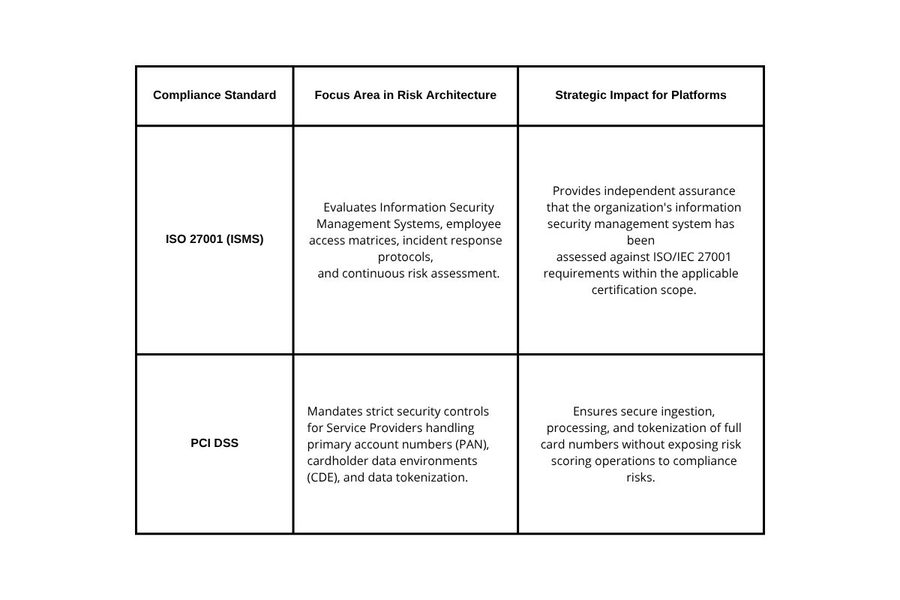
Where applicable and within their respective scopes, independent assessments can provide additional assurance regarding the effectiveness of relevant security and governance controls.
Security as a growth engine
Risk management in high-risk digital sectors has evolved beyond passive defense. High chargeback rates, bonus abuse and account takeovers directly erode net margins.
However, aggressive security controls that introduce friction for legitimate users destroy lifetime value (LTV).
The path forward relies on invisible, privacy-first security:
- Collecting low-level hardware traits instead of invasive user profiles.
- Isolating telemetry within dedicated, containerized cloud environments.
- Validating security posture through rigorous international compliance standards.
When risk engines operate on these principles, platforms protect their bottom line from modern fraud vectors – while giving compliance officers, system architects and end users complete confidence that their data remains secure, isolated, and private.
By Focus Gaming News Editorial Team