


Milko Grmuša, UPIS RS: “I believe that, within five years, BGF can become one of the strongest examples of constructive regional cooperation in Southeast Europe”
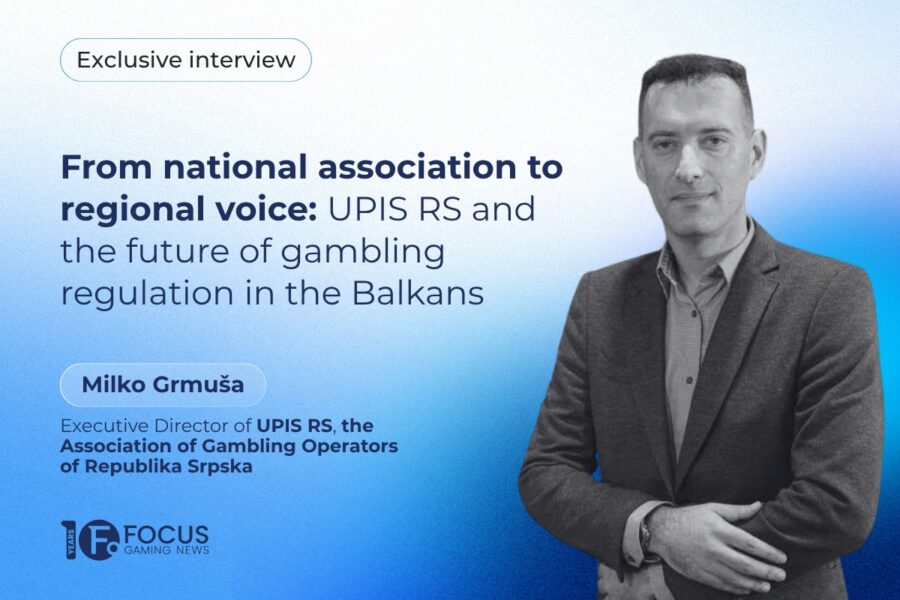
Focus Gaming News spoke to Milko Grmuša, the Executive Director of UPIS RS, about the Republika Srpska market, regulatory challenges and tackling unlicensed online gambling.
Exclusive interview.- In Republika Srpska, where both land-based and igaming have undergone significant development in recent years, the conversation around creating a sustainable and well-regulated market has become increasingly important.
In this exclusive interview with Focus Gaming News, Milko Grmuša, executive director of UPIS RS, the Association of Gambling Operators of Republika Srpska, discusses the current state of the gambling sector, the challenges facing licensed operators, and the role of industry cooperation in shaping the market’s future.
Drawing on your experience across both land-based and online gaming, how would you describe the current state of the gambling market in Republika Srpska?
The gaming market in Republika Srpska has developed significantly over the past five years. This progress has been driven by a combination of operators’ knowledge, experience and investment, together with increasingly constructive cooperation with the Gaming Authority of Republika Srpska (RUIS). Both the land-based and online segments have become more technologically advanced, while investment in people, digital solutions and the overall quality of the customer experience remains strong. In that sense, gaming is one of the more modern and technology-driven sectors of the Republika Srpska economy, with a broader positive impact on employment, public revenues and the adoption of new technologies.
At the same time, important challenges remain, particularly unlicensed competition in the online sector. This is not unique to our market: technological development is moving faster than legislation and traditional enforcement mechanisms in almost every jurisdiction. Another challenge is the relatively limited number of legal, accounting and public-policy professionals who understand both the commercial reality of the industry and the specific legal nature of games of chance in sufficient depth. When regulation is shaped more by stereotypes than by evidence and specialist knowledge, the result can be inconsistent rules and practical uncertainty.
UPIS RS therefore seeks to be a reliable and constructive partner to regulators and policymakers at every level. We believe the industry has the professional, operational and technological capacity to help clarify complex regulatory issues and to contribute to the modernisation and strengthening of the wider economy.
As executive director of UPIS RS, what main priorities have you set for the association and its members in the short and medium term?
Our priorities are focused in three main directions. The first is the continued formalisation and protection of the legal market, including a determined response to unfair and, in many cases, illegal competition. Licensed operators that invest, employ people, pay taxes and comply with demanding regulatory standards must be able to compete in a market in which the same rules apply to everyone.
The second priority is the continuous improvement of the customer experience, combined with the implementation of the highest achievable responsible-gaming standards. We want customers to enjoy a high-quality service, but also to play responsibly, understand the nature of gambling and have access to clear information and effective protection tools. This also means providing transparent information about taxation and other regulatory matters that may affect players and their winnings.
The third priority is the modernisation of the industry’s overall regulatory and economic framework. Fiscal and administrative burdens should be reasonable, proportionate and legally sustainable, rather than overlapping or detached from the actual cost and risk of regulation. At the same time, responsible-gaming measures should be practical, evidence-based and genuinely effective. We also believe there is considerable potential to connect gaming investment with the wider hospitality and tourism sector. Republika Srpska and Bosnia and Herzegovina have exceptional tourism potential, and well-regulated private investment can help create new facilities, jobs and a broader investment cycle.
From an operator’s perspective, what are today the most pressing regulatory and compliance challenges in Republika Srpska’s gambling sector?
The most pressing challenge is not simply the number of rules, but the lack of coordination between them. Operators must simultaneously comply with taxation and fee regimes, AML/CFT requirements, personal-data protection, consumer protection and sector-specific gaming regulations. These obligations are legitimate, but in practice they can overlap, conflict or produce mutually inconsistent expectations. Too often, operators are required to find practical solutions without sufficiently clear or coordinated guidance from the competent authorities.
A second challenge is regulatory predictability. The industry needs stable, proportionate and technology-neutral rules that recognise the difference between legal, licensed operators and unlicensed market participants. Frequent changes, double charges or inconsistent interpretations increase legal uncertainty without necessarily improving consumer protection or public revenues.
On the positive side, this environment has made the licensed sector highly adaptable. Leading operators in Republika Srpska already apply compliance, governance and technical standards comparable to those found in many EU markets. The next step should be a more structured partnership between the industry and public authorities, with common interpretations, practical guidance and regulation based on measurable risk rather than assumptions.
Anti-money laundering and counter-terrorist financing requirements have become increasingly demanding across the region; how is the Republika Srpska market adapting to these stricter AML standards, and what role does UPIS RS play in this process?
The market has made substantial progress in adapting to stricter AML/CFT standards. Licensed operators have strengthened enterprise-wide risk assessments, customer due diligence, transaction monitoring, internal reporting, staff training and governance procedures. This is operationally demanding, particularly because gaming has a large number of transactions and customer interactions, but the industry understands that effective AML controls are essential for its credibility and long-term sustainability.
UPIS RS has played an important coordinating role together with RUIS, and I would also highlight the constructive cooperation of colleagues from the State Investigation and Protection Agency of Bosnia and Herzegovina (SIPA). Our role is to translate broad legal requirements into workable sector-specific practice, identify common implementation problems, facilitate the exchange of experience and maintain an open dialogue between operators and competent authorities.
Our experience in discussions with domestic and international stakeholders is that the licensed gaming sector should not be treated as a systemic problem, but as part of the solution. Our common interest is a legal and well-regulated market in which laws are respected, taxes are paid, players are protected and suspicious activity is detected and reported. The alternative is not the disappearance of demand, but its migration to an illegal market that applies no standards at all.
Illegal gambling remains a concern in many jurisdictions; how serious is the problem in Republika Srpska, and what tools do regulators and licensed operators currently have to combat it effectively?
The situation is considerably better than it was a decade ago, particularly in the land-based sector, where illegal activity has been substantially reduced. The continuous growth of public revenues generated by the licensed industry and the visible formalisation of the market are important indicators of that progress.
The principal challenge today is unlicensed online gambling. Although the provision of online games without the required licence is prohibited, the cross-border nature of the internet, the constitutional and institutional complexity of Bosnia and Herzegovina and the absence of sufficiently rapid technical and operational mechanisms make enforcement difficult. Traditional inspections alone cannot effectively address operators that are established abroad, advertise digitally and process payments through international channels.
Regulators already have licensing, inspection and sanctioning powers, while law-enforcement bodies can act where the relevant legal conditions are met. However, effective online enforcement requires stronger coordination and faster tools, including cooperation with internet service providers, payment institutions, banks, advertising platforms and other intermediaries. Licensed operators can support this process by reporting illegal activity, sharing technical knowledge and helping to educate the public. We are fully prepared to assist the authorities, but the exercise of enforcement powers must, of course, remain the responsibility of the competent public bodies.
UPIS RS is one of the founding members of the Balkan Gaming Federation (BGF); what motivated you and your association to join this regional initiative, and what added value does BGF bring to your work at a national level?
We are convinced that, in today’s economy, scale and cooperation are essential. The markets of Southeast Europe are naturally connected, and although each jurisdiction has its own legal framework, we face many of the same challenges: illegal online gambling, rapid technological change, fragmented regulation, responsible-gaming requirements and the need for greater legal and fiscal predictability.
BGF gives its members access to comparative knowledge, practical experience and a stronger regional voice. It allows us to exchange solutions that have already been tested in larger or more mature markets, develop common professional standards and communicate more effectively with national regulators. At the domestic level, this helps UPIS RS benchmark local rules and practices against regional and European developments rather than addressing every issue in isolation.
I believe that, within five years, BGF can become one of the strongest examples of constructive regional cooperation in Southeast Europe, contributing to regulatory convergence, the rule of law, investment, innovation and the freer movement of knowledge, ideas and capital.
The BGF has placed the fight against illegal gambling and the protection of legal business at the centre of its agenda; what specific regional actions or projects should be developed to support operators in Republika Srpska and the wider market of Bosnia and Herzegovina?
For operators in Republika Srpska and Bosnia and Herzegovina, this is particularly important because more and more processes in the industry are already regional. Many operators, suppliers, platforms and technology companies operate in more than one Balkan market, while illegal online gambling is, by its nature, a cross-border problem. This is why solutions cannot be only national.
A key practical step in this direction is the round table with Balkan regulators that BGF is already working on and that is planned for next year. Such a format can provide the basis for more direct coordination between associations, regulators and competent institutions on issues such as illegal online gambling, enforcement and the protection of the legal market.
On this basis, BGF can develop a regional observatory for illegal gambling: a structured mechanism for collecting and exchanging information on unlicensed websites, brands, advertising channels, payment methods and recurring enforcement patterns. This would not replace the powers of national authorities, but it would provide regulators and licensed operators with a much stronger common evidence base.
Another important direction is the development of model protocols for coordinated action against illegal online operators, adapted to the legislation of each jurisdiction represented in the Federation. These could cover notification procedures, website and domain blocking where legally available, payment disruption, restrictions on illegal advertising and cooperation with digital platforms and financial institutions.
This should be complemented by an annual regional regulatory and compliance benchmark covering AML/CFT, responsible gaming, data protection, taxation and technical standards, together with joint training programmes for operators, regulators and law-enforcement bodies. Finally, the region needs credible research and comparable data on player behaviour and responsible gaming. The objective should be to replace prejudice and improvised regulation with legal certainty, measurable outcomes and a consistently high level of customer protection.
Looking ahead over the next five years, what would be your ideal roadmap to ensure a sustainable, responsible and competitive gambling industry in the region?
My ideal roadmap would rest on four connected principles. First, regulation must become stable, proportionate, technology-neutral and risk-based. Operators need clear rules and predictable fiscal obligations, while regulators need effective powers and reliable data. Legal operators should be encouraged to invest and innovate, not placed at a competitive disadvantage compared with unlicensed businesses.
Second, the region needs a coordinated strategy against illegal online gambling, involving regulators, law-enforcement bodies, banks, payment providers, internet service providers, advertising platforms and licensed operators. Third, we should work towards gradual regional regulatory convergence through BGF, particularly in technical standards, AML/CFT, responsible gaming and the treatment of cross-border digital risks.
Finally, the industry must continue investing in people, technology and the wider economy. Over the next five years, success should be measured not only by revenue, but by the strength of legal institutions, the level of player protection, the quality of jobs and investment, and the public’s confidence that the market is fair, transparent and sustainable. If we achieve that balance, the gaming industry can become a recognised partner in the economic modernisation of Republika Srpska, Bosnia and Herzegovina and the wider region.
By Focus Gaming News Editorial Team