Filip Jelavić, BGF: “Regulators must recognise that excessive or poorly designed regulation can unintentionally strengthen the illegal market”
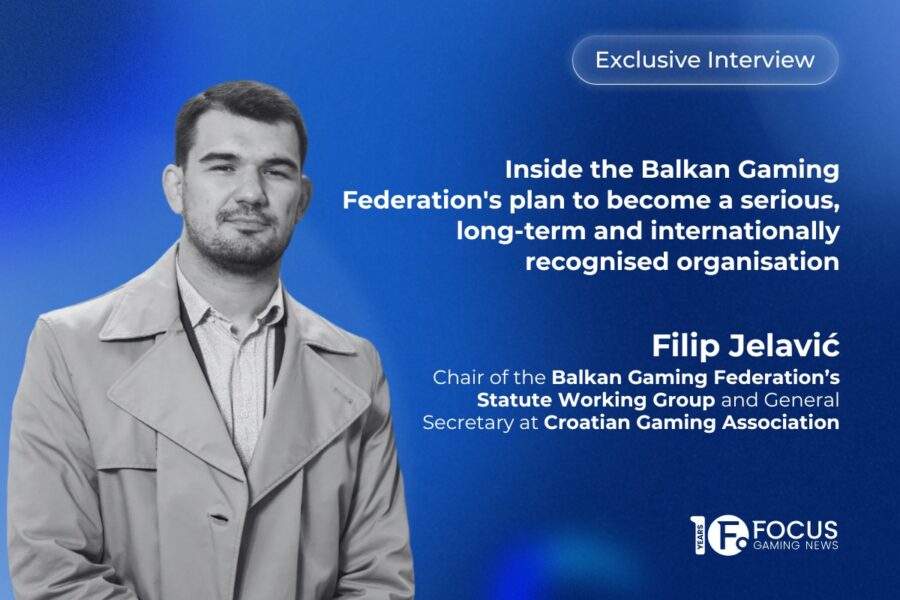

Filip Jelavić, Chair of the Balkan Gaming Federation’s Statute Working Group, spoke to Focus Gaming News about regional regulation and combating illegal gambling.
Exclusive interview.- The Balkan Gaming Federation (BGF) is entering a new phase of development following the decision to establish its permanent seat in Croatia, a move designed to strengthen regional cooperation and provide a formal platform for dialogue between industry stakeholders, regulators and policymakers.
In this exclusive interview with Focus Gaming News, Filip Jelavić, chair of the BGF Statute Working Group and general secretary of the Croatian Gaming Association, discusses the Federation’s long-term vision, the growing challenge posed by illegal gambling across the Balkans, and the importance of coordinated regional action. He also shares insights into the Federation’s upcoming initiatives, including its first industry awards and a major round table focused on combating unlicensed operators.
The BGF has now formally chosen Croatia as its seat. What does that choice signal about the direction and ambitions of the organisation, and what does having a permanent base mean in practical terms for how BGF will operate?
The decision to establish the Federation in Croatia sends a clear message that BGF intends to become a serious, long-term and internationally recognised organisation.
Croatia offers a stable legal framework, a developed regulated market, strong industry representation and close links with European stakeholders through organisations such as EUROMAT. It is also home to numerous international operators, suppliers and payment providers active throughout the region.
In practical terms, having a permanent seat provides legal certainty, institutional continuity and a central point for coordination. It allows the Federation to move beyond informal cooperation and develop into a structured organisation capable of engaging with regulators, governments and European institutions on behalf of the region.
BGF is preparing a major round table bringing together Balkan regulators and the legal industry to address illegal gambling. What is the scale of the illegal market problem across the region today, and why is a coordinated Balkan response more effective than each country acting independently?
Illegal gambling is one of the most significant challenges facing regulated markets across the Balkans. While the exact size varies from country to country, the trend is consistent: illegal operators are becoming increasingly sophisticated and are targeting consumers across borders.
They use mirror websites, affiliate networks, social media advertising, crypto payments and other tools that make national enforcement increasingly difficult.
A coordinated regional response is more effective because illegal operators do not operate within national borders. The same brands, affiliates, payment channels and advertising methods often appear simultaneously across several Balkan countries. Sharing intelligence, enforcement experiences and best practices can significantly improve effectiveness while avoiding duplication of effort.
At the same time, regulators must recognise that excessive or poorly designed regulation can unintentionally strengthen the illegal market by pushing consumers away from licensed operators.
“Illegal gambling is one of the most significant challenges facing regulated markets across the Balkans.”
Filip Jelavić, chair of the BGF’s Statute Working Group.
Which examples and good practices has the BGF adopted from other regions in order to combat the illegal gambling market more effectively?
The Federation is closely following developments across Europe and other regulated markets.
A key lesson emerging internationally is that fighting illegal gambling requires a combination of measures rather than a single solution. Effective enforcement increasingly relies on cooperation between regulators, financial institutions, payment providers, technology platforms and licensed operators.
The most successful jurisdictions focus on three areas simultaneously: restricting access to illegal websites, disrupting payment flows and limiting illegal advertising.
Equally important is maintaining a regulatory framework that keeps consumers within the licensed market. Strong enforcement and strong channelisation must work together. Experience across Europe shows that enforcement alone cannot compensate for regulation that unintentionally drives players towards unlicensed alternatives.
“Experience across Europe shows that enforcement alone cannot compensate for regulation that unintentionally drives players towards unlicensed alternatives.”
Filip Jelavić, chair of the BGF’s Statute Working Group.
The Balkan region includes countries at very different stages of EU accession and regulatory development. How does BGF manage the diversity of its members while still presenting a coherent regional position?
The Federation recognises that different countries have different legal systems, levels of market maturity and regulatory priorities.
The objective is not to create identical policies across the region. Instead, BGF focuses on areas where interests overlap. Regardless of the regulatory framework, every market faces challenges related to illegal gambling, consumer protection, responsible gaming and sustainable regulation.
By concentrating on these common interests, the Federation can develop shared positions while fully respecting national differences. Diversity is not a weakness; it allows members to learn from each other’s successes and mistakes.
On November 24 in Sofia, BGF will present the first Balkan awards. What criteria will define who is recognised, and what message do you want those awards to send to the wider industry?
The awards are intended to recognise excellence, innovation, integrity and long-term contribution to the gaming industry.
The goal is not simply to reward commercial success, but also to highlight achievements in responsible gaming, compliance, technological innovation, consumer protection and industry development.
We want the awards to send a positive message that the regulated gaming sector is built on professionalism, innovation and responsibility. They should also showcase the significant expertise and talent that exists throughout the Balkan region.
What is your view of the regional industry landscape in the coming years, and what do you consider to be the main challenge that Balkan regulators will face in the future?
The region will continue to grow, but it will also face increasing regulatory and technological challenges.
The main challenge for regulators will be finding the right balance between consumer protection and market sustainability. Protecting players is essential, but regulation must also recognise the reality of an increasingly digital and borderless market.
The greatest risk is not insufficient regulation, but ineffective regulation. Measures that are not evidence-based can reduce channelisation and strengthen illegal operators.
In my view, the future success of Balkan markets will depend on the ability of regulators and industry stakeholders to work together, adapt to technological developments and maintain a competitive legal market that remains more attractive than the illegal alternative.
By Focus Gaming News Editorial Team