Dragan Skrbić, AGOS: “The Balkans now have much more serious weight as an industrial region”
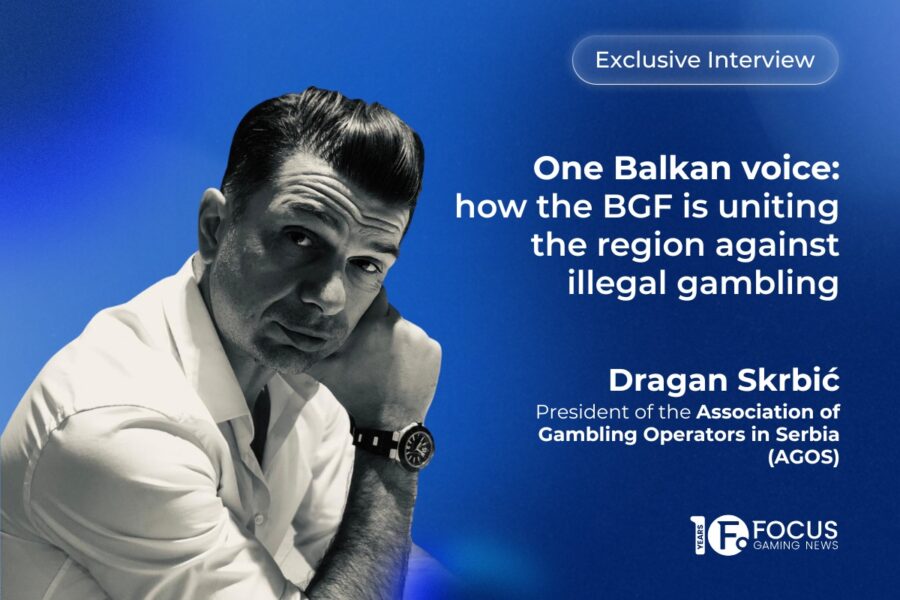
Focus Gaming News conducted an exclusive interview with Dragan Skrbić, AGOS president, to discuss the creation of the Balkan Gaming Federation and the regional fight against illegal gambling.
Exclusive interview.- The Balkan gaming industry is entering a new phase of regional cooperation with the creation of the Balkan Gaming Federation (BGF), an organisation designed to strengthen dialogue, share expertise, and address common challenges across Southeast Europe. Bringing together national industry associations from across the region, the Federation aims to provide a unified platform for tackling issues such as illegal gambling, regulatory development, responsible gaming, and market sustainability while preserving the unique characteristics of each national market.
In this exclusive interview with Focus Gaming News, Dragan Skrbić, president of the Association of Gambling Operators in Serbia (AGOS) and one of the driving forces behind the initiative, discusses the origins of the BGF, the challenges of building a common regional voice, and the Federation’s long-term vision for the industry. He also shares his perspective on the growing importance of cross-border cooperation, the balance between regulation and market competitiveness, and how the Balkans can position themselves as a stronger and more influential gaming region both within Europe and beyond.
How did the idea for creating BGF first emerge, and was there a specific moment or reason that led you to decide that the region needed a common structure instead of each association continuing to act independently?
The idea for the BGF came from a simple observation: although the Balkan markets have their own national specificities, many of the challenges facing the gaming industry are regional in nature. Issues such as regulation, responsible gaming, illegal operators, technology, compliance standards and market development do not stop at national borders.
This idea did not appear suddenly. Some of the associations that today form the foundation of BGF, AGOS, AOGGAB, HUPIS and ROMSLOT already knew each other, communicated actively and had a common connection through EUROMAT. This created trust and an understanding that many of the topics we discuss at the national level also have wider regional significance.
For many years, individual associations worked effectively within their own countries, but there was no common platform through which the region could exchange experience, coordinate positions and present a stronger common voice. This need became increasingly clear as the industry developed and regulatory discussions became more complex.
At the same time, the Balkans now have much more serious weight as an industrial region. There are strong local companies with international presence, major investments, international operators, manufacturers, suppliers, technology businesses, casino resort projects and important B2B events in different countries. This shows that the region is no longer peripheral, but that this energy needs better coordination and clearer representation.
That is why the creation of BGF was not aimed at replacing national associations, but at building an additional level of cooperation, a structure through which the region can speak together on issues of common importance.
You hosted the first two meetings of all member associations. What do you remember from those meetings and why were they so important?
Those first meetings were important because they turned an idea into a real organisation. Bringing together representatives from different countries meant building trust, understanding different perspectives and defining common priorities.
The first meeting in Belgrade, when the Memorandum of Cooperation was signed, gave official form to a process that had already been developing gradually through communication between the associations. Representatives of associations from Serbia, Bulgaria, Croatia, Romania, Montenegro, Bosnia and Herzegovina and North Macedonia sat at the same table. It was a strong signal that the region was ready to think in a more organised way and to build a common platform for the legal gaming industry.
What stood out was the open nature of the discussions. Although each association represented its own market and had its own challenges, there was a clear understanding that cooperation would be useful for everyone.
There was also a very human element in those meetings. In the Balkans, institutional dialogue does not begin only with documents, positions and formal procedures. Very often, personal trust has to be built first, to see how people think, how they react, how they speak about their problems and how ready they are to look for a common direction. In this sense, Balkan markets are close not only in terms of challenges, but also in terms of communication, emotion and feeling for the industry. This helped the conversation to be open and much more practical.
The second meeting was even more practical. The conversation was already focused on how BGF should function in reality: the future statute, working principles, registration, governance, common positions and the first specific topics where the Federation could be useful.
The importance of those meetings was that they laid the foundation for dialogue. Before common positions can be created, there must first be a space where people can openly exchange experience and understand the realities in which others operate.
Those meetings showed one more important thing: BGF should not be only a formal structure. The Federation should have a practical role, supporting associations in serious regulatory challenges, helping the exchange of experience and creating formats for broader regional dialogue.
“Those first meetings were important because they turned an idea into a real organisation.”
Dragan Skrbić, president of the AGOS.
What were the main challenges in aligning the different visions, interests and priorities of the associations from the Balkans?
The biggest challenge was to take into account that, although the region has many similarities, the markets are not the same. Each country has a different regulatory framework, a different level of market development, a different political environment and a different structure of the industry.
In some countries, the leading issues are taxes, licensing regimes or restrictions on the legal sector. In others, the focus is on the illegal market, public pressure, advertising rules or insufficient predictability of legislative changes. That is why it was important not to look for a mechanical model that would be the same for everyone.
The key was to find common ground without removing the individuality of each association. BGF was not established to impose a single model on all markets, but to identify the topics where cooperation creates value.
The process required patience, dialogue and a willingness to look beyond national interests, with a focus on long-term regional development. The most important thing was to preserve the role of each national association while at the same time building a mechanism through which, on common regional topics, we can speak more strongly and in a more coordinated way.
“BGF was not established to impose a single model on all markets, but to identify the topics where cooperation creates value.”
Dragan Skrbić, president of the AGOS.
From a regulatory point of view, which topics most strongly require regional coordination in the Balkans?
Several areas require stronger regional coordination. These include the fight against illegal gambling, the exchange of good regulatory practices, responsible gaming standards, consumer protection, digital transformation and the development of sustainable regulatory frameworks.
Illegal operators are one of the clearest examples, because they often operate across borders, while regulators and associations traditionally work at the national level. A coordinated approach allows markets to exchange knowledge and develop more effective responses.
Another very important issue is regulatory predictability. In the region, we often see legislative initiatives that can have a serious impact on the legal sector, investments, jobs and state revenues. When there is no sufficient impact assessment, there is a risk that the legal market will be weakened while the illegal market becomes more attractive to consumers.
There is also a serious opportunity for cooperation in harmonising professional standards and encouraging responsible growth of the industry.
This is why we have started working on the organisation of a roundtable with the participation of associations, regulators, institutions and experts. The idea is for topics such as illegal gambling, protection of the legal market and good regulatory practices to be discussed professionally, with specific examples from the region and with a focus on solutions that can work in practice.
How do you see the relationship between BGF and EUROMAT developing in practice, and what can one Balkan voice achieve at the regional level that cannot be achieved only through the European framework?
EUROMAT has an important role as the representative voice of the European gaming and amusement industry, and cooperation with EUROMAT is extremely valuable. BGF complements this work by focusing specifically on the realities and challenges of the Balkan region.
For us, the connection with EUROMAT is natural, because some of the associations in BGF are already part of that European dialogue. It is also important that representatives of associations from the region have active functions and participate in the work of EUROMAT, including through HUPIS and ROMSLOT. This creates an even stronger link between the European level and the realities of the Balkan markets. That is why BGF should not be seen as an alternative to EUROMAT, but as a regional platform that can bring the European conversation closer to the specific challenges in the region.
Balkan markets have certain common characteristics: similar stages of development, comparable regulatory challenges and a shared regional dynamic. A specialised regional platform allows these topics to be discussed in greater depth.
One Balkan voice can bring regional experience into broader European discussions, while at the same time ensuring that European processes are understood and adapted to the realities of local markets.
This is important because the region has its own regulatory specificity and practical challenges. BGF can help present these realities in a more concentrated and understandable way, both to European partners and to national institutions.
The fight against illegal gambling is the most clearly defined priority of BGF. However, the experience of more mature regulated markets shows that law enforcement alone is rarely sufficient and that channelling consumers toward the legal market improves only when the legal product is genuinely more attractive than the illegal alternative. In the case of Serbia, what is the right balance between pressure on illegal operators and product or regulatory improvements that make the regulated market the obvious choice?
The fight against illegal gambling requires a balanced approach. Strong law enforcement is essential because illegal operators undermine consumer protection, responsible gaming objectives and the integrity of the regulated market. However, law enforcement alone cannot solve the problem.
A successful regulated market must also provide a competitive, attractive and reliable environment for consumers. This means constantly improving regulation, encouraging innovation, ensuring that responsible gaming measures are effective and allowing licensed operators to offer products that meet consumer expectations.
For Serbia, this means preserving the competitiveness of the licensed market while the state simultaneously increases pressure on illegal operators. If the legal market becomes too restricted, the consumer will not disappear. They may simply move toward illegal alternatives that offer no protection, follow no rules and do not contribute to the budget.
The goal should be a market in which consumers naturally choose regulated operators because they offer greater security, transparency and quality. This balance is important not only for Serbia, but for the entire region, because any excessive or wrongly targeted regulation can create similar effects in other markets as well.
What impact do you expect BGF to have on the professionalisation and modernisation of the sector in the region?
The long-term goal of BGF is to help the industry develop in a more coordinated and professional way. By bringing associations together, exchanging knowledge and encouraging good practices, the Federation can support higher standards across the entire region.
Modern gaming markets require expertise in areas such as technology, compliance, cybersecurity, responsible gaming and consumer protection. Cooperation allows the region to learn faster and avoid repeating mistakes made in other markets.
BGF can help make this process more structured through the exchange of expertise between associations, better coordination on common topics and the development of clearer professional standards in the region.
Ultimately, BGF should contribute to building a more mature industry: better regulated, more transparent and recognised as a responsible part of the broader entertainment economy.
The goal is for the modernisation of the sector not to happen in isolation in each country, but through better exchange of knowledge, experience and good practices between the markets in the region.
By Focus Gaming News Editorial Team“The long-term goal of BGF is to help the industry develop in a more coordinated and professional way.”
Dragan Skrbić, president of the AGOS.