Lazar Agatonovich, Amusnet: “Every year, our goal is to come up with something new and trendy that sets us apart from the competition”
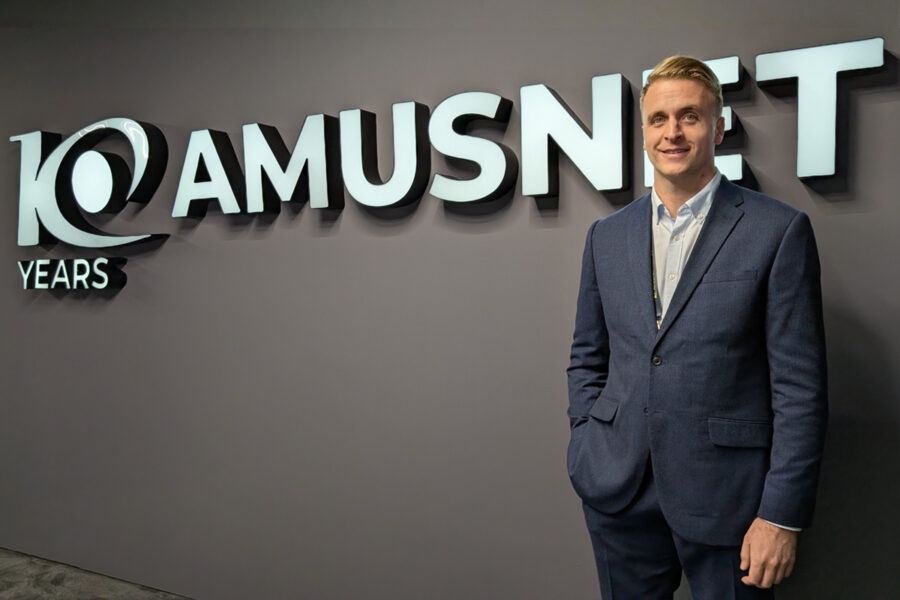

Lazar Agatonovich, CTO at Amusnet, spoke with Focus Gaming News about the company’s modular technology vision, the role of AI in personalisation and strategies for scaling in regulated markets.
Exclusive interview.- For years, ICE has provided the perfect opportunity for companies to showcase their latest products and innovations, and to learn about the trends and topics that will dominate the industry’s agenda throughout the year.
Originally held in London, for the past two years it has been held in Barcelona. Amusnet was there, of course, and this time celebrating its tenth anniversary. During the event, Focus Gaming News spoke with Lazar Agatonovich, Amusnet’s CTO, to learn more about the company’s technological vision, its advances in incorporating AI into daily tasks, and its new developments. Agatonovich also discussed how Amusnet is refining UX, engagement, and responsible gaming through real-time data, predictive tools, and rapid iteration, while preparing the platform for the next stage of its technological evolution.
What is Amusnet’s current technology vision, and how do you ensure your platform can scale as markets and operator needs grow?
Well, it’s actually our tenth birthday. For ten years, we have continued to innovate and improve. Every year, our goal is to come up with something new and trendy that sets us apart from the competition. Our vision is to always stay at the forefront of lateral and vertical industry movements by catering for the needs of players and operators.
We have had to overcome quite a few challenges in the last couple of years. Our strategy is to be as flexible as possible. This is why our platform and architecture are modular. It is made up of small monoliths, which are horizontally scalable, enabling us to cater for commercial and product needs while remaining compliant and available in markets with different types of regulations.
We operate in over thirty regulated markets and have a portfolio of 2,000 clients. We are looking forward to and working towards scaling the cloud computing hybrid approach in our setup.
“Our strategy is to be as flexible as possible.”
Lazar Agatonovich, CTO at Amusnet.
How are AI, data analytics, game engines, and bonus platforms influencing the way Amusnet develops and personalises its games today?
At Amusnet, we basically handle AI from two perspectives. The first is operational and does not directly affect the player experience, but it helps us a lot with our internal organisation, allowing us to focus on real player personalisation.
Most of our operations at Amusnet are already covered by AI. Processes such as those traditionally handled by HR are now delegated to AI. Internal communication between departments and the product development cycle is also handled with the help of AI.
In answer to your question, AI affects the player experience by enabling us to engage with players more effectively through a player tracking system. One implementation is a player behaviour tracking system, which allows us to personalise the content we serve through our lobby to the end user. That’s one thing.
The other thing is that we are basically combining and using the same patterns to collect and process data through different models in order to suggest hints on player behaviour to our B2B clients and operators. This goes hand-in-hand with monitoring responsible gaming and tracking player behaviour.
But in the context of moving from B2B to B2C, we are basically using the same dataset with different models to offer users different ways to engage with the game. These ways are not related to the RNG or gaming itself, but rather involve special bonuses or small distractions on the left or right of the screen to encourage more or less engagement, depending on the user’s behaviour. If they are spending too much or not engaging enough, this is where we currently use AI for commercial purposes.
“AI affects the player experience by enabling us to engage with players more effectively through a player tracking system.”
Lazar Agatonovich, CTO at Amusnet.
So, we have around 80 per cent AI in the back office, behind the scenes, and unfortunately—or perhaps fortunately—we are still making small moves when it comes to AI usage in the business itself. Of course, the plan for the future is to move in this direction more, and we’ll come up with some… Next time we speak, though, you’ll probably hear something new.
How does Amusnet manage security, fairness, and regulatory compliance across multiple jurisdictions without slowing innovation?
What we have improved quite a bit in the last couple of years is actually that exact segment: the security and compliance segment. We have a completely separate team of colleagues who cater for all the different markets and certifications. We are constantly searching for new laboratories and companies—our partners—who can help us test our system.
We carry out weekly, monthly and quarterly scans, which are mandatory and completely independent of the expectations of the laboratories and regulators. We do these just for our own safety. Then, of course, there is the standard process that all game providers have to go through, which we cater for: the standard process of certification and licence renewal.
In this particular case, I forgot to mention previously that AI is also fine from an operational perspective. We also use different AI approaches to orchestrate and scale our defence mechanisms. Of course, most things are delegated to the cloud, but we have our own particular implementation that tracks different lateral moves of potentially malicious player behaviour. For example, reverse bets, especially in the live casino segment.
Our anti-fraud system is heavily supported by AI because it is our own in-house development, which keeps both our company and all our clients safe while catering for compliance and certification needs. There is nothing to be disrupted or endangered, though.
So far, it’s been a smooth process. We have invested quite a lot, and increasingly, we are delegating more and more to technology and less and less to manual work, as was traditionally done in our industry.
How does technology help Amusnet improve UX, personalisation, engagement, and responsible gaming at the same time?
Actually, we’re going back to the second question — or rather, my answer. We have a small platform that we developed for player behaviour and tracking. Over the last year and a half, we have made significant changes to our UX and UI.
We completely decomposed the gaming segments — the game itself, the animation, the sound and all the elements that attract the player — and the functional components, such as buttons, odometers for jackpot banners, sound toggles and help sections. We have 100 per cent accurate tracking of all these elements. This allows us to see how players engage with our game and what they do. The only thing we don’t have is an eye-tracking mechanism, because we don’t have a camera. But we can track everything else.
Using the real-time data processing ETL (extract, transform, load) process for player behaviour, we can spot what our next move should be, combined with A/B testing. We can see if we should remove some things, move them to the left or right, and so on.
The way we do it is because we know that, unfortunately, quite a few jurisdictions do not allow us to do revolutionary work in a matter of days. We de-componentised our whole layout so that we can deliver things on the very next day, once we see that the mass behaviour has changed from yesterday to today. We also have components that we know, due to regulations, move slowly. We can make minimal or no changes to them, but still manage to compensate for things we want or achieve things we saw would be beneficial.
There is a bit of AI there, too. We are now experimenting with a small prediction engine that wouldn’t work with historical data, but would base decisions on it to offer players a new experience every time they visit our engine.
We are heavily regulated. We have quite a few fights in certain markets. We would like to offer more in those markets. Hopefully, either those markets will become more accommodating in the future, or we will find a way to achieve our goals without changing anything.
By Focus Gaming News Editorial Team