Jenny Arnell, Fast Track: “We want to grow team members from within to become leaders”
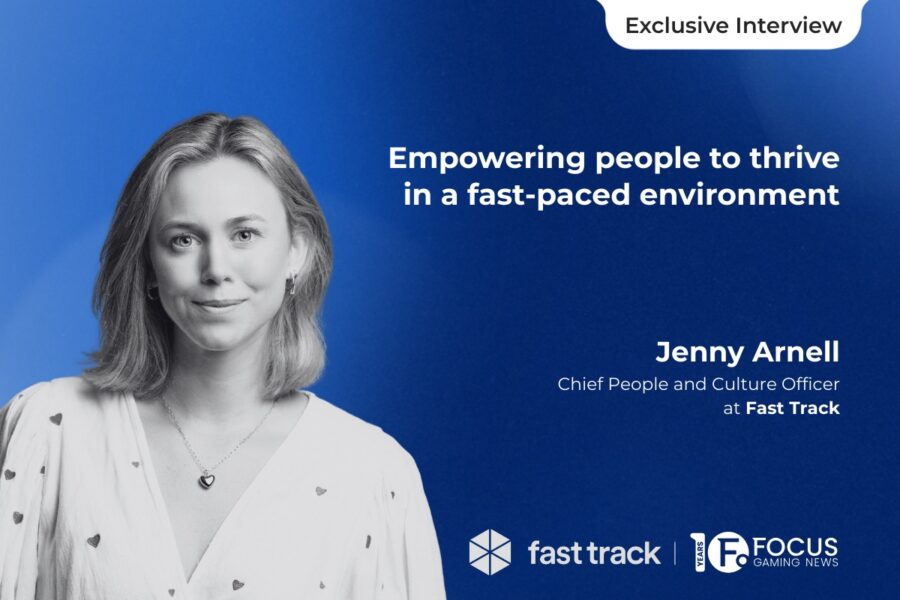

Focus Gaming News spoke with Jenny Arnell, Chief People and Culture Officer at Fast Track, to discuss the company’s recent “Best Workplace” recognition and its strategy for scaling organisational culture.
Exclusive interview.- As the igaming industry continues to scale at pace, people, culture, and leadership are increasingly recognised as critical drivers of long-term success. At Fast Track, this evolution is reflected not only in how the company builds technology, but in how it builds teams, develops leaders, and measures what it truly means to be a great place to work.
In this interview with Focus Gaming News, Jenny Arnell, chief people and culture officer at Fast Track, discusses the shift beyond traditional HR, Fast Track’s approach to scaling culture alongside rapid growth, and the thinking behind its four consecutive “Best Workplace” recognitions. She also shares insights on leadership development, cross-team collaboration in a multi-office environment, and the skills and mindset Fast Track believes will define high-performing organisations in the years ahead.
Let’s begin with your role at Fast Track. You’re the chief people and culture officer. We have a C-suite function here dealing with humans and taking care of personnel. How does it feel to carry that responsibility in this new era at Fast Track?
Exciting and meaningful. Having a Chief People and Culture Officer at a C-suite level says something important about a company: that people and culture are not an add-on, but a true priority.
When I joined five years ago, I had one clear objective: to understand what makes Fast Track special from the employee’s perspective, and how we could protect that as we scale. I spent a lot of time listening across the organisation, and it became clear very quickly that what sets Fast Track apart is our people and the culture we’ve built together. Since then, my focus has been on strengthening that foundation and making it scalable.
Your tenure seems to coincide with four consecutive “Best Workplace” wins, right?
I believe in “what gets measured gets done”, so we introduced this measurement intentionally in my second year with Fast Track when we had set ourselves the long-term ambition: not just to be a good employer, but to become a truly world-class one.
To do that, we needed to define what “world-class” actually means in practice and in a way we could measure consistently. That led us to the Great Place to Work survey. We introduced it in 2022, and since then we’ve been committed to doing the work behind the certification, not just celebrating the outcome.
And that measurement also ties into the 91 per cent Trust Index, doesn’t it?
Absolutely. Great Place to Work certification requires a Trust Index score of 70 per cent, which already signals a strong workplace environment.
But we wanted to aim higher. Internally, we set our benchmark at 89 per cent to reflect what “world-class” would mean for us. Last year we targeted 90 per cent, and I was both proud and honestly a little surprised when we reached 91 per cent. It’s a powerful reflection of the current trust and connection within the organisation, and something we never want to take for granted.
As companies get bigger, it’s hard to hold on to these values. How do you keep that small team feel, that personal feel, as Fast Track continues to expand?
I do not think our goal is to preserve a “small team feel” in the literal sense, because growth requires evolution. What matters more is making sure the organisation grows with the business, in a way that stays true to our values.
Trying to hold on too tightly to what worked in the early days can actually become limiting. Just like people evolve over time, organisations must evolve too. As Fast Track scales, the culture naturally shifts: from a start-up that can feel like a family, to a scale-up that feels more like a community. Our job is to stay intentional: to cherish what made us strong in the beginning, while also building what we need to succeed at scale.
Something you’ve referred to before is that leadership is from within. Could you go a little further into that for me?
When we can, we want to grow leaders from within Fast Track. We believe leadership becomes more impactful when it is grounded in context. People who have been part of the journey carry deep understanding of how we operate, what matters here, and how our culture works in practice.
So when team members have the ambition and the qualities to lead, we want to invest in that potential. It is incredibly valuable, both for continuity and for culture, when future leaders already have a strong connection to the people, the vision, and the realities of the organisation. And of course, it is also incredibly rewarding to see people grow their careers here over time.
Looking ahead, which skill sets do you believe will be most important for new hires in the future?
A strong sense of self-responsibility, not just for your own growth, but for the growth of the people around you and the organisation as a whole. In fast-moving companies, things evolve constantly, and to thrive in that environment, you need both agility and a genuine willingness to keep learning.
Equally important is having a “team-first” mindset. This is not an environment where individual performance matters more than collective progress. The people who succeed here tend to be those who contribute on behalf of the team, with humility, curiosity, and low ego. That combination: ownership, adaptability, and collaboration, becomes increasingly critical as the organisation scales.
Can you share a concrete example of how collaboration across teams actually works in practice?
At the core, we build software for the gaming industry, and we care deeply about the experience our partners have when they use it. That partner experience is shaped by many different touchpoints, and each touchpoint is owned by different teams across the organisation.
For example, one team might build the product, another supports implementation, another works closely with partners to help them grow, and another is responsible for commercial outcomes. But the key is that we are collectively accountable for the full experience, and that naturally demands strong collaboration across functions.
A more tangible example is how we work with shared goals and milestones throughout the year. We operate through structured progress cycles where we prioritise what matters most for the business at that point in time. The owners and collaborators for those goals and milestones often come from different departments and different offices, which builds cross-functional collaboration into how we deliver outcomes day to day.
Well, and it’s not just here; you’ve got offices in Spain, offices in Stockholm, all these people coming together, you can imagine that it’s very easy for culture to shift. How do you go about holding them together as a cohesive team?
We try to embrace the reality that different offices will naturally develop their own subcultures, and we see that as a strength, not a threat. Different perspectives, backgrounds, and ways of working add richness to the organisation, just like diversity does when we hire people with different experiences and strengths.
At the same time, we are intentional about creating shared connection points. We meet regularly as an organisation through weekly touchpoints and company-wide meetings. Our goal-setting structure also encourages cross-collaboration across both teams and locations. And we also make sure we come together in person, because there is something uniquely powerful about being in the same physical space.
Last year we gathered in Malta for our Growth Summit in August, and it was an incredible experience. It reinforced connection, energy, and alignment in a way that is hard to replicate remotely.
And you’ll be doing that again this year?
That’s the plan, yes.
Looking five years ahead, what would you like people to say about Fast Track and its journey?
I would love for team members to look back on this period as one of the most rewarding chapters in their careers – a time when they felt part of something meaningful, connected to a community, and genuinely able to make a difference.
I hope that people will feel they grew here, both professionally and personally, and that they gained experiences and skills they carry with them long after. And ideally, in five years time, I would love for many of them to feel just as excited about their future at Fast Track as they do today. That would be the dream.
By Focus Gaming News Editorial Team