

Botswana Parliament passes Gambling Bill containing 21-to-18 gambling age change
Botswana’s National Assembly has passed the Gambling (Amendment) Bill, 2026, with Clause 2 retaining the proposed reduction of the minimum gambling age from 21 to 18, alongside wider reforms.
Botswana.- Botswana’s National Assembly has passed the Gambling (Amendment) Bill, 2026, which contains a proposal to reduce the minimum gambling age from 21 to 18. The 18-year threshold is now part of the Bill passed by Parliament. Once enacted, the Gambling (Amendment) Act, 2026 will come into operation on a date appointed by the Minister through an Order published in the Gazette.
The Bill was passed at Third Reading on August 13, 2026, with 23 members present: 20 voting in favour, one against, one abstaining and one not voting. The official Hansard records: “Bill read a third time and passed.”
The proposed age change was a key point of contention during Committee Stage. On August 12, Chobe MP Simasiku Oscar Mapulanga challenged the reduction, arguing that the existing 21-year threshold should be retained. Okavango West MP K. Kapinga also argued that the provision changing the gambling age from 21 to 18 should be removed.
The Government defended the change by arguing that the laws should be aligned with the Constitution and should be enforceable. Labour and Home Affairs Minister Maj. Gen. Mokgware said: “Do not have legislations which you cannot enforce, it is dangerous.” Clause 2 contains the Bill’s proposed change to the gambling age from 21 to 18. When Committee Stage resumed on August 13, the Hansard recorded: “Amendment negated.” “Clause 2 agreed to.”
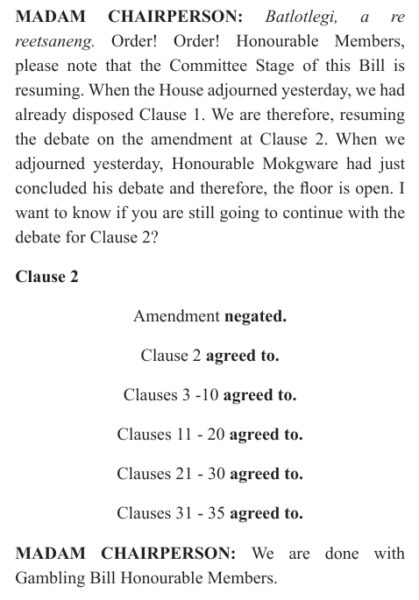
The remaining clauses were then agreed to before the Bill proceeded to Third Reading. The 20-1 vote at Third Reading was on the Bill as a whole, rather than a separately recorded vote on the gambling-age provision. The later Bill text provides for “the age of 21” to be replaced with “the age of 18.”
Wider gambling reforms
The Bill’s memorandum says the reform seeks to align the Gambling Authority Act with the Financial Intelligence Act and Financial Action Task Force (FATF) standards, with the aim of reducing financial-crime risks. It covers beneficial ownership, financial offences, financial interests, fit-and-proper requirements, controlling interests and know-your-customer requirements.
The Bill also broadens the licensing framework and introduces provisions covering gambling establishments and amusement arcades. It tightens ownership and control requirements, with relevant owners, directors, shareholders, beneficial owners, managers, key employees and holders of controlling interests subject to fit-and-proper requirements.
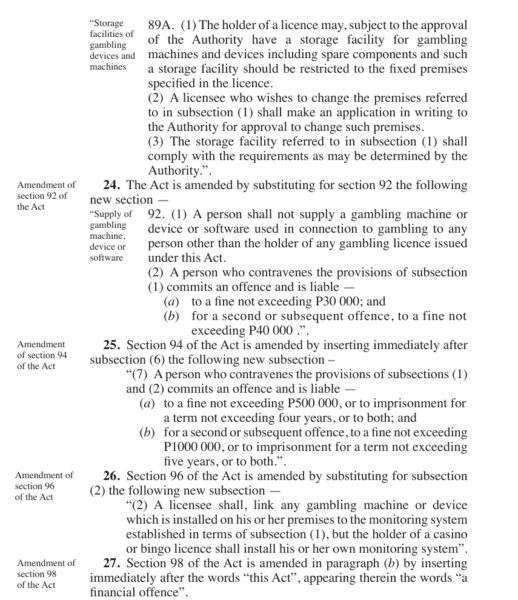
Financial offences are brought directly into licensing decisions, with the Bill providing for refusal of a licence where an applicant has been convicted of a financial offence. The legislation also strengthens monitoring of gambling equipment. Licensees must link gambling machines or devices installed on their premises to the monitoring system, while casino and bingo licence holders must install their own monitoring systems.
The Bill introduces regulation of amusement arcades, requiring registration with the Authority. Liquor-bar licence holders are exempt from registering an amusement arcade licence for darts, table football, snooker and pool, but betting on the outcome of those games is prohibited.
The Bill also provides for penalties of up to P500,000 (US$37,386), rising to P1m (US$74,772) for a second or subsequent offence, alongside possible prison terms.
Parliament has separately reported that the Botswana Institute for Development Policy Analysis (BIDPA) briefed the Parliamentary Committee on Finance, Trade and Economic Development on the Bill’s alignment with the Financial Intelligence Act and FATF standards and measures to reduce financial-crime risks.
The Bill’s commencement provision states that the resulting Gambling (Amendment) Act, 2026 will come into operation “on such date as the Minister may, by Order published in the Gazette, appoint.” The documents establish that the National Assembly has passed the Bill, but do not establish presidential assent or publication of the commencement order.