



What makes a true C-level leader in igaming? insights from Marina Zapolskaya (Talentgrator) & Tatiana Zinchenko (Slotegrator)
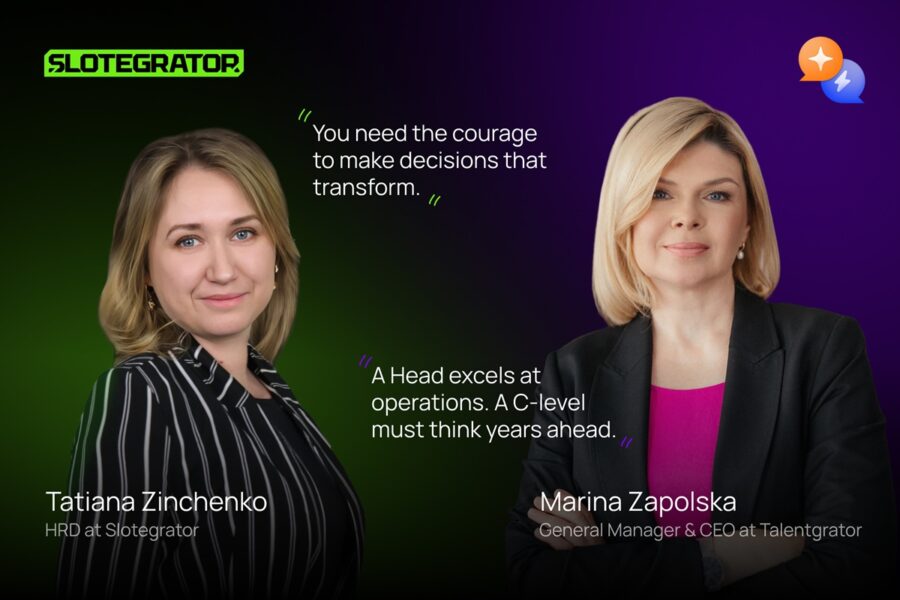

Marina Zapolskaya and Tatiana Zinchenko share what really sets C-level leaders in the igaming industry apart. They look beyond titles to what actually defines an executive leader: owning the strategy, having an impact across departments, and being fully responsible for the business.
Interview.- In this interview with C-lvl Media, Marina Zapolskaya, general manager and CEO at Talentgrator, and Tatiana Zinchenko, HRD at Slotegrator, share their perspectives on what truly defines a C-level leader in the igaming industry. Drawing on their extensive experience in recruitment across all levels, both experts offer a practical view of what companies are really looking for when hiring senior leadership.
Throughout the conversation, Zapolskaya and Zinchenko explore the key differences between a department head and a C-level executive, the skills and results candidates must demonstrate to reach the C-suite, and how hiring processes for these roles work in practice. They also discuss how the expectations for C-level leaders are evolving, and what factors will shape leadership requirements in the igaming sector over the next two years.
Where do you draw the line between a strong Head and a C-level executive in igaming? What qualities must a candidate possess for you to consider them a C-level executive rather than a strong leader of a specific function?
Marina Zapolskaya: For me, the distinction is clear and practical. A Head is responsible for the results of their function. A C-level executive is responsible for the sustainability and growth of the business as a whole.
A strong Head possesses deep expertise within their area: risk, compliance, technology, product, payments, marketing, or sales. They manage processes, teams, and metrics, and do everything they can to strengthen their department.
C-level is on a whole different scale. It involves strategic thinking and responsibility for the overall P&L. It’s the ability to see the big picture, understand the dynamics of key metrics, and anticipate where they’re headed. C-levels may not be the best analysts when it comes to the details, but they know exactly which numbers determine the fate of the business and what needs to be presented to the board of directors. They manage the expectations of the board, investors, regulators, and key partners.
A C-level executive knows how to manage trade-offs between functions when product, risk, compliance, sales, tech, and finance are pulling in different directions. They build a system rather than win an argument; they build cross-functional teams rather than just strengthening their own area. This is beyond providing strong leadership in one area; it involves managing the business as a holistic entity.
What competencies do Head-level executives most often lack before moving up to the C-suite?
Marina Zapolskaya: A strong Head often runs into a bottleneck not in terms of knowledge, but in the scope of their thinking.
The first risk area is strategic vision and commercial responsibility. A Head excels at operations, quickly solves problems, and puts out fires. But a C-level executive must think years ahead. Not “how to close the month/quarter,” but “where is the company headed, and what will happen to margins, licensing, and the market in 18 months?”
The second is a lack of experience in cross-functional leadership. A Head manages their team. C-level leadership synchronises the product, traffic, commerce, technical team, and finance.
The third is working with the board and investors. Many managers have never defended a strategy to owners, explained why the budget needs to be increased, or justified the risk. But at the C-suite level, it’s a daily practice—knowing how to find the words that interest investors.
“A C-level executive must think years ahead”
Marina Zapolskaya, general manager & CEO at Talentgrator.
What specific business results must a candidate demonstrate to qualify for a C-level position?
Tatiana Zinchenko: Specific business results are the first thing I look for. But for me, it’s not just about the numbers themselves — it’s about how the candidate talks about them. They should discuss completed processes in the past tense. Not “I know how to scale teams,” but “I grew a team from 40 to 120 people — and here’s how the metrics changed.”
Numbers are only half the story. The logic is more important: why did it work, what decision led to it, and at what point? If a candidate can’t build that chain of events, that’s a red flag for me.
I also look at: entering new geographies, restructuring an inefficient organisation, and growing without losing control. This shows whether a person can work in complex conditions, not just in comfortable ones.
Another key indicator is the maturity of the role itself. A C-level executive thinks in terms of systems, not tasks. They look beyond the current quarter to a two- or three-year horizon. And here I look at how the candidate made decisions under uncertainty: did they take responsibility when data was scarce, and — just as important to me — can they openly discuss their mistakes? This isn’t evident from their words, but from how their narrative is structured.
And finally, one result that I consider underrated but fundamentally important: has the candidate groomed a successor? This isn’t about loyalty to the company. It’s about the scale of their thinking. A leader who builds a system that depends solely on him is a risk, not an asset. A true C-level executive builds in such a way that things are no worse without him. And if he can name a specific person whom he has developed to his level, that is one of the strongest signals of maturity.
How critical is industry-specific experience, specifically in igaming? In which C-level roles are you willing to consider candidates from other industries, and in which areas does a lack of igaming background become a critical risk to the business?
Marina Zapolskaya: I know the market has rigid opinions on this, but I’m more open.
At the C-level, we’re talking about a strategic leader and process architect — someone who understands how teams, systems, and responsibilities work. And that, by and large, isn’t specific to any one industry. A strong leader knows how to build structures in fintech, high-risk sectors, and IT.
Yes, related industries — especially high-risk and tech — are preferred. There’s already an understanding of regulation, banks, risks, and complex infrastructure.
The truth is that many igaming companies still require industry experience. From the perspective of networking, reputation, market understanding, and achieving commercial goals, this makes sense. Quick access to partners, knowledge of the region, and personal contacts—these accelerate results.
But if you look deeper, C-level competencies are largely transferable.
Products are becoming more data-driven. Regulators and banks today focus more on a candidate’s professional background, governance, and transparency than on whether they can spell the word “casino” correctly.
Roles where igaming experience is not required: CFO, CTO, CHRO, CMO
At the same time, a lack of igaming background becomes a real risk for the CPO, Chief Compliance Officer, Chief Risk Officer, and Chief Payments Officer.
How does your C-level hiring process work in practice?
Marina Zapolskaya: It doesn’t start with a request. And it doesn’t end with an offer.
The process of working with candidates for roles that are strategically important to our clients — and C-level positions fall into this category — never stops. It’s an ongoing effort, not a reaction to a job opening.
That’s the advantage of Talentgrator. We don’t “turn on the search” when an order comes in. The dialogue is already underway.
We connect at industry trade shows. And on LinkedIn, we don’t just connect; we comment on each other’s posts, discuss the market, and see how people think and make decisions. This allows us to understand a person before the formal interview.
Networking within the industry is extremely helpful when candidates approach us on their own, saying, “I’m starting to look around.”
And when a client comes to us with a specific request — for a CCO, for example — the formal part of the process begins. First comes networking, but not in a cold market; rather, with relevant contacts with whom we already have an established relationship.
Then comes the standard executive approach:
- Screening based on track record and business context—it’s important to understand the company’s stage and whether the candidate’s scale is a good fit.
- An interview with the CEO or founder.
- Meetings with key stakeholders: CFO, CTO, Product.
- References, often informal.
- A final decision at the owner or board level.
It’s rarely just “two interviews and an offer.”
And yes, it’s a candidate’s market. Especially where igaming competes with fintech and high-risk sectors for the same talent. That’s why systematic, ongoing engagement with C-level executives is no longer an advantage — it’s a necessity.
How do you mitigate the risk of costly hiring mistakes for C-level positions? What do you scrutinise most closely: reputation, references, case studies, management style, cultural fit, or something else?
Tatiana Zinchenko: A mistake at the C-level isn’t just about replacing a person. It’s a loss of time, team, and sometimes even reputation and market share. That’s why we have a clear verification process in place that prevents us from making this decision based on intuition alone.
We start with in-depth background checks — three to five sources, and not just those named by the candidate themselves. It’s important to understand how the person behaved in difficult situations, how they made unpopular decisions, and how they managed relationships with the team under pressure. Recommendations from “friendly” contacts don’t paint this picture.
At the same time, we analyse management style. Micromanagement is a “red flag.” A leader who cannot delegate or build a system will hold the company back rather than scale it. This is assessed through behavioural questions: how the team was built, who made decisions, and what happened in the leader’s absence.
We also assess cultural fit separately. A person may be a brilliant professional, but if their values clash with the company’s culture, sooner or later this will create a rift—and the cost of that rift is very high.
And most importantly, how the candidate talks about their failures. This is the only question for which it’s impossible to prepare the “right” answer in advance. A mature leader doesn’t shift the blame to external circumstances. He says, “Here’s what I did wrong. Here’s what it cost me. Here’s what I learned.” If I hear exactly that, I understand that I’m dealing with someone who can be entrusted with a significant level of responsibility. If not, no numbers can make up for it.
“A mistake at the C-level isn’t just about replacing a person. It’s a loss of time, team, and sometimes even reputation and market share.”
Tatiana Zinchenko, HRD at Slotegrator.
Why are you willing to pay C-level executives above market rates? What value does the candidate actually bring to justify such a high offer?
Tatiana Zinchenko: A C-level executive isn’t just a position — they’re a business multiplier. They operate differently. They make decisions that trigger a chain reaction: their strategy impacts multiple areas at once, their team works more efficiently, and the business grows faster than it would without them.
Many people can think in broad terms. Only a few are capable of translating that into concrete changes within the business without losing momentum or getting bogged down in details. It is precisely these people who drive the company forward, rather than merely managing it.
At the C-level, you need the courage to make decisions that transform the company — not incrementally, but structurally. You need to make decisions that are uncomfortable and unpopular, yet necessary. You need the willingness to take on this responsibility and bear the consequences if something goes wrong. In my opinion, that certainly justifies paying above market rates.
And when you look at compensation through this lens, the question of whether it’s expensive or not becomes irrelevant. Compensation ceases to be an expense — it’s an investment.
How will the requirements for C-level executives in igaming change over the next two years? Which factors will have the greatest impact on business needs: regulation, new GEOs, AI, increased competition, cost pressure, or team effectiveness?
Marina Zapolskaya: I am confident that requirements will become stricter and more specific. It is no longer about status and experience in general, but about demonstrable managerial maturity.
1. Understanding regulation as part of the operational model
Regulation is no longer the domain of lawyers but is becoming part of day-to-day business management. C-level executives will be expected to have a systematic understanding of how requirements are integrated into the product, processes, and technology. This means understanding data flows, reporting, experience with B2C platform certifications, and interacting with regulators at the process architecture level. It’s not enough to know the rules—you need to be able to build a system that complies with them.
2. Experience in complex regions
Expanding into new geographies requires practice, not theory. Real-world experience in launching and scaling operations in specific countries will be valued, as will the ability to work with local banks and payment providers, manage risks in an unstable regulatory environment, and maintain commercial sustainability.
3. Experience in business transformation and restructuring
Companies are consolidating and revising their management models. C-level executives are expected to have experience with structural changes: restructuring teams, standardising processes, centralising functions, and managing distributed structures. It is important not only to initiate changes but also to see them through to completion without losing momentum or control.
4. Reputation as a factor in role eligibility
C-level executives are increasingly viewed not only through the eyes of owners, but also through those of banks, regulators, and partners. When making appointment decisions, they will scrutinise career trajectories, decision-making patterns, public statements, and professional stances more closely. What you write, what you say, the projects you’ve been involved in, and what the market says about you. This is no longer just a selection by the board of directors—it is a vetting by financial institutions and regulatory bodies.
Tatiana Zinchenko: The industry is maturing, and the demands placed on its leaders are maturing alongside it.
AI and automation (how could we not mention AI?) will cease to be a competitive advantage and will become the norm. Demands for transparency in regulation, finance, and the management of people and processes will increase. Against this backdrop, the demand for emotionally mature leaders will surge, because the pace of change isn’t slowing down, meaning resilience and the ability to make decisions in the face of uncertainty will become critically important.
Today, a C-level executive in igaming is no longer just a strategist; they are a leader of strong leaders. A person who maintains a balance between numbers and people. A C-level executive embodies an inner readiness to live with the consequences of their decisions. And it is precisely this quality that, over the next two years, will distinguish those who merely hold a position from those who truly drive the business forward.
By Focus Gaming News Editorial Team“The industry is maturing, and the demands placed on its leaders are maturing alongside it.”
Tatiana Zinchenko, HRD at Slotegrator.