
Stephen Crystal, SCCG Management: “The UAE is, without exaggeration, the most strategically engineered market opening our industry has seen in a generation”

Stephen Crystal, Founder and CEO of SCCG Management, discusses the UAE gaming market, regulatory frameworks, and revenue projections reaching US$10bn by 2030.
Exclusive interview.- As the United Arab Emirates accelerates the rollout of its tightly controlled commercial gaming framework, the market is rapidly emerging as one of the most strategically significant opportunities in the global industry. Under the oversight of the General Commercial Gaming Regulatory Authority (GCGRA), the country is not following the typical path of gradual liberalisation, but instead deploying a deliberately engineered model defined by limited licences, premium positioning, and strict regulatory oversight from day one.
In this exclusive interview with Focus Gaming News, Stephen Crystal, founder and CEO of SCCG Management, offers a comprehensive strategic assessment of the UAE’s gaming trajectory. Drawing on decades of advisory experience, he explains why this market stands apart from other emerging jurisdictions, highlighting its state-led design, controlled pace of expansion, and the early validation provided by landmark developments such as Wynn’s integrated resort in Ras Al Khaimah and the launch of the country’s first licensed online operator.
How would you assess the current shape of the UAE gaming opportunity?
The UAE is, without exaggeration, the most strategically engineered market opening our industry has seen in a generation. This is not a jurisdiction reacting to tax pressure or political opportunism. It is a deliberate, state-led transition from total prohibition into a premium, highly controlled, regulated sector, and it is happening on a timeline the region’s policymakers are driving themselves. The federal regulator, the General Commercial Gaming Regulatory Authority (GCGRA), was stood up in September 2023 under experienced US leadership, with former MGM Resorts CEO Jim Murren as chairman. Founding CEO Kevin Mullally, a veteran of Gaming Laboratories International and the Missouri Gaming Commission, stepped down in November 2025, and Murren is now serving as interim CEO. Within roughly a year of the regulator’s formation, Wynn Resorts was awarded the country’s first commercial gaming facility licence, and Play971 was approved as the first licensed online operator. That is a remarkable pace for a market that was officially closed eighteen months earlier. What you have today is a small number of operator and vendor licences, a working regulator, and a population with strong demographics: over eleven million residents, an expatriate share near ninety per cent, and one of the highest per-capita income levels in the region. For the operators and suppliers already inside the perimeter, this is a rare window. For those waiting, the window narrows every quarter.
Your SCCG Research report describes the UAE as one of the world’s most important emerging gaming markets. What makes it different from other new regulated markets you have seen?
Most new markets open by liberalising: they move from grey to regulated, issue dozens of licences, and let competition sort it out. The UAE is doing the opposite. It is designing a premium, heavily controlled, limited-licence market patterned after its own playbook in finance, tourism and entertainment. The framework appears to be “one licence per emirate,” with Sharjah having opted out entirely. That is closer in spirit to Singapore or Monaco than to anything you see in Europe or the Americas. Three things make it genuinely distinctive. First, the regulator was populated with senior Western gaming expertise before the first license was issued, which is the inverse of how most new markets sequence things. Second, Emirati nationals are prohibited from participating entirely, so the addressable market is defined by expats and tourists. That is a constraint, but it is also what made political consensus possible. Third, the rollout is intentionally slow. Play971’s initial availability was limited to select emirates, and mobile distribution was deliberately delayed. The UAE is proving the model before it scales it. That is not a bug. That is the product.
“Most new markets open by liberalising: they move from grey to regulated, issue dozens of licences, and let competition sort it out. The UAE is doing the opposite.”
Stephen Crystal, founder and CEO of SCCG Management.
Play971’s launch and Wynn Al Marjan Island are often described as the first real markers of the market. How significant are those two projects in signalling where the UAE is heading?
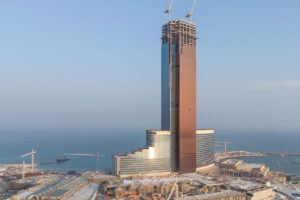
Both are the proof points that turn the UAE story from aspiration into market. Wynn Al Marjan Island is a US$5.1bn integrated resort in Ras Al Khaimah with a 20,900 square metre casino, 1,530 guest accommodations, and a spring 2027 opening. The main tower reached its topping out in December 2025, and construction is on schedule. That is real capital committed, real staff being hired, and a real signal to capital markets that this is a durable regulated environment. Play971 is the second proof point, and in some ways the more operationally interesting one. It is the first licensed online casino and sportsbook, operated by Momentum LLC, with OneTouch and Evolution supplying content, Sportradar for data, and Xpoint for geolocation, all inside strict age, geofencing and VPN controls. Together, they validate two different pillars: premium land-based tourism-led gaming and tightly controlled digital gaming for non-Emiratis. Either one on its own would be noteworthy. Both executed in parallel, under a regulator that is clearly pacing itself, is the blueprint. Every subsequent decision by MGM, by content providers, by investors, will be made against those two reference points.
You have argued that the UAE could reach annual gaming revenues of US$6-10bn by 2030 under the right conditions. What assumptions sit behind that range?
Any credible forecast for the UAE has to sit on a few explicit assumptions, and I want to be direct about ours. Our expansive scenario of US$8-10bn annual GGR by 2030 assumes three things. First, multiple integrated resorts open across the major emirates, not just Wynn in Ras Al Khaimah. MGM Resorts has been publicly pursuing a UAE license, originally associated with Abu Dhabi and more recently linked to Dubai, and that process, while slow, is active. Second, the online framework scales beyond Play971 into a mature, regulated igaming and sports betting vertical, with additional licensees and full mobile distribution. Third, and this is the assumption most often overlooked, the UAE continues to succeed as a destination. Ras Al Khaimah is targeting 3.5 million visitors by 2030, and Wynn’s own investor materials project a 26.8 per cent visitor CAGR from 2024 through 2030. For context, the Las Vegas Strip produced US$8.8bn in gross gaming revenue in 2024, and Wynn CEO Craig Billings has cited analyst ranges of US$5-8bn for the UAE. Even our mid-range scenario would put the UAE in the same conversation as Singapore. If any of those three assumptions slip, we fall back toward our mid-range US$5-6bn outcome. A conservative path with one resort and limited online looks more like US$1.5-2bn. These are not forecasts for the sake of forecasts. They are the decision points operators should be tracking.
How do you see the balance between online gaming and land-based development playing out in the UAE over the next few years?
Through 2027, land-based is the headline and online is the quiet workhorse. Wynn Al Marjan will dominate the narrative when it opens, and rightly so. But operationally, digital is where the regulator has been most active and where most of the real enforcement infrastructure is being built: geolocation, age verification, AML, responsible gaming, and VPN blocking. Online is the sandbox for the compliance regime that eventually has to govern billions of dollars of land-based activity. From 2027 onward, I expect the balance to shift deliberately. Land-based GGR will arrive in a single concentrated wave, with Wynn being the only licensed casino for its first several years of operation. Online will continue scaling on its own more gradual curve, with additional operator licenses, broader distribution, and eventually full mobile. My expectation is that the steady-state UAE market ends up looking more balanced than Macau, where land-based overwhelmingly dominates, and closer to mature European regulated markets like the UK, where online has grown into a substantial share of total gaming GGR over time. The important point for operators: do not treat these as separate conversations. The same consumer protection, KYC and responsible gaming stack has to work across both, and the regulator is clearly designing it that way.
“Online is the sandbox for the compliance regime that eventually has to govern billions of dollars of land-based activity.”
Stephen Crystal, founder and CEO of SCCG Management.
From an advisory perspective, what mistakes do you think international operators are most likely to make when approaching the UAE?
Three, and I see all of them being made in real time. The first is treating the UAE like any other new market, assuming it will liberalise on a normal curve. It will not. The “one-licence-per-emirate” structure means operators are not competing for share; they are competing for exclusive territory rights, and losing a bid is not a setback you recover from next year. The second is underinvesting in local partnership. In markets like Singapore or Monaco, you do not win without a credible local principal. The UAE is no different. Operators showing up with a Las Vegas org chart and a regional business development manager are misreading the room. The third, and the costliest, is underestimating the compliance bar. The GCGRA was deliberately built with senior Western regulatory expertise, and the standards being set for age verification, geofencing, responsible gaming and vendor licensing are at or above the most mature jurisdictions. Operators, vendors and affiliates that are sloppy elsewhere will not survive early diligence here. The operators winning right now are the ones who arrived early, invested in relationships, and treated compliance as a product feature rather than a cost centre. That list is short, and it is not growing quickly.
“Operators showing up with a Las Vegas org chart and a regional business development manager are misreading the room.”
Stephen Crystal, founder and CEO of SCCG Management.
If the UAE market performs well, do you think other countries in the region could become more open to legal gaming in the future?
Yes, and I think the conversation is already quietly underway. The UAE has effectively de-risked the political, cultural and regulatory path for its neighbours by proving three things: that a Muslim-majority jurisdiction can stand up a world-class regulator, that a limited-license premium model works commercially, and that consumer protection frameworks can be designed to respect local norms, including the outright exclusion of nationals from participation where required. That is a meaningful template. The legalisation strategy has also been partially framed as a competitive response to tourism dynamics in the Gulf, particularly Saudi Arabia’s own ambitions under Vision 2030. The question is not whether others look at the UAE; it is whether they are prepared to move at the same pace. The UAE benefits from federal coordination, established Western investor relationships, and a regulator that is standing up under serious leadership. Not every neighbour has those conditions. My expectation is that over the next five to seven years, you will see at least one additional regulated market open in the broader region, most likely structured around tourism and integrated resorts rather than broad online liberalisation. For operators building regional strategy today, the UAE is the beachhead, not the endpoint.
If we revisit the UAE in five years, what would success look like to you from a market-structure and industry-development perspective?
Five years out, if the UAE has executed well, the picture is specific. You have three to four integrated resorts operating across different emirates, with Wynn as the anchor and MGM plus at least one other global operator having followed. You have a mature licensed online market with a handful of operators, deep content catalogues from the major suppliers already holding vendor licenses, Aristocrat, Light & Wonder, IGT, Konami and Sportradar among them, and a sports betting vertical that has matured through at least two World Cup cycles. You have annual GGR somewhere between US$6bn and US$10bn, putting the UAE market in the same conversation as the Las Vegas Strip, which produced US$8.8bn in 2024, and well ahead of Singapore’s roughly US$6bn. On the industry side, success looks like the UAE having become the de facto regulatory reference for any country in the MENA region considering legalisation. You see a local supplier and services ecosystem emerging, not just imported expertise. You see Emirati talent in senior gaming roles. And critically, you see a clean compliance record. No major enforcement scandals, no illicit-market leakage of scale, no reputational incidents. If those conditions hold, the UAE is not just a new market. It is the new model. That is what we are watching for.
By Focus Gaming News Editorial Team