

Arslan Malik: “The UAE’s real strength is that licensing and tax oversight can work together by design”
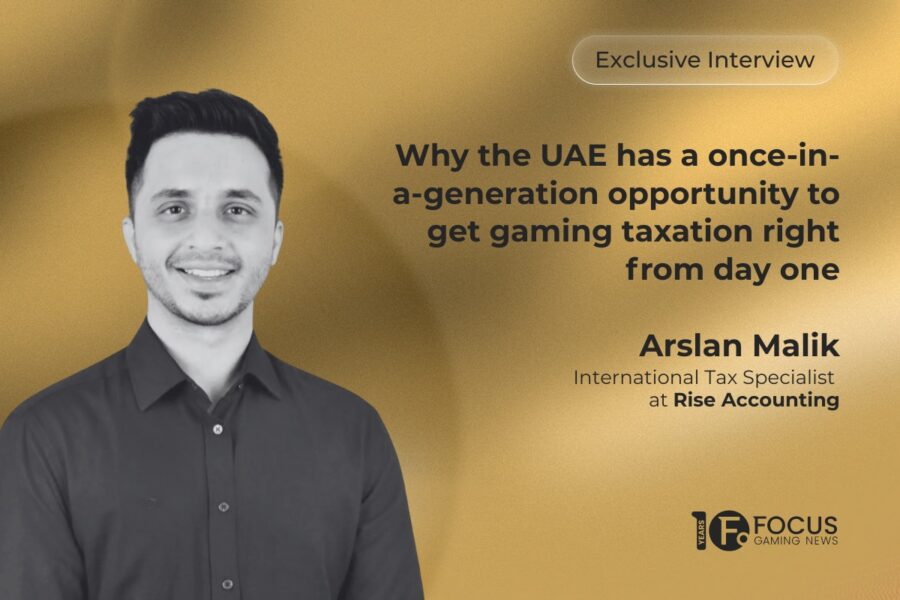

Focus Gaming News sat down with Rise Accounting international tax specialist Arslan Malik to discuss the tax and compliance considerations shaping the UAE’s emerging regulated gaming market.
Exclusive interview.- As the UAE’s regulated gaming market continues to evolve, attention is increasingly turning to the tax and compliance frameworks that will underpin the industry’s long-term growth. With licensed operators already active and major developments progressing towards launch, questions surrounding VAT treatment, regulatory certainty and investment planning are becoming increasingly important as the sector matures.
In an exclusive interview with Focus Gaming UAE, Arslan Malik, international tax specialist at Rise Accounting, an ACCA-qualified accountant and holder of a Master of Arts (Honours) degree specialising in international taxation, VAT and cross-border business structuring, shares his insights on the tax considerations shaping the UAE’s emerging gaming market. He discusses lessons from established gaming jurisdictions, the importance of early tax and VAT guidance, and why the UAE’s ability to align licensing and tax oversight from the outset presents a unique opportunity to build a coherent and investor-friendly framework for the sector’s future development. The interview builds on Malik’s recent analysis of how VAT treatment, regulatory developments and tax policy could shape the future of the UAE’s regulated gaming market.
The UAE has had the advantage of observing mature gaming jurisdictions before opening its own market. What key lessons from Europe and other established markets – particularly in relation to VAT treatment and regulatory approaches to gambling – are most important when designing a VAT framework for a newly regulated gaming sector?
The most valuable lesson from Europe is that the taxable base for gaming is a genuinely difficult technical question, and the jurisdictions that addressed it early fared best. The EU spent years before the Court of Justice working out what the “value of the supply” actually is when a player stakes money and a portion comes back as winnings. The position Europe arrived at – most clearly in the Glawe case – is that the base is the operator’s net retention rather than gross stakes. That is settled knowledge now, and it is available to any jurisdiction designing its framework today.
The dominant European response has been to treat gambling as VAT-exempt, with individual states given discretion over the conditions. Broadly, that economically similar games should be treated alike. The real advantage the UAE enjoys is timing: it is designing its approach with the full benefit of that experience, on what is effectively a blank page. That is a strong position to build from, and it allows the framework to be shaped deliberately and coherently from the outset.
With licensed platforms such as play971 and Truewin already active in the UAE market, how important is early tax clarity in helping operators structure pricing models, compliance systems and long-term investment decisions in a market that is still evolving in real time?
It is very important, and it is a natural and welcome part of a sector maturing this quickly. The technical reason is that VAT is calculated as a percentage of the taxable base, so the base needs to be well defined for the liability figure to be right. In a sector with thin margins and very high transaction volumes, even a small question on the base is one that operators want to get right from the start, because it scales across millions of transactions.
Ahead of formal sector-specific guidance, operators are working through three connected decisions. First, pricing – whether the 5 per cent sits inside the odds and the margin or is presented separately. Second, systems – how to configure VAT logic at invoice level. And third, investment – modelling returns for boards and shareholders. These are exactly the points where published guidance adds the most value, and operators will welcome it as the framework continues to develop. Early clarity helps the UAE consolidate its position as a credible, well-regulated international destination, which is plainly the direction of travel.
The timing is also shaped by the UAE’s move to e-invoicing, which is itself a sign of how rapidly the country is modernising its tax infrastructure. The Federal Tax Authority is introducing a structured e-invoicing regime – voluntary from July 2026 and mandatory for larger businesses from January 2027 – under which invoices are issued in a prescribed digital format and reported to the authority in near real time. This is a positive and forward-looking reform, and it makes the case for early sector guidance even stronger: as VAT treatment becomes embedded directly in transaction data, having a clear position to build systems around is something operators will value greatly. In practice, the e-invoicing timetable and sector guidance complement one another, and aligning the two is an opportunity to get the architecture right from day one.
As online gaming grows and is potentially classified as electronically supplied services, what practical challenges arise in enforcing VAT obligations on offshore operators serving UAE-based customers?
The most useful point here is that the UAE is well positioned to handle this, because its gaming sector is licensed and regulated from the outset. The electronically supplied services (ESS) classification can trigger a UAE registration and VAT obligation for an offshore operator providing services to UAE-resident players even without a physical presence here. Where this becomes practically interesting — for every jurisdiction, not just the UAE — is collection from operators based outside the jurisdiction, which is a long-standing feature of ESS regimes worldwide.
The UAE’s structural advantage is the link between licensing and tax. Because the gaming regulator licenses the market, tax compliance can be aligned with licensing, so an operator serving UAE players sits within a regulated perimeter rather than outside it. That is a stronger starting position than many established markets had, where tax authorities relied largely on payment intermediaries, marketplace and platform liability rules, and cross-border cooperation to reach offshore operators after the fact. The UAE has those tools available too, but its real strength is that licensing and tax oversight can work together by design. Coordinating those two levers is the opportunity, and it is one the UAE is well placed to take.
“The UAE’s structural advantage is the link between licensing and tax.”
Arslan Malik, international tax specialist at Rise Accounting.
As projects such as Wynn Al Marjan Island move closer to launch, what role does tax clarity, particularly around VAT treatment, play in supporting large-scale gaming and hospitality investment in the UAE?
For a large integrated resort, the most consequential VAT question is input recovery. A development of that scale incurs significant VAT on construction, fit-out, technology and procurement. If gaming supplies are ultimately treated as exempt, the VAT on costs attributable to the gaming activity is not recoverable and instead sits within the project’s cost base. That is a meaningful figure on a project of this size, and the value of clarity is that it can be modelled with confidence at the investment-decision stage.
There is also a mixed-use dimension. A resort combines gaming with hospitality, food and beverage, retail and entertainment, which carry different VAT treatments, so input tax is apportioned across exempt and taxable activities — a normal but important compliance exercise. Investors committing at this scale value the ability to model these mechanics precisely, and clear treatment supports exactly that. Tax clarity is therefore part of what makes a proposition of this ambition straightforward to underwrite, and it reinforces the UAE’s appeal to the kind of long-term, large-scale investment these projects represent.
As the UAE enters the next phase of gaming regulation, what are the most important priorities for VAT guidance to ensure consistency between regulatory intent and practical application across operators and suppliers?
The most useful first step would be a clear position on the treatment of gaming supplies – ideally exemption, in line with the established global norm. Certainty on the principle is itself highly valuable to the market.
It is worth being precise about what exemption means, because it is sometimes misunderstood. Exemption from VAT is not exemption from tax. The European model pairs VAT exemption with a separate, dedicated gambling duty levied on gross gaming revenue – the operator’s retention after winnings are paid out. The UK, Italy and the Netherlands all tax licensed gaming this way, with GGR-based rates broadly in the range of the low twenties to the high thirties in percentage terms; Germany takes a slightly different route, taxing certain online products on player stakes rather than retention. Whichever base is chosen, the structure separates the two questions cleanly: VAT steps aside, while a purpose-built levy captures the fiscal value of the activity. This is a well-tested model the UAE is well placed to adapt, and the GCGRA framework offers a natural home for such a levy.
Beyond the headline treatment, guidance is most helpful when it is consistent in two directions. Across verticals; online betting, casino gaming, lottery and slots have different revenue and prize models, and a coherent framework can address them together. And across the supply chain; since gaming-related vendors and suppliers operate in the standard-rated world, clarity on how exempt operators interact with their taxable suppliers, particularly on input recovery, is genuinely useful.
It would also be valuable for guidance to address the practical points that arise in any gaming market: complimentary and free bets, refunds, loyalty schemes, non-cash prizes and shared jackpot pools. Europe worked through these incrementally over many years. The UAE has the opportunity to address them together in a single, considered framework – another benefit of designing with the full picture in view.
In your analysis, you noted that the UAE VAT system was originally designed before gaming became a regulated activity. Which aspects of the current framework are most difficult to apply to licensed gaming operations in practice?
The VAT framework was developed at a time when commercial gaming was not part of the economy, so it was naturally designed around other sectors. That simply means the natural next step is sector-specific guidance to sit alongside the existing law, which is a familiar and expected pattern as any tax system extends to a new industry.
The most technically interesting area is the taxable base. The default rule standard-rates a supply of services at 5 per cent unless an exemption applies. Applied to gaming, the immediate question is what the value of the supply actually is, because the ordinary model assumes a clearly identifiable price paid for an identifiable service, and gaming has a different economic shape. This is precisely the question Europe worked through, so the analytical groundwork already exists to draw on.
The second area worth highlighting is online supply. Internet gaming may be classified as electronically supplied services (ESS) which affects both the rate and the registration position, including for offshore operators serving UAE players without a physical presence here. These are rules originally framed for digital services such as streaming and software and applying them thoughtfully to wagering is one of the areas where guidance will add real value.
Why does gaming challenge the traditional VAT concept of a taxable base, particularly when revenue is influenced by player incentives, probabilistic outcomes, and pooled prize structures that do not exist in standard digital service models?
Because the ordinary model assumes a fixed, knowable price exchanged for a service, and gaming has a different structure. A player stakes an amount, but a portion is returned as winnings determined by chance, so at the moment of the wager the operator’s actual retention is not yet fixed. The natural question is whether the base is the gross stake or the net amount kept after payouts. Europe addressed this in the Glawe case, concluding that the taxable amount excludes the statutorily mandated proportion of stakes paid back to players, so the base is the operator’s retention, a well-established answer that is available to draw on.
There are further features that distinguish gaming from a standard digital service. Free and complimentary bets involve a wager where no real consideration changes hands. Probabilistic outcomes mean the retained margin is best understood in aggregate over time rather than per transaction. And pooled prize structures such as jackpots are shared across operators or players differ from the simple case of one supplier receiving one identifiable amount. None of these features appears in a standard digital service, where the price is simply the price, which is why gaming is genuinely its own category and benefits from purpose-built treatment.
Your analysis highlights complexities around the treatment of complimentary and free bets, refunds, fraudulent transactions, bad debts, loyalty points, non-cash prizes, and jackpot pools shared across operators. Which of these areas is likely to create the most immediate practical challenges for operators in the UAE?
In the current launch phase, I would point to complimentary and free bets, and bonus play more broadly, as the most immediate. The reason is volume and timing. A market establishing itself is naturally acquisition-led – operators compete on promotions, free bets and welcome bonuses – so this is high-frequency activity across a large share of customers. The treatment of a wager placed with no real consideration is therefore one of the first things operators will want settled, simply because it touches so many early transactions.
By comparison, refunds, bad debts and fraudulent transactions tend to be more episodic, and shared jackpot pools – while structurally the most intricate to reason about – affect a narrower set of operators at this stage. All of these benefit from clear treatment, but free bets and bonuses sit at the intersection of high volume and frequent occurrence, which is where early clarity delivers the most practical value to operators today.
Even under a VAT-exempt model, operators would still absorb unrecoverable input VAT on infrastructure, staffing and technology. How does this affect cost planning and investment decisions for operators entering the UAE market?
This is an important and sometimes overlooked feature of exemption: it is not a one-directional benefit. Exemption removes the obligation to charge VAT on the output side, but it also means input VAT on the cost base – technology platforms, premises and fit-out, staffing, marketing and professional services – is not recoverable and instead sits within the operator’s margin. The effect is that VAT is still captured, simply embedded in the operator’s costs rather than at the point of the gaming supply, which means the fiscal cost of exemption to the public purse is narrower than it first appears.
For operators, whether exemption is favourable in practice depends on the ratio of input VAT exposure to revenue. A capital-intensive launch, with significant upfront spend on platforms, build-out and customer acquisition – carries higher input VAT, so this is a factor worth modelling carefully into cost planning and structuring from the outset rather than treated as an automatic saving. Understanding it properly is simply good planning, and it is one of the areas where sound advice and clear treatment help operators enter the market on a confident footing.
By Focus Gaming News Editorial Team