



Simone Vicentini: “Rather than simply replicating foreign models, Brazil developed its own regulatory system”
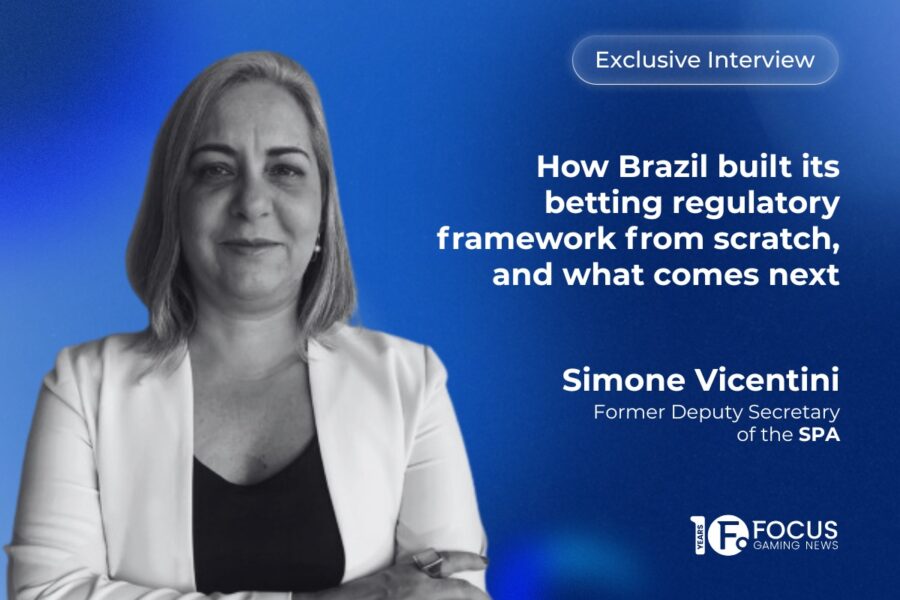
The former Deputy Secretary of Brazil’s Secretariat of Prizes and Betting (SPA) discusses the challenges of building the country’s regulatory framework, lessons learned from international markets, and the next steps in the fight against illegal gambling.
Exclusive interview.- As Brazil’s regulated igaming market completes its first full year of operation, the country continues to attract global attention as one of the industry’s most significant emerging jurisdictions. Few people witnessed the creation of the regulatory framework as closely as Simone Vicentini, former Deputy Secretary of the Secretariat of Prizes and Betting (SPA). In this exclusive interview with Focus Gaming News, Vicentini looks back on the process of building the market from the ground up, the priorities that shaped Brazil’s regulatory model, and the challenges that still lie ahead in the fight against the illegal sector.
Looking back to December 2023, when Law No. 14,790 was enacted, what was the actual situation of the betting market in Brazil? How would you describe the size and structure of the illegal market?
The year 2023 was decisive in enabling the implementation of Brazil’s regulated fixed-odds betting market. Although Law No. 14,790 was only enacted in December of that year, the work of building the regulatory framework had already begun months earlier and was intensified following the issuance of Provisional Measure No. 1,182 on 25 July 2023.
In this context, the Ministry of Finance began establishing the institutional and regulatory foundations necessary for the future opening of the regulated market. In October 2023, the first cornerstone regulation for the sector was published – Normative Ordinance MF No. 1,330 – which established the general guidelines for the industry, covering issues such as consumer protection, data protection, responsible gambling, and advertising. A prior expression of interest was also conducted, attracting more than 130 domestic and international companies, demonstrating the strong economic interest in the Brazilian market.
At the same time, work began on the development of SIGAP, the structuring of the future Secretariat of Prizes and Betting, and the drafting of the regulations that would form the 2024 Regulatory Agenda.
At that stage, however, there was no reliable and validated estimate of the market’s actual size. Since the enactment of Law No. 13,756/2018, the activity had been operating without specific regulation, which encouraged rapid and disorganised growth, without adequate mechanisms for state supervision, tax collection, or player protection. The creation of the regulatory framework was specifically intended to bring transparency, legal certainty, integrity, and effective control mechanisms to a sector that was already generating significant revenues in Brazil.
When the Secretariat of Prizes and Betting (SPA) was created in January 2024, what was the biggest immediate challenge that you and your team faced? Where did you start from?
The main challenge was time. Although much of the preparatory work was already underway when the SPA was formally established, there was still an enormous volume of tasks to be completed within an extremely tight timeframe.
As mentioned, the regulation of the sector began even before the Secretariat itself was created. A very lean team was already working on the development of the regulatory model, analysing international experiences and drafting the first regulations necessary to make the market launch possible.
We started with a comprehensive comparative study of the world’s leading regulated markets, identifying best practices, supervisory models, consumer protection mechanisms, and anti-money laundering frameworks. Based on those references, a regulatory model was developed that was compatible with Brazil’s reality and with the limits established by Law No. 14,790/2023.
At the same time, it was necessary to build a new administrative body virtually from scratch, which involved institutional, budgetary, technological, and human resources challenges. In little more than a year, it was necessary to regulate a complex sector, develop systems, define licensing requirements, establish inspection, and sanctioning mechanisms, and prepare the launch of the regulated market.
Given the scale of the task and the limited number of public servants available, the challenges were considerable. Nevertheless, it was possible to deliver, within the established timeline, a comprehensive and sufficiently robust regulatory framework that enabled the regulated market to begin operations on 1 January 2025.
Brazil went 78 years without gambling regulation. Was that an advantage or a disadvantage when building the regulatory framework? Were you able to learn from other countries, or did you have to invent everything from scratch?
From a regulatory perspective, the absence of regulation generally results in asymmetries, supervisory gaps, and weaknesses in consumer protection. The longer the period without state oversight, the greater the difficulty tends to be in understanding the true size of the market, mapping risks, and establishing effective control mechanisms.
On the other hand, Brazil had the opportunity to learn from the accumulated experience of several countries that had already faced similar challenges. Established regulatory models were analysed, including both their successes and shortcomings, with the aim of incorporating international best practices and adapting them to Brazil’s legal, economic, and social characteristics.
The result was the creation of a model that combines international references with home-grown solutions. Particularly in the areas of responsible gambling, consumer protection, bettor identification, transaction monitoring, and anti-money laundering, Brazilian regulation adopted requirements that are, in several respects, more stringent than those observed in some already established markets.
Therefore, rather than simply replicating foreign models, Brazil developed its own regulatory system, aligned with international trends and with the specific needs of the domestic market.
What were the regulatory pillars that you decided to prioritise from the outset? Why were player protection, responsible gambling and anti-money laundering measures treated as urgent matters?
Player protection has always been at the centre of the regulatory construction of Brazil’s fixed-odds betting market. The reason for this prioritisation is simple: from the very beginning, it was clear that the legitimacy and sustainability of the regulated market would depend on the ability to protect consumers and safeguard the integrity of the sector.
Betting involves inherent risks related to consumer behaviour, potential over-indebtedness, the misuse of the activity for illicit purposes, and information asymmetry between operators and bettors. For this reason, we believed that building a safe, transparent and trustworthy regulated environment should take precedence over any fiscal or economic objectives.
From the earliest regulations, efforts were made to ensure that the economic exploitation of the activity would be accompanied by effective user protection mechanisms, including responsible advertising rules, information obligations, compliance with the Consumer Protection Code, and adherence to the General Data Protection Law.
This approach was later strengthened through several regulatory acts. Among them, Ordinance SPA/MF No. 615 of April 2024 deserves special mention. It established rules for payment transactions and introduced important player protection measures, including the prohibition of credit cards and any post-paid instruments for betting activities, a measure aligned with international best practices aimed at preventing indebtedness and promoting responsible gambling.
Likewise, Ordinance SPA/MF No. 1,231 of July 2024 established detailed rules governing the rights and obligations of operators and bettors, identification and authentication procedures, responsible gambling mechanisms, reward programmes, registration requirements, and measures designed to prevent fraud and protect consumers.
With regard to anti-money laundering, counter-terrorist financing and related offences, Ordinance SPA/MF No. 1,143/2024 established a robust set of obligations concerning governance, risk assessment, customer identification, transaction monitoring, and suspicious activity reporting, incorporating internationally recognised practices aligned with standards adopted by specialist international organisations such as the Financial Action Task Force (FATF).
“Player protection has always been at the centre of the regulatory construction of Brazil’s fixed-odds betting market.”
Simone Vicentini, former deputy secretary of the SPA.
During the development of the Brazilian framework, which countries did you study as references?
The construction of the Brazilian model involved an extensive exercise in comparative regulatory analysis. Some of the world’s leading regulated jurisdictions were studied, with particular attention paid to the experiences of the United Kingdom, Spain, Denmark, Sweden, Italy, Germany, Malta, Colombia, and the various regulatory models adopted across the United States, as well as other international references relevant to the sector.
More than simply analysing legal texts, we sought to understand the practical results generated by each regulatory model. This process made it possible to incorporate international best practices, avoid problems identified in other jurisdictions, and develop a regulatory framework aligned with the most modern regulatory standards while remaining adapted to the legal, economic, and social particularities of the Brazilian market.
If you could go back to the beginning, in January 2024, is there anything you would have done differently in structuring the SPA or in the sequence of regulations that were introduced?
Every regulatory process is dynamic and naturally subject to improvement. Practical implementation always generates lessons that enable future adjustments and developments.
However, considering the circumstances that existed at the time, the legal deadlines available, the institutional structure then in place, and the need to make the opening of the regulated market possible in January 2025, I believe that the key decisions taken were appropriate and compatible with the challenges faced.
Naturally, some issues only become fully visible after the market begins operating in practice. That is precisely why modern regulation should be viewed as a continuous process of monitoring, evaluation, and improvement, rather than as a static or definitive construction.
What is the next major regulatory challenge for Brazil?
The main challenge over the coming years will be to consolidate the regulated market and increase its attractiveness in relation to the illegal market.
The existence of a robust regulatory framework is fundamental, but it is not sufficient on its own. The regulated environment must remain competitive, safe, and economically viable for both operators and consumers.
In this context, combating the illegal market will continue to be an indispensable condition for the success of Brazil’s regulatory model. This involves enforcement, institutional cooperation, blocking irregular operations, raising consumer awareness, and strengthening supervisory, inspection, and sanctioning mechanisms.
It will also be essential to strengthen the institutional capacity of the SPA by expanding technological resources, infrastructure, and staffing levels compatible with the size of the Brazilian market.
Furthermore, increasing player channelisation towards the regulated market will be crucial. International experience shows that combating the illegal market depends not only on enforcement but also on the ability to offer consumers a safe, attractive, and competitive environment. The greater the adoption of authorised platforms, the greater the gains in consumer protection, integrity, and regulatory effectiveness.
Another important challenge will be the continuous improvement of responsible gambling policies. The sector evolves rapidly, as do the risks associated with consumer behaviour, requiring constant monitoring and ongoing updates to protective measures.
Finally, preserving regulatory balance is essential. Consumer protection must remain a priority, but it should always be accompanied by evidence-based assessments. Not every restrictive measure necessarily produces better outcomes. The major challenge will be finding the right balance between protection, competitiveness, tax revenue generation, innovation, player channelisation towards the regulated market, and the long-term sustainability of the sector.
“The main challenge over the coming years will be to consolidate the regulated market and increase its attractiveness in relation to the illegal market.”
Simone Vicentini, former deputy secretary of the SPA.