Oleksandr Hloza, PIN-UP Partners: “In today’s market, the affiliate model is no longer about delivering users and stepping aside”
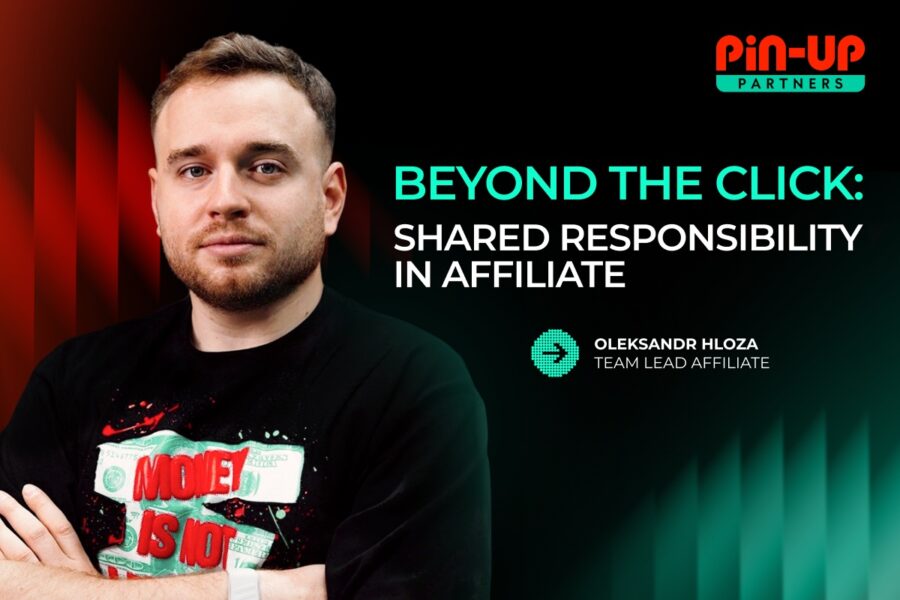

Oleksandr Hloza, Affiliate Team Lead at PIN-UP Partners, discusses how affiliate models have evolved and why deep collaboration is important for achieving long-term growth.
Exclusive interview.- For years, the affiliate model followed a simple formula: the affiliate brings the user, the advertiser handles the rest. But as markets mature and competition intensifies, that linear approach no longer guarantees sustainable growth.
Focus Gaming News spoke with Oleksandr Hloza, Affiliate Team Lead at PIN-UP Partners, about why the traditional model stopped working, where affiliate economics usually break down, and how deeper collaboration between teams has become the real driver of long-term scale.
The affiliate model used to be fairly straightforward: an affiliate brings the user, and the advertiser takes it from there. When did you realise that this was no longer enough, especially in complex GEOs?
To be honest, it became clear that this approach was insufficient not only in complex GEOs but almost everywhere.
If we look at the market realistically, traffic arbitrage is often treated as a fast way to generate revenue. Launch a bundle, get conversions, move on. But in the rush for short-term results, lower-quality traffic frequently enters the system. Misleading creatives, incentivised mechanics, elements of social engineering — these tactics can convert well at the top of the funnel, but they create long-term problems.
Retention drops. Reactivation becomes harder. Engagement weakens. LTV declines. Eventually, all sides feel the impact.
At PIN-UP Partners, we understood early on that if we stuck to the logic of “the partner delivered the user, everything else is not our responsibility,” scaling would hit a ceiling very quickly.
That’s why we started going deeper into our partners’ funnels. Before launch, we test applications, analyse user journeys, and review creatives. At times, partners were cautious — they worried we were trying to reverse-engineer their working bundles. But that was never the goal.
The goal is simple: identify risks early, optimise weak points, and prevent technical or structural issues before they affect the economics.
Because sustainable scale only comes from working with the right audience — and building a model that supports long-term value.
When the economics stop working, where do you usually find the problem — at the acquisition stage or after the user has already entered the funnel?
In most cases, the issue starts at acquisition.
Even when funnels are aligned in advance, there is always temptation to experiment with more aggressive creatives, especially during periods of moderation pressure, falling ROI, or technical limitations. Incentivised approaches may deliver short-term uplift, but they often damage user quality.
At PIN-UP Partners, we have a monitoring team that continuously tracks such practices through ad libraries and other analytical tools. When we identify problematic patterns, we don’t simply flag them — we return to partners with specific recommendations.
Short-term gains never compensate for long-term economic damage.
When the wrong audience enters the system, everything downstream becomes more expensive — retention, reactivation, support resources.
In these cases, what is usually the real bottleneck — acquisition itself or what happens after the click and registration?
Acquisition is typically the entry point of the problem.
It sets the tone for everything that follows. If users don’t stay, if activity stagnates, if the product doesn’t fully engage them, it usually traces back to how and why they entered the funnel.
But after that, responsibility becomes shared across teams.
We often reconstruct the entire user journey. We rebuild the funnel, form hypotheses about where friction may have occurred, validate them with data, and work on improvements. At scale, it becomes obvious that traffic alone cannot fix structural issues.
If the post-click logic is weak — if onboarding, communication, or segmentation doesn’t work — scaling quickly reaches a hard ceiling.
At what point do you realise a case goes beyond classic affiliate work and requires broader team involvement? Which teams typically join?
In reality, almost every serious scaling case goes beyond classic affiliate work.
As soon as the goal shifts from short-term uplift to sustainable growth, it becomes clear that a cross-functional approach is necessary.
Depending on the situation, we involve analytics, retention teams, anti-fraud specialists, product managers, and technical teams. Each of them sees a different part of the system.
Analytics evaluate behavioural patterns and cohort performance.
Retention teams assess lifecycle communication.
Anti-fraud ensures traffic integrity.
Product teams analyse onboarding friction and UX elements.
Only when these perspectives come together do we fully understand where the model is strong — and where its growth points lie. Affiliate management in 2026 is no longer a standalone function. It is a coordination hub between multiple disciplines.
“Affiliate management in 2026 is no longer a standalone function. It is a coordination hub between multiple disciplines.”
Oleksandr Hloza, Affiliate Team Lead at PIN-UP Partners.
How do relationships with partners evolve when you move towards this more involved model of collaboration?
I wouldn’t call it a more complicated model. I would call it a more responsible one.
The shift happens when both sides prioritise sustainable results over short-term uplifts. As cooperation deepens, transparency increases. There is more data exchange, more joint decision-making, and more trust.
Partners begin to see that PIN-UP Partners is not simply accepting traffic, but actively investing in the health of the overall model.
Over time, this creates stronger foundations for scaling. Commercial terms improve. Communication becomes more open. Strategic planning becomes more collaborative.
And most importantly, the economy becomes stable.
In today’s market, the affiliate model is no longer about delivering users and stepping aside. It is about building a shared system where acquisition, product, retention, and compliance operate as one structure.
That is what defines scalable affiliate partnerships in 2026.
By Focus Gaming News Editorial Team