


Japan’s integrated resorts: why Osaka’s MGM casino matters for 2027 licences

Focus Gaming News examines Japan’s decision to legalise integrated resorts with gaming facilities, the progress made so far and what lies ahead.
Key takeaways:
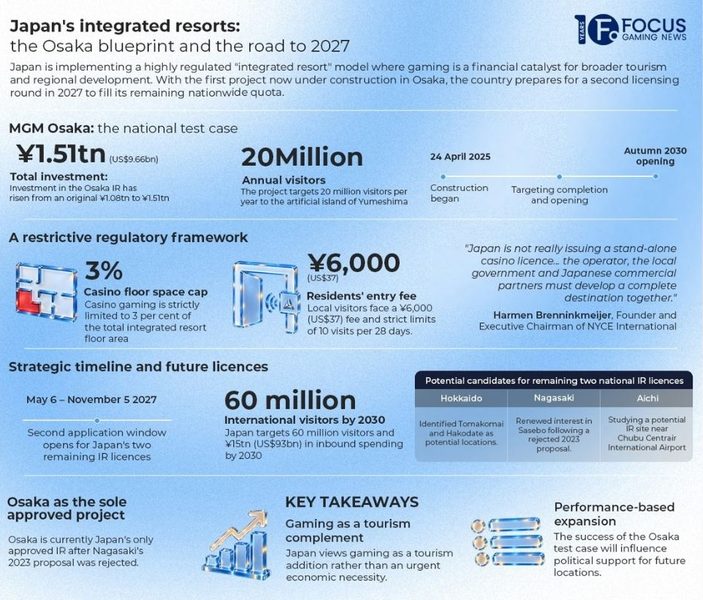
- Osaka is Japan’s only approved IR: under construction since April 2025, targeting an autumn 2030 opening and around 20 million visitors a year.
- Investment has grown sharply: from an original ¥1.08tn (US$6.71bn) plan to around ¥1.51tn (US$9.66bn).
- Strict caps define the market: three IR licences nationwide, with casino floor space capped at 3 per cent per resort.
- Two licences remain: a second application window runs May 6–November 5, 2027, with Hokkaido, Nagasaki and Aichi seen as likely bidders.
- Tourism objective: Japan targets 60 million international visitors and ¥15tn (US$93bn) in inbound spending by 2030.
Japan is putting its tightly controlled casino model to the test as construction advances on its first integrated resort in Osaka. MGM Osaka is expected to demonstrate whether the country’s strategy of using gaming to support tourism and regional development can deliver the results needed to build support for further IRs.
Special report.- Japan’s first integrated resort (IR) is under construction on the artificial island of Yumeshima in Osaka Bay, led by MGM Resorts International and Orix Corporation, in a project whose investment cost has grown to about ¥1.51tn (US$9.66bn). Construction began on April 24, 2025 and MGM Osaka is targeting an autumn 2030 opening, with capacity for around 20 million visitors a year. Japan’s framework caps casino gaming at 3 per cent of an integrated resort’s floor area and limits the country to three IR licences nationwide, of which two remain unassigned; a second application window for those licences will run from May 6 to November 5, 2027, with Hokkaido, Nagasaki and Aichi among the prefectures expected to bid.
This is the sixth in a series of special articles analysing how the gambling industry has evolved over the past decade, the challenges it has faced and what the future holds. In this special report, Focus Gaming News examines Japan’s long road to legalising casinos through IRs: why the government adopted a cautious, phased approach, how Osaka became the country’s first approved project, what progress MGM Osaka has made towards its 2030 opening, and what the 2027 application round means for the two licences still available.
Why did Japan decide to legalise casinos through integrated resorts?
Japan’s decision to legalise casinos was intended to boost tourism and stimulate regional economic growth. Almost a decade after the country established the legal framework for integrated resorts, the first project is under construction in Osaka, while a second application round is scheduled for 2027.
For decades, casinos were prohibited in Japan, even as the country maintained a substantial domestic gaming culture through pachinko, lotteries and regulated public sports wagering. The turning point came in December 2016, when Japan enacted the Act on Promotion of Development of Specified Integrated Resort Districts, establishing the policy framework for integrated resorts.
The decisive step followed in July 2018, when the Diet passed the Act on Development of Specified Integrated Resort Districts. The legislation created the detailed legal and regulatory framework for privately operated casinos within large-scale tourism developments.
Harmen Brenninkmeijer, founder and executive chairman of NYCE International and a global technology and gaming entrepreneur, believes this distinction was fundamental to making casino legislation politically viable. “I think Japan stopped looking at this as simply legalising casinos. The discussion became much broader. It was about tourism, investment, conventions, entertainment and regional development,” he said.
According to Brenninkmeijer, the experience of other Asian markets, particularly Singapore, helped demonstrate how gaming could support a wider tourism destination. “Japan was seeing the success of integrated resorts elsewhere in Asia. In particular, Singapore demonstrated that gaming could help finance a much larger tourism destination,” he said.
Meanwhile, Shaun McCamley, founder and managing partner of Euro Pacific Asia Consulting Ltd (EPA), reaches a similar conclusion. “The fundamental change was that Japan stopped looking at casinos as standalone gambling venues and began viewing integrated resorts as instruments of tourism, regional development and economic policy,” he said.
The distinction became the foundation of Japan’s IR strategy: the casino would generate revenue, but the resort itself would be judged by its contribution to tourism, conventions, entertainment and regional development.
What is Japan’s regulatory framework for casinos?
The Japan Casino Regulatory Commission (JCRC) was established on January 7, 2020, as an external bureau of the Cabinet Office. Its mandate includes licensing and supervising casino operators, investigating the integrity of operators and related stakeholders, enforcing casino regulations and implementing measures to prevent gambling addiction. The regulatory framework is considerably more restrictive than that of many established casino markets.
Japan capped the number of IR districts at three nationwide, with one casino facility permitted in each IR. The casino gaming area cannot exceed 3 per cent of the total floor area of the IR facility.
Japanese residents are also subject to strict entry controls:
- a ¥6,000 (US$37) admission fee
- casino visits limited to three times within seven consecutive days and 10 times within 28 days
- identification checks and self- and family-exclusion measures
For Brenninkmeijer, limiting the number of locations was as much about public confidence as economics. “Japan wanted to start carefully. There was still considerable public concern about addiction, organised crime and the social impact of casinos,” he said.
Brenninkmeijer added: “Limiting the market to three locations made it easier to regulate and easier to explain politically. It also created scarcity. That encouraged operators to propose very large, high-quality developments rather than smaller casinos across the country.”
McCamley similarly views the three-IR ceiling as both a political safeguard and a strategic choice. “Politically, it reassured the public that casinos would not spread rapidly across the country. It allowed the government to frame the policy as a controlled national experiment involving a small number of exceptional tourism projects rather than the widespread liberalisation of gambling,” he said.
How does Japan’s IR licensing model differ from other markets?
In Las Vegas or Macau, gaming is typically at the centre of the commercial proposition. Japan has attempted to reverse that relationship: the resort comes first, with gaming operating as its financial catalyst.
Under the Japanese system, local governments must work with private-sector operators to develop and submit an IR district development plan. The facilities must incorporate hotels, convention and exhibition space, entertainment, retail and tourism-related functions alongside the casino.
Brenninkmeijer describes the system as closer to a long-term public-private partnership than a conventional casino concession. “Japan is not really issuing a stand-alone casino licence. The operator, the local government and Japanese commercial partners must develop a complete destination together,” he said.
“The casino is only one very small part of the project, percentage-wise (3 per cent of the total floor area) but obviously the driver.”
McCamley makes the same comparison with established gaming markets. “Japan’s model is considerably more prescriptive and government-led.” And, he argues, Japan is attempting to avoid the evolution seen in other markets, where destinations were initially built around gaming and later diversified. “Japan is attempting to design the diversified destination from the beginning, with gaming deliberately contained within it,” McCamley said.
That philosophy is reflected in the government’s own description of IR policy: Japan seeks to create internationally competitive, stay-based tourism destinations while addressing the concerns associated with casinos.
MGM Osaka, Japan’s first approved IR
Once the framework began to take shape, competition emerged among Japanese cities and prefectures seeking to host the country’s first IR. Potential locations included Hokkaido, Tokyo, Yokohama, Osaka, Wakayama and Nagasaki. Hokkaido, Yokohama and Wakayama ultimately withdrew from the first round, leaving Osaka and Nagasaki to submit formal applications in April 2022.
Osaka proposed an IR on Yumeshima, an artificial island in Osaka Bay, with MGM Resorts International and Orix Corporation leading the private consortium. Nagasaki, meanwhile, submitted a proposal for Sasebo in partnership with Casinos Austria International Japan.
The first application process demonstrated both the scale of the opportunity and the difficulty of satisfying Japan’s requirements.
Nagasaki’s proposed IR was valued at approximately ¥438.3 billion, but concerns emerged around financing and the project’s implementation capacity. The national government eventually rejected the proposal in December 2023, leaving Osaka as the sole approved project. The decision effectively transformed Osaka from one candidate among several into the test case for Japan’s entire IR policy.
What is the status of the MGM Osaka project?
On April 14, 2023, the Japanese government formally approved Osaka’s IR district development plan, making it the country’s first approved integrated resort with a casino. The resort is being developed on Yumeshima by Osaka IR Corporation, backed by MGM Resorts International and Orix, together with Japanese partners.
The original plan envisioned a development costing around JPY1.08tn, although the project’s investment scale subsequently increased. The project’s investment cost has since risen to approximately JPY1.51tn (US$9.66bn), according to MGM Osaka Corp.
The resort is expected to include hotels, an international convention and exhibition centre, restaurants, retail, entertainment facilities and a casino.
The casino will occupy no more than 3 per cent of the IR’s total floor area, in line with national regulations. The project is also designed to attract approximately 20 million visitors annually, with international visitors forming an important part of its tourism proposition.
The government subsequently approved the implementation agreement between Osaka Prefecture and Osaka IR Corporation in September 2023, moving the project another step closer to construction. Then, on April 24, 2025, construction officially began. MGM Osaka is now targeting an autumn 2030 opening, with construction scheduled to run through the summer of that year.
Brenninkmeijer said: “I think the Osaka project will set the direction. When it opens, people will stop debating the theory and start looking at the actual results. They will look at visitor numbers, convention business, employment, tax revenue and the impact on the surrounding area. They will also watch the responsible-gaming measures very closely.”
Brenninkmeijer believes Japan arrived late but that the delay provided an opportunity to learn from the experience of other jurisdictions. “Japan can study Singapore, Macau, South Korea and other markets. It has been able to observe what has worked well and what has not.”
McCamley similarly argues that Japan is late, but not necessarily too late. “Yes, Japan arrived late, but it has not necessarily arrived too late.”
By the time MGM Osaka opens, Japan will be competing for international visitors with established Asian gaming destinations such as Singapore and Macau, as well as expanding markets in the Philippines and South Korea and emerging jurisdictions such as the UAE. “Japan has assets that few destinations can replicate: its culture, cuisine, infrastructure, safety, service standards and global tourism appeal,” McCamley says.
How does Japan’s approach compare with the UAE’s?
While Japan has taken years to establish its IR framework and move its first project into construction, the UAE has moved rapidly to establish a federal gaming regulator and develop its emerging casino-resort market. For both experts, the difference reflects fundamentally different political and economic systems.
Brenninkmeijer describes the contrast in simple terms: “So, Japan prioritises consensus and risk control. The UAE prioritises execution and speed.”
McCamley similarly points to the structure of decision-making. “Japan operates through consensus-building, detailed legislation, extensive consultation and coordination between national government, prefectures, municipalities, regulators, operators and local business partners.”
“However, in large-scale development, time matters. Excessive delay can increase costs, reduce operator interest and cause a market opportunity to move elsewhere,” McCamley says.
Japan, however, has not faced the same economic pressure as the UAE to use gaming-led tourism as an engine of diversification. As Brenninkmeijer notes, “Japan already has a large and diversified economy. Gaming is an addition to its tourism strategy. It is not seen as an urgent economic necessity.”
What happens in Japan’s second IR application round in 2027?
The next application window for IR district development plans will run from May 6 to November 5, 2027. The country has up to two remaining IR approvals available under the current framework.
The process will be closely watched by potential bidders, particularly:
- Hokkaido, which has identified Tomakomai and Hakodate as potential locations
- Nagasaki, showing renewed interest after its previous proposal was rejected, with the Sasebo business community calling for a fresh attempt and a business group in nearby Omura considering a feasibility study
- Aichi, which has been studying a potential IR near Chubu Centrair International Airport
For Brenninkmeijer, the second round should benefit from the lessons of the first. “It should move faster. But I would not assume that it will.”
McCamley reaches a similar conclusion. “I would expect the second process to be more efficient in certain respects,” he said. “However, I would be cautious about assuming that the process will suddenly become fast.”
Local political support, infrastructure, financing and a credible international operator will remain essential.
Hokkaido, in particular, faces an opportunity to differentiate its proposition through its tourism assets, although McCamley stresses that a successful bid would need to demonstrate year-round demand, transport capacity, local support and a realistic investment structure.
What comes after Osaka?
The opening of MGM Osaka will ultimately provide Japan with the evidence it has lacked throughout the long IR debate: a functioning Japanese integrated resort from which policymakers can measure economic and social outcomes.
If Osaka succeeds, it could strengthen the political case for the two remaining locations. For McCamley, “Osaka will be the test case. Its performance will influence political support, investor confidence and the speed at which the remaining locations progress.”
“Their success will not be measured solely by gaming revenue, but by their ability to increase visitor numbers, extend length of stay, stimulate regional tourism and enhance Japan’s position as one of the world’s leading travel destinations.”
That objective is consistent with the government’s broader tourism strategy, which increasingly focuses on inbound travel, regional tourism and increasing visitor spending. Japan’s current tourism policy maintains a target of 60 million international visitors and ¥15tn in inbound travel spending by 2030.
How does Japan regulate responsible gambling in its IRs?
Japan’s regulatory system was built around the idea that the social costs of casino gaming must be contained if the wider economic benefits are to be politically sustainable. The JCRC explicitly frames its role around public order, safety and public trust, while the regulatory system imposes strict controls on entry, gaming operations, advertising, financial activities and addiction prevention.
For Brenninkmeijer, that principle will define the market’s long-term trajectory. “Responsible gaming will shape the entire market. Japan will not tolerate an industry that appears to create more social problems than economic benefits.”
Frequently asked questions (FAQs)
- When will MGM Osaka open? MGM Osaka is targeting an autumn 2030 opening. Construction officially began on 24 April 2025 and is scheduled to continue through summer 2030.
- How much will MGM Osaka cost? The project’s estimated investment has risen to approximately ¥1.51tn (US$9.66bn), up from the original plan of around ¥1.08tn.
- How many casino licences will Japan issue? Japan’s framework allows up to three integrated resort districts with casinos nationwide. Osaka has the first approved project, leaving up to two licences available.
- When is Japan’s second IR application round? Applications will be accepted from 6 May to 5 November 2027. Hokkaido, Nagasaki and Aichi are among the potential bidders.
This article is the sixth instalment of a series produced by Focus Gaming News to mark its tenth anniversary. Over the course of 2026, the articles will examine the most defining moments that shaped the global igaming industry between 2016 and 2026, from regulatory changes and market openings to technological shifts and the rise of new regions. Each piece will be accompanied by exclusive interviews with the executives, regulators and analysts who were part of these changes.