


Zimbabwe lawmakers push to double bookmaker levy to expand community projects
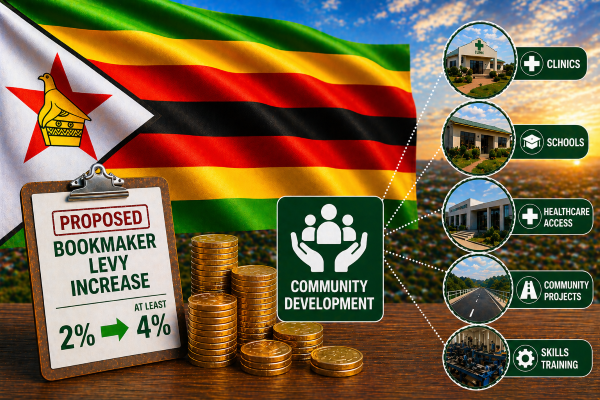
Parliament recommends raising the levy on licensed bookmakers to strengthen funding for clinics, schools and public infrastructure through the Lotteries and Gaming Board.
Zimbabwe.- Zimbabwe lawmakers have recommended doubling the levy paid by licensed bookmakers from 2 per cent to at least 4 per cent, saying the additional funding could expand healthcare access, schools, skills training centres and other public infrastructure projects supported through the Lotteries and Gaming Board (LGB).
The recommendation follows a parliamentary review of LGB-supported projects across Mutasa, Gutu, Zaka, Lupane and Kadoma, where lawmakers assessed how regulated gaming revenue is being used to improve access to healthcare, education and essential public services in underserved communities.
“The committee recommended that the levy collected from licensed bookmakers be increased from 2 per cent to at least 4 per cent to strengthen the Board’s resource base,” the parliamentary committee said in its report, according to NewsDay.
LGB receives funding through a 2 per cent levy collected from bookmakers, with 1.8 per cent allocated to community development projects. This dedicated contribution supports clinics, schools, skills training centres and other public infrastructure and is separate from standard gambling taxes and operator tax obligations.
This is distinct from Zimbabwe’s broader 2026 gambling tax reform, which came into effect on January 1, 2026, where tax on bookmakers increased from 3 per cent to 20 per cent and tax on bettors’ winnings rose from 10 per cent to 25 per cent. Those changes were introduced as part of national tax policy, while the proposed increase from 2 per cent to 4 per cent relates specifically to funding public projects through the LGB.
Parliament said the board has moved beyond regulation alone and is now helping to reduce long travel distances for patients, improve school enrolment and create better access to skills training and maternal healthcare. The committee said: “The interventions by the LGB have significantly improved service delivery in previously underserved communities.”
Community projects deliver impact
Among the projects highlighted was Harava Clinic in Zaka, together with a mothers’ waiting shelter serving more than 9,000 people across 22 villages, giving expectant mothers safer access to healthcare closer to home.
Pupu Clinic in Lupane was also cited for reducing long travel distances for patients, serving around 6,000 residents who previously had to travel nearly 80 kilometres to Lupane District Hospital. The clinic now attends to about 60 outpatients per day and records an average of three births per week.
In education, the Herbert Chitepo Skills Training Centre in Mutasa reportedly increased enrolment from 20 to 80 students per term following infrastructure investment, creating more opportunities for vocational training and youth development. Elim Primary School in Penhalonga also saw learner numbers rise from 90 to 320 pupils after the construction of a classroom block, improving access to formal education for children in the area.
Lawmakers linked these interventions to Zimbabwe’s National Development Strategy 1, saying the projects had helped bridge infrastructure gaps while improving access to essential public services. “These initiatives have not only advanced the implementation of key national policy frameworks, but have also played a pivotal role in bridging critical infrastructure gaps,” said the committee.
However, the committee also flagged operational concerns, including delayed approvals from government departments, under-budgeted projects, poor maintenance of completed facilities and electricity disconnections caused by unpaid utility bills. Harava Clinic was given as an example as it reportedly went for months without electricity due to unpaid bills and showed visible structural cracks requiring urgent attention.
Despite these challenges, Parliament said the LGB model demonstrates how regulated gaming revenue can deliver measurable public value beyond the betting sector itself. “While the Lotteries and Gaming Board has laid a strong foundation for community transformation, sustained success will depend on robust governance, strategic partnerships and efficiency,” concluded the committee.