

Kenya gambling licensing case heads back to court
Judgment was expected on October 2, but three interested parties have been given more time to respond before the case returns for further directions.
Key takeaways:
- Kenya’s High Court did not deliver the judgment expected on October 2, 2026 in the gambling licensing case.
- The matter is scheduled for mention and further directions on October 12 after the 3rd, 4th and 5th Interested Parties were given additional time to respond.
- The case continues to challenge Kenya’s 2026 gambling licensing regulations, including higher licence fees and gambling capital requirements.
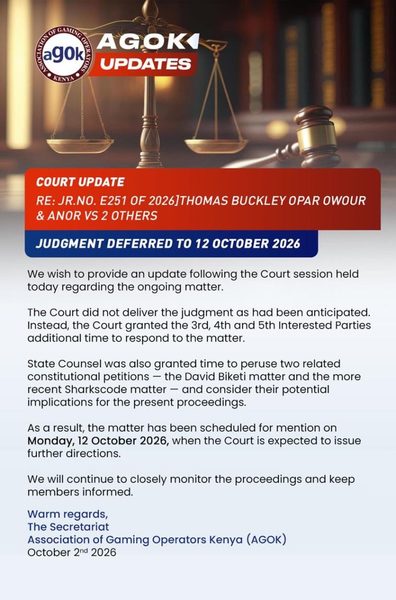
Kenya.- Kenya’s High Court did not deliver the judgment expected on October 2 in a legal challenge to the country’s gambling licensing framework. Instead, the matter has been scheduled for mention on October 12 for further directions, according to a statement by the Association of Gaming Operators Kenya (AGOK).
The development relates to Judicial Review No. E251 of 2026, Thomas Buckley Opar Owuor and another vs 2 others. In its court update, AGOK said the court granted the 3rd, 4th and 5th Interested Parties additional time to respond.
AGOK said: “State Counsel was also granted time to review the related David Biketi and Sharkscode constitutional petitions and their potential implications for the proceedings.”
The association added that “the matter is scheduled for mention on Monday, 12 October 2026, for further directions.” AGOK said it would continue to monitor developments and keep its members informed.
The case is significant for Kenya’s gambling industry because it challenges provisions of the Gambling Control (Licensing) Regulations, 2026, including increased licence fees and gambling capital requirements.
The case was brought by Thomas Buckley Opar Owuor and Ken Brance against the Prime Cabinet Secretary, the Gambling Regulatory Authority of Kenya (GRA) and the Attorney General, with AGOK and Safaricom listed as interested parties.
The High Court initially stayed implementation of the regulations in July. In August, the court narrowed the stay to the increased fees under the Second Schedule and gambling capital requirements under the Third Schedule, allowing the other provisions to take effect.
A subsequent ruling allowed the disputed fees to be implemented for licensing purposes, although they could not be enforced while the legal challenge was pending and would have to be refunded if ultimately found unlawful.
The court had set October 2, 2026 for judgment in the substantive judicial review. The court had maintained the date following proceedings involving concerns raised by AGOK over alleged communications relating to operators’ Paybills.
The new licensing framework includes a KES50m (US$387,500) licence fee for online bookmakers and online casinos and KES20m (US$155,000) for online lottery operators.