



Uplatform – Case 1: The growth investigation


Uplatform has launched a new campaign highlighting why online gaming operators must treat short-term conversion rates as a clue rather than definitive proof of sustainable business growth.
Press release.- Uplatform is urging operators to look beyond headline conversion figures and take a deeper approach to measuring growth. In its latest analysis, the igaming software provider explores what it calls “KPI misdirection”, player lifetime value (LTV), average revenue per user (ARPU), and return on marketing investment (ROMI).
TL;DR
A spike in conversion can make an online gaming business look healthier than it really is. In this case, registrations and first-time deposits increased, but players did not return, ARPU and LTV stayed flat, and engagement failed to improve. Uplatform, an igaming software provider, explains why operators should treat conversion as a clue, not proof of growth.
The KPI Misdirection
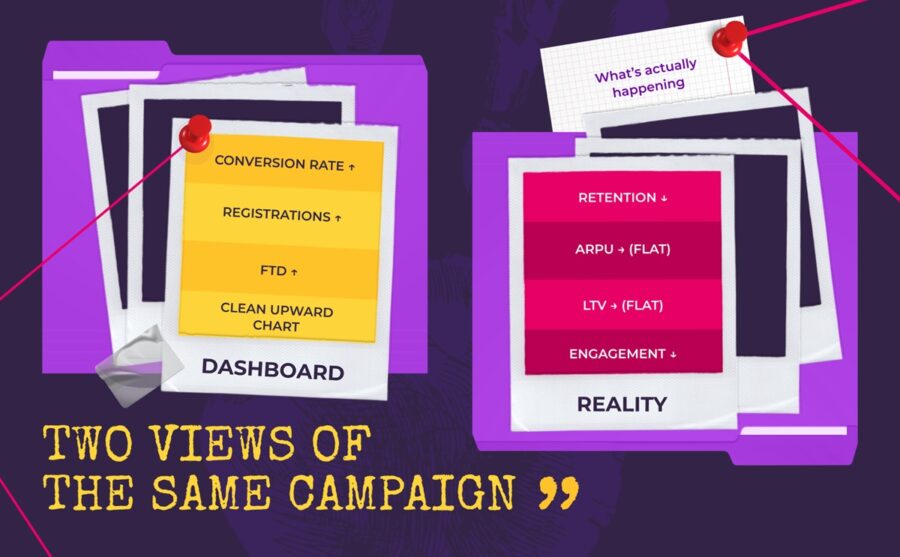
The dashboard was smiling as conversions rose and registrations kept moving. First-time deposits looked stronger than last month. The campaign report chart seemed flawless, with a clean, upward line that was easy to understand, easy to defend, and easy to celebrate.
So, at first glance, it made sense to believe the case was almost closed. The campaign had gone live, and the audience was responding. The funnel looked active, and the numbers seemed to confirm that the strategy was working.
But every good investigator knows one thing: the obvious clue is rarely the whole truth.
So, the question had to be asked.
If conversion is rising, why does the business still feel unstable?
That was the first crack in the case.
Dina, head of B2B projects at Uplatform, puts it clearly: “Conversion is the first and most noticeable signal that a given strategy is working. But it is crucial to remember: even though conversion appears to be the main sign of success, it is only an indicator of reaction.”
And that is where the misdirection begins.
KPI misdirection happens when a team gives the loudest metric the highest authority, even when that metric is only showing part of the business reality.
Conversion tells you that something is working now. It does not automatically tell you that the business is building long-term value.
Conversion is just a clue; it’s not the answer you are looking for.
The scene: A healthy dashboard with something to hide
One would not really blame the operator for feeling confident. A new campaign had gone live, and traffic responded quickly. Registration-to-deposit conversion improved. The numbers seemed to prove that the strategy was working.
But that is not the full story. Something still did not sit right.
Players were converting but not staying. Nothing had collapsed. Nothing looked obviously wrong. But the growth had started to feel harder to explain.
The numbers were saying one thing, but the business was beginning to feel like something else was happening underneath.
No one could call it failure, not yet. But the case was no longer clean.
So the detective’s question changed.
What if the dashboard is not lying, but it is leaving something out?
At this stage, no conclusion could be made, only suspicion.
So, let’s examine the scene more closely.
The first clue: Behavioural indicators start weakening behind the scenes
The first clue was not much of a big deal.
It did not appear as a dramatic collapse on the dashboard, nor did it look like an obvious warning sign. In fact, the headline numbers still looked strong enough to keep the room calm.
But behind the visible movement, smaller signals began to shift.
Some users completed the first action, then became quiet. Some cohorts looked less active after the initial response. Deposit patterns were not as steady as expected. Session activity started to feel uneven.
Nothing seemed broken, but something no longer looked fully convincing either.
Dina explains why this kind of moment can be easy to miss: “Focusing too heavily on short-term metrics, like conversion, can hide less effective work in other areas. For example, user loyalty may drop, or continuous engagement may decline, but these problems stay behind the curtain and are not immediately visible.”
The dashboard was still telling a convincing story, but a few details refused to stay quiet. Nothing pointed to a clear answer, not yet. It was only the first hint that the case had another layer.
Are we attracting users who want the product, or users who only want the offer?
That should be the question on every operator’s mind.
The second clue: Retention, cohort quality, and efficiency metrics contradict the headline result
The sustainability metrics began to disagree with the headline. Retention did not support the conversion story, ARPU did not justify the excitement, and LTV could no longer defend the cost. That changed the direction of the investigation.
The campaign still looked successful from one angle, but from another angle, the picture had become less convincing. An increase in conversion can create excitement. But if the players behind that increase do not stay, do not engage, and do not generate enough value, the result becomes harder to trust.
Two campaigns can produce the same conversion rate but deliver completely different business outcomes. One may bring in users who return, deposit again, and grow in value. The other may attract users who convert once, claim the offer, and leave. Looking at the dashboard, both may look similar.
Dina gives a direct example: “An operator might have a strong registration-to-deposit conversion. But at the same time, their cost of acquiring a single user could be inflated, and the returns from that user may not be enough.”
The promotion had created movement, yet the story behind that movement was beginning to look less certain. Something was hidden inside the success signal, and the case was starting to feel bigger than the dashboard first suggested, which begs the question.
What if the team is not scaling growth, but scaling inefficiency?
The real diagnosis: The product is generating reaction, not long-term value.
The mystery was not in the dashboard. It was in how the dashboard was being read.
The rising conversion, the weakening behaviour, the uneven cohorts. The rising player acquisition costs pressure. None of them looked dangerous alone. But together, they pointed to one hidden problem: the team was not reading growth in motion. They were reading one metric in isolation.
This situation can be referred to as KPI misdirection.
KPI misdirection happens when the loudest metric is mistaken for the most important one. It leads teams to optimise for what looks successful on the dashboard, rather than what creates real business value.
A single metric can be true and still be incomplete. Conversion can rise while retention weakens. Registrations can increase while ARPU declines. Acquisition can scale while CAC increases. A growth push can look successful in the first week and still create pressure on profitability later.
In this case, conversion showed that players were responding, but it did not prove that the strategy was creating lasting business value. The numbers had moved. But movement alone was not proof of progress.
What should operators do next?
The right KPI stack helps operators separate visible growth from real growth.
Visible growth says:
- Conversion is up.
- Campaigns are working.
- Traffic looks strong.
- The funnel is moving.
Real growth asks:
- Are players staying?
- Is ARPU stable or rising?
- Does LTV cover CAC?
- Is ROMI healthy?
- Is this growth repeatable, profitable, and sustainable?
That is the difference between reading the headline and solving the case.
Dina, Head of B2B Projects at Uplatform, captures this clearly when discussing sustainable growth: “True brand growth is not built on registrations; it is built on engagement, loyalty, and trust between the user and the product.”
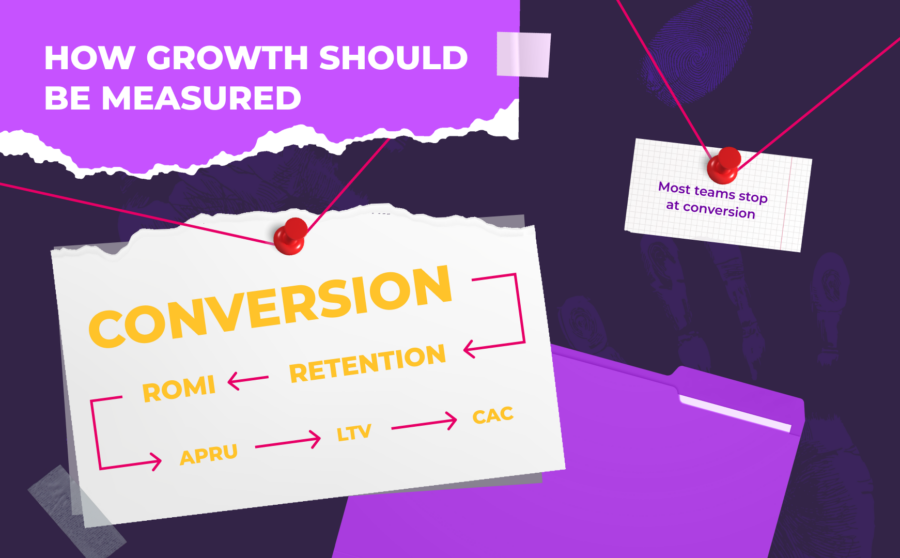
Conversion should lead into retention. Retention and engagement should strengthen ARPU. ARPU should support LTV. LTV should justify CAC. And then ROMI can reveal whether growth is truly sustainable.
Only then does the picture become clear.
A healthier KPI hierarchy looks like this:
- Conversion shows immediate audience reaction.
- Retention shows whether players return and form habits.
- ARPU shows whether engagement produces value.
- LTV shows the long-term worth of the player.
- CAC shows the cost of acquiring that player.
- ROMI shows whether the whole campaign investment makes commercial sense.
A better review rhythm would look like this:
Daily, operators can monitor immediate reaction signals such as conversion, deposit activity, and session starts.
Weekly, they should review behavioural indicators such as early retention, session duration trends, ARPU movement, and changes in player activity.
Monthly, they should assess sustainability metrics such as D30 retention, LTV, CAC versus LTV, ROMI, and cohort performance.
This creates a living view of growth.
Not a snapshot or a celebration of one number but a full-on investigation.
Closing the Case
By the end of the investigation, the dashboard no longer looked as simple as it did at the start. Conversion was still rising, but now the team understood what it meant and what it did not mean.
The real takeaway is that when operators give the wrong metric too much authority, they end up optimising the wrong outcome, and that’s a straight way to losing your business.
To learn more about KPI Misdirection, read Dina’s full interview and explore Uplatform’s ebook on “Conversion Is the Clue, Not the Answer: Read Between the Metrics.” (https://ebook.uplatform.com)
It breaks down how operators can move beyond surface-level reporting and build a KPI stack that reveals whether growth is real, profitable, and sustainable.
So, before the next campaign is called successful, operators should review whether the KPI hierarchy matches business reality.
By Focus Gaming News Editorial Team