

Jennifer Carleton, GCGRA: “We operate a supervision model that calibrates oversight according to the nature, scale and risk profile of the licensed activity”
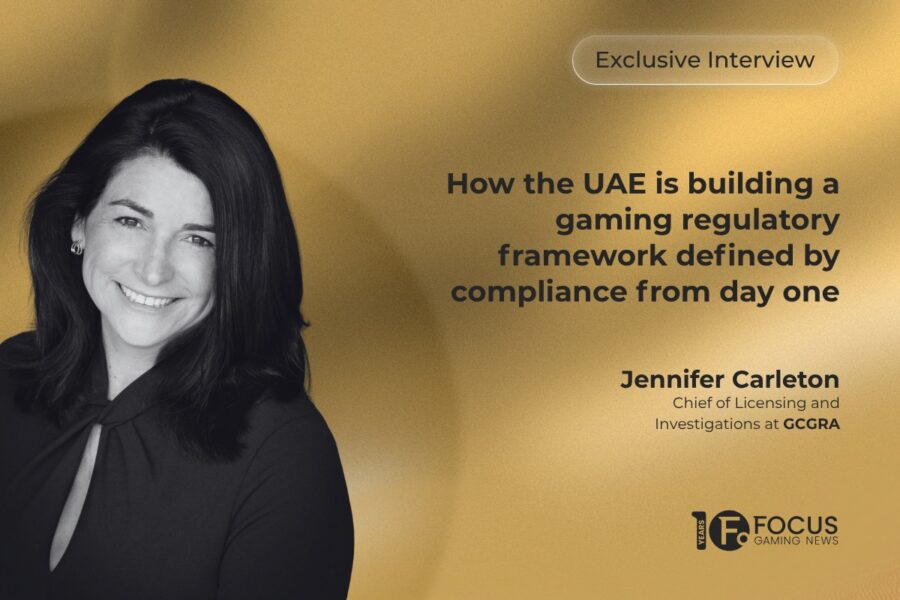

Focus Gaming News spoke with Jennifer Carleton, Chief of Licensing and Investigations at the General Commercial Gaming Regulatory Authority (GCGRA), regarding the UAE’s federal framework for licensing, AML compliance, and responsible gaming.
Exclusive interview.- As the United Arab Emirates takes its first structured steps into the commercial gaming sector, the focus is firmly on building a framework defined by regulatory clarity, compliance, and long-term sustainability. Rather than following a typical market liberalisation path, the UAE is positioning itself as a jurisdiction where governance, financial integrity, and responsible gaming are embedded from the outset.
In this context, Focus Gaming News spoke with Jennifer Carleton, chief of licensing and investigations at the GCGRA, to explore the foundations of this emerging model.
In this exclusive interview, Carleton outlines the Authority’s approach to licensing and supervision, its emphasis on AML and responsible gaming, and how the UAE aims to establish a globally credible and tightly regulated commercial gaming environment.
How would you describe the core objectives and guiding principles of the General Commercial Gaming Regulatory Authority in the UAE’s broader economic strategy?
The GCGRA was established to create and oversee a transparent, robust and internationally credible commercial gaming framework for the United Arab Emirates. Our core objective is to ensure that any authorised gaming activity in the UAE is conducted in a manner that is well-regulated, socially responsible and aligned with the country’s broader standards of governance.
The Authority’s guiding principles are integrity, consumer protection, financial crime prevention, and regulatory clarity. Commercial gaming in the UAE is not being introduced as a standalone activity, but as part of a carefully structured and compliance-led model that reflects the UAE’s wider commitment to regulatory excellence, rule of law and long-term economic planning.
“Our core objective is to ensure that any authorised gaming activity in the UAE is conducted in a manner that is well-regulated, socially responsible and aligned with the country’s broader standards of governance.”
Jennifer Carleton, chief of licensing and investigations at GCGRA.
What are the key elements that differentiate the UAE’s commercial gaming framework from other emerging gaming jurisdictions globally?
The UAE’s approach is distinctive in several respects.
First and foremost, our framework has been designed as a federal model from the outset, ensuring consistency and regulatory clarity across the country.
Secondly, the GCGRA was established before large-scale commercial operations were permitted, allowing the regulatory architecture, licensing standards and supervisory mechanisms to be defined clearly in advance.
A third distinction is our strong emphasis on compliance, AML/CFT alignment and responsible gaming integration as core regulatory pillars rather than secondary considerations.
Finally, the UAE benefits from an existing culture of strong financial oversight and international cooperation across other regulated sectors. This provides a solid foundation for commercial gaming to operate within a mature governance environment rather than as an isolated new industry.
“The UAE benefits from an existing culture of strong financial oversight and international cooperation across other regulated sectors.”
Jennifer Carleton, chief of licensing and investigations at GCGRA.
Could you outline the GCGRA’s approach to licensing and supervision, particularly in relation to risk-based regulation and ongoing compliance monitoring?
Licensing is not a one-time approval. It is the beginning of an ongoing supervisory relationship. The GCGRA applies a structured licensing process. Applicants are subject to rigorous suitability, probity, and financial integrity assessments. This includes detailed reviews of ownership structures, source of funds, governance arrangements, internal controls, and compliance systems.
We operate a supervision model that calibrates oversight according to the nature, scale and risk profile of the licensed activity. This includes regular reporting, compliance reviews, data monitoring, and the ability to conduct inspections and investigations where necessary.
The objective is to maintain active supervision, not passive regulation.
How does the Authority integrate responsible gambling requirements into its regulatory framework, and what standards does it expect licensed operators to meet in this area?
Responsible gaming is embedded within the UAE’s regulatory framework as a foundational requirement.
Licensed operators are expected to implement robust player protection measures, including age verification, self-exclusion mechanisms, spend and time controls where appropriate, and clear customer communication. They must also maintain internal policies for identifying and responding to indicators of problematic play.
We view responsible gaming not as a marketing feature, but as an operational and compliance obligation. Operators must demonstrate that responsible gaming controls are properly resourced, monitored and subject to internal oversight.
AML/CFT is a critical topic for all gaming regulators. How is the GCGRA working to align its expectations with international best practice?
The UAE has a strong national framework for AML/CFT, and the GCGRA’s regulatory expectations are fully aligned with that broader regime.
Licensed entities are required to implement risk-based AML programmes, conduct customer due diligence, monitor transactions, and report suspicious activity in accordance with applicable federal requirements.
We engage closely with relevant domestic authorities to ensure that commercial gaming operators are integrated into the UAE’s wider financial crime prevention architecture, including the implementation of guidance from the UAE Supervisory Sub-Committee to support private sector entities operating in the UAE. Our expectations are benchmarked against international standards and evolving best practice.
Financial integrity is central to maintaining confidence in the sector.
What is the Authority’s approach to technology-driven products and to ensuring robust controls in those channels?
Technology-driven products, including online and digital platforms, require strong control frameworks and real-time oversight capability.
The GCGRA expects licensed operators offering digital products to implement secure technical infrastructure, data protection controls, geolocation safeguards where required, and systems capable of supporting regulatory reporting and monitoring.
Technology can enhance regulatory effectiveness when properly structured. Our framework is designed to ensure that digital delivery channels operate within clearly defined compliance parameters.
How does the GCGRA engage with international regulators, standard-setting bodies and industry stakeholders when developing and refining its regulatory policies?
The GCGRA participates in multilateral forums with industry stakeholders to exchange knowledge and benchmark regulatory practices.
Our objective is not to replicate other jurisdictions, but to understand global standards and incorporate relevant best practice where appropriate for the UAE.
Constructive dialogue with experienced regulators and technical experts supports continuous refinement of our supervisory approach.
To what extent does the GCGRA seek formal cooperation or information-sharing arrangements with other gaming regulators, and which areas are the main focus of those relationships?
Where appropriate, the GCGRA supports structured cooperation and information exchange with counterpart regulators, particularly in areas such as licensing and investigations, enforcement coordination, and financial crime prevention.
Such arrangements help strengthen cross-border regulatory integrity and ensure that operators and suppliers meet consistent standards of probity and compliance.
Our focus remains on protecting the integrity of the UAE market and maintaining regulatory clarity.
What are the main messages you would like potential licensees and gaming-related suppliers to understand about the UAE as a well-regulated jurisdiction?
The key message is that the UAE is building a commercial gaming sector grounded in compliance, transparency and active supervision.
Prospective licensees and suppliers should understand that regulatory expectations are high. Suitability, governance standards, financial integrity, and responsible gaming capability are essential, not optional.
The GCGRA welcomes serious, well-prepared applicants who are committed to compliance and operating within a robust regulatory framework.
By Focus Gaming News Editorial Team