



“The market is speaking for itself” Maksym Shtun on Predictor by Slotegrator
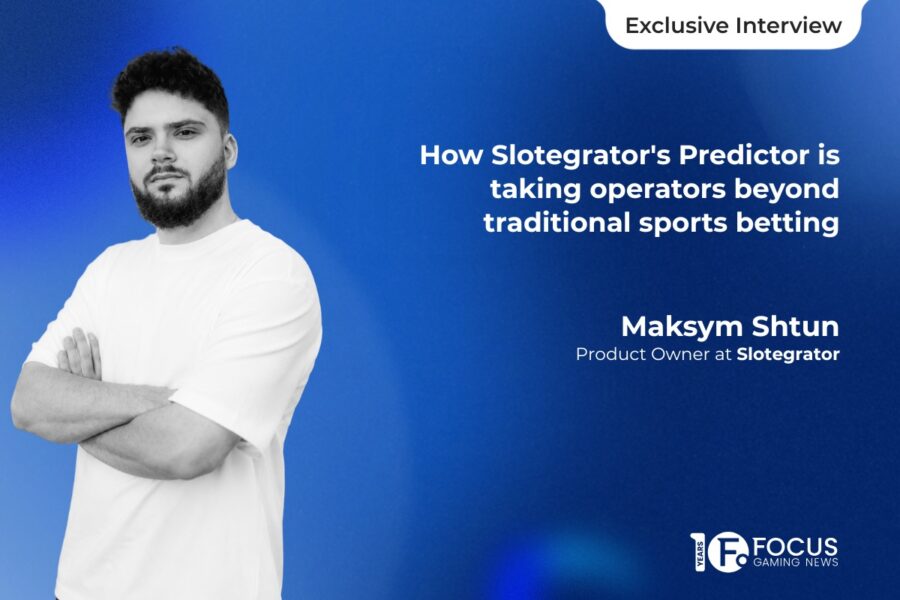

Focus Gaming News spoke with Maksym Shtun, Product Owner at Slotegrator, about the launch of the company’s prediction market engine, Predictor, and the rising potential of peer-to-peer mechanics.
Exclusive interview.- Predictor by Slotegrator, the company’s prediction market engine, was released on 5 May. We caught up with product owner Maksym Shtun to learn more about the solution, why the P2P exchange dynamic will appeal to both bettors and operators, the vertical’s potential as an engagement mechanism, and Slotegrator’s place in the future of prediction markets.
Prediction markets have existed for years in different forms, but recently they seem to be gaining significant traction within both igaming and fintech. Why do you think the timing feels right now for this model to move into the mainstream?
That’s true, prediction markets themselves aren’t new, but the excitement around them has suddenly reached an entirely new level. The first and most obvious reason is that the technology has developed enough to make them possible at scale. Another factor is the regulatory landscape; while it’s still fairly fractured, we have the example of the US, where they’re regulated as financial instruments.
But the biggest factor might be cultural. Widespread familiarity with financial markets and instruments means prediction markets feel natural to many bettors. There’s just a higher level of awareness about trading, markets, crypto, and Web3, and all of that together is creating the right audience.
One of the most interesting aspects of Predictor is the peer-to-peer dynamic behind the experience. In your view, how does this fundamentally change player engagement compared to traditional sportsbook mechanics?
Yes, the player-to-player exchange model really sets Predictor apart from other prediction market products that simply offer fixed-odds betting on current events. It creates a very different experience for the player, both in terms of odds and player perception. I’ll explain.
First, the odds are different because they’re set by market forces, not by a sportsbook massaging the numbers to work in the house edge. The odds are a direct, statistical representation of popular opinion on the outcome of the bet in question. And that fact leads me to the second part, player perception. The P2P model means that every bet is a contract between two players. It’s a head-to-head competition. This makes it more fair, in the player’s perception, than betting with a sportsbook that tilts the odds to protect its margin.
In the end, you can offer fixed-odds betting on current events if you want, but I think players will perceive that as a sportsbook trying to capitalise on a trend, rather than a real prediction market, where the odds you see truly reflect bettor sentiment.
We’re seeing a clear shift towards faster, more interactive and community-driven entertainment experiences, especially among younger audiences. How closely is the rise of prediction markets connected to broader changes in digital behaviour and content consumption?
I think it’s directly related. We’re all constantly connected and up to date on current events, thanks largely to social media. And when people are well-informed, they’re also bound to be opinionated — and why not take that next, natural step and place a bet? So, definitely, the explosion of internet content and connectivity has definitely created the right circumstances for prediction markets to take off. It’s no surprise that prediction markets are especially popular among younger men, who’ve grown up with social media and are more likely to have developed an interest in trading; prediction markets just fit naturally with their worldview.
Predictor allows operators to expand beyond traditional sports betting into categories such as crypto, politics and entertainment. How important is diversification becoming for operators looking to maintain long-term engagement?
If you take a quick glance at the front page of Polymarket and Kalshi, you’ll see that even incredibly niche bets have millions of dollars in trading volume. The market is speaking for itself. Player appetite has expanded far beyond Champions League winners and even quirky prop bets; for modern players, any event with a publicly verifiable outcome could be worth betting on. Heading into the future, if operators want to keep their players, they have to keep feeding that appetite.
“Player appetite has expanded far beyond Champions League winners and even quirky prop bets.”
Maksym Shtun, product owner at Slotegrator.
From an operator’s perspective, what makes prediction markets particularly attractive as a business model today? Is the appeal more related to engagement, operational flexibility, new audience acquisition, or something else entirely?
It’s all of those and more. A prediction market is, in one way, a layered engagement engine. If we focus on sports, you not only have betting on whether team A or team B wins, whether a team covers the spread, or who wins the playoffs, but you also have bets on whether a league will change its rules, who will be selected for the all-star team, and a web of other connected prop bets.
There’s even more potential when it comes to betting on streamers; you can create a home-grown betting ecosystem based around an affiliate streamer, appealing to bettors who are already engaged in real time.
And yes, the operational flexibility is a huge draw. The option of running a prediction market as a complementary product to your established casino or sportsbook has tremendous cross-selling potential. There’s also the stability; the player-to-player exchange model makes it essentially risk-free for the platform.
That’s right, Slotegrator describes Predictor as a “risk-free” model. Without giving away too much, can you explain how this structure changes the operational dynamics compared to traditional sportsbook offerings?
Sportsbooks need to calculate their odds so that the money from the losers pays off the winners. They’re very good at it, but sometimes underdogs come out on top. And if that happens in a big enough way, operators can be exposed to a significant short-term loss. With Predictor, it’s a different story.
Due to the P2P model, the losers pay the winners directly, and the operator takes a commission from the winnings. Operators simply aren’t exposed to the same level of risk; they’re a market maker, hosting the platform where the action happens, instead of acting as the counterparty.
Of course, this ties into payments — there are usually issues like escrow and fund holding to consider, and that often creates friction during onboarding. With Predictor, though, we’ve decoupled the payment layer through the Wallet Adapter API, so operators simply connect to the existing balance and payment processing. That makes it easier for a player to bet on a prediction market powered by Predictor than any of the alternatives.
Mobile-first audiences continue to reshape the way gaming products are designed and consumed. What role does simplicity, speed and accessibility play in the future growth of prediction-based experiences?
Mobile-first has always been our baseline; ease of use is everything. Every aspect of Predictor is designed for mobile by default, with desktop as the secondary view. Simplicity, speed, and accessibility aren’t added features; they’re constraints that we have in place from day one. A prediction market only works if the user can understand the question, form and opinion, and place a position in seconds, and our UX makes that possible.
Do you see prediction markets evolving into a complementary vertical alongside sportsbook and casino, or do you believe they could eventually become a standalone category within the industry?
Both are possible. In the future, yes, there will be more standalone prediction markets, but for now, prediction markets like Predictor can sit alongside an existing sportsbook as a perfect complement. Offering a prediction market alongside a classic sportsbook will allow operators to keep what already works while both expanding the options available to players and bringing in new players who are attracted by the prediction market options.
Looking ahead over the next few years, how do you expect prediction-based engagement models to evolve, and where does Slotegrator aim to position itself within that evolution?
I think brands will focus more on creating tailored betting experiences. The best example is the streamer partnerships I mentioned earlier. Prediction market bettors love to wager on even the smallest events, and streamers offer a constant fountain of betting opportunities. Will they win their next spin? What will they say if they lose? There’s no limit. Brands can create increasingly targeted retention ecosystems.
As for Slotegrator’s position, I think that’s already clear — we’re one of the first movers in the space. We’re already in a place where we can keep refining our product, so whatever happens in the space moving forward, it’ll happen here first.
By Focus Gaming News Editorial Team“I think brands will focus more on creating tailored betting experiences.”
Maksym Shtun, product owner at Slotegrator.