Yaroslava Romaniv, GR8_TECH: “Bet It Drives was built to feel more like an industry conversation than a brand campaign”
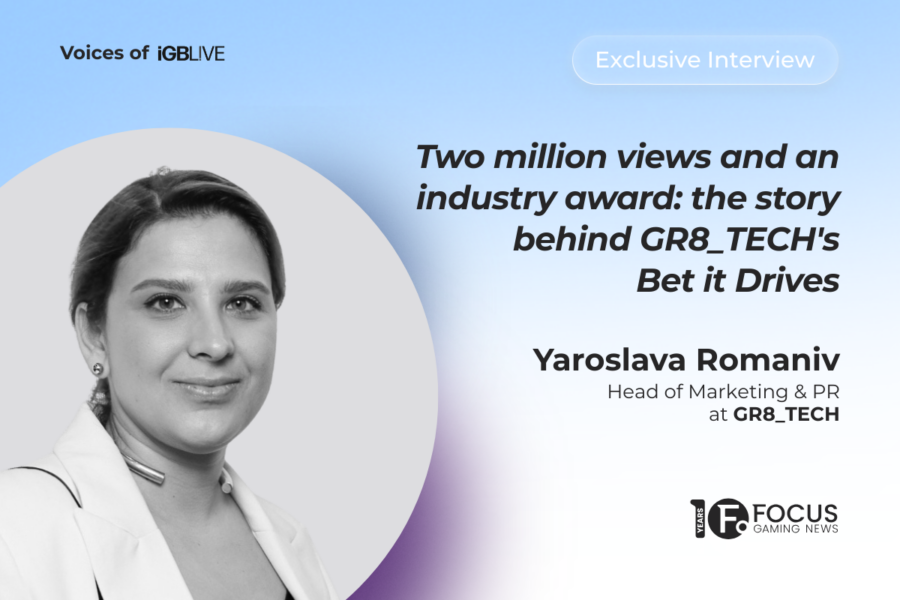
During the latest edition of iGB L!VE, Focus Gaming News spoke with GR8_TECH’s Head of Marketing and PR, Yaroslava Romaniv, about the success of its award-winning Bet It Drives campaign.
Exclusive interview.- In May, GR8_TECH’s Bet It Drives series was recognised with the Best Marketing Campaign 2026 award, highlighting a content format that broke away from traditional product-led promotion and instead focused on authentic conversations, industry personalities, and storytelling. The campaign’s success has become a powerful example of how brands can capture attention in an increasingly crowded and competitive content landscape.
Speaking with Focus Gaming News at iGB L!VE, Yaroslava Romaniv, head of marketing & PR at GR8_TECH, reflected on the journey behind Bet It Drives and the lessons it offers for the wider industry. She also discusses the changing nature of B2B marketing in igaming, the growing value of personality-led content, and why the brands that succeed today are those capable of creating conversations audiences genuinely want to be part of.
First of all, congratulations on Bet It Drives winning Best Marketing Campaign 2026. It’s a fantastic recognition, and honestly very well deserved. Looking back at the project now, what do you think made it resonate so strongly both with audiences and with the industry?
Thank you! It means a lot, because from the start, Bet It Drives was built to feel more like an industry conversation than a brand campaign.
I think what made it resonate is that it felt different from the usual B2B content in igaming. Our industry is full of very polished corporate messaging. There’s nothing wrong with that, but we wanted to create something more genuine.
The car format helped a lot. When you put someone in a car, away from the conference and the usual interview setup, people relax, and the conversation becomes more natural. There aren’t scripts or heavy product talk — only honest conversations with people who are shaping the industry.
Another big factor was the quality of the guests. Having the industry’s senior leaders join the show gave it credibility. But more than that, they were willing to open up and speak honestly, and I think audiences could feel that.
We wanted to show that we understand the industry, we are part of the conversation, and we can create a platform where meaningful conversations happen.
The numbers were amazing, of course: over 2 million YouTube views, more than 280 media publications, and strong growth in brand recall. But the biggest success is that people in the industry actually chose to watch it, share it, and be associated with it. That’s what made it special.
“We wanted to show that we understand the industry, we are part of the conversation, and we can create a platform where meaningful conversations happen.”
Yaroslava Romaniv, head of marketing & PR at GR8_TECH.
One of the most interesting things about Bet It Drives is that it never felt like a traditional B2B campaign. It felt more like a content format people actively wanted to spend time with. Was that the intention from the very beginning?
Yes, definitely. From the beginning, we knew we didn’t want Bet It Drives to feel like GR8_TECH pushing a promo message or talking about itself. We felt that if people were going to give us their time, the format had to earn that attention. So, we allowed the guests’ stories, opinions, and experiences to guide the content.
That’s why it felt more like a show than a campaign. It had its own rhythm, personality, and reason to exist beyond marketing. People could watch it for the guests, for the industry insight, or just because it offered something new. With Bet It Drives, we tried to keep it open, relaxed, and genuinely interesting — and I think that’s what helped people connect with it.
In your view, what does the success of campaigns like Bet It Drives tell us about how B2B marketing in igaming is evolving? Are audiences becoming less responsive to product-led promotion and more interested in personality, context and storytelling?
Yes, I think that’s exactly what it shows.
B2B marketing in igaming is definitely changing. For a long time, a lot of it was very promotion-led and product-focused: here is our platform, here are our features, and here is why we are better. Of course, at some point, people still need to understand what you actually do.
But audiences are much more selective now. They see so much content every day, especially around big events, that another product message can easily get lost.
What Bet It Drives proved is that people still give attention when the content feels worth it. They want context, opinions, and they want to see the people behind the companies.
In igaming, relationships are super important, as well as trust and reputation. So content that shows personality and gives people a sense of how you think can be much more powerful.
I also think audiences are becoming better at spotting when something is too polished or too sales-driven. They don’t reject marketing, but they do reject content that feels like it was made only to sell to them.
So yes, the future of B2B marketing in igaming is less about shouting louder and more about creating something people actually want to be part of. The brands that can bring useful, entertaining, and honest conversations to the table will have an advantage.
“What Bet It Drives proved is that people still give attention when the content feels worth it.”
Yaroslava Romaniv, head of marketing & PR at GR8_TECH.
GR8_TECH managed to blend thought leadership, entertainment and brand visibility without the content ever feeling forced or overly corporate. How difficult is it to strike that balance in practice, and what did the team learn from the process?
It’s actually a very difficult balance, because each part can easily take over.
If you push the brand too much, it starts to feel like an ad. If you focus only on entertainment, people might enjoy it, but they won’t necessarily connect it back to GR8_TECH. Then, if you make it too serious, you lose the natural energy that made the format interesting in the first place. So the challenge was to let the content breathe, but still keep a clear purpose behind it.
The biggest lesson was that restraint is really important. We didn’t need to force GR8_TECH into every conversation or turn every episode into a product message. The brand visibility came through the quality of the idea, the people involved, and the fact that GR8_TECH was the one creating that space.
Another big learning was how much the host matters. Yevhen had to make guests feel comfortable enough to move away from polished answers. Trust is a major reason the show worked.
If the conversation is good, the thought leadership feels natural. If the production is strong, the entertainment is there. Also, if the whole thing feels credible, the brand benefits without needing to over-explain itself.
One of the strongest aspects of the series is the human element, executives aren’t just speaking as company representatives, but as people with opinions, humour and personality. How important is that shift towards more human, personality-led content in today’s B2B landscape?
I think that shift is very important, and not just because it makes content more enjoyable to watch.
For me, this is where B2B marketing is going in general. There is still this old idea that B2B has to be very serious, product-led, and very rational. But actually, decisions are still made by people. People remember tone, confidence, timing, opinions, and whether a brand feels like it understands the world they operate in.
That’s why the human element matters so much. When executives speak only as company representatives, the message is often easy to forget. But when they show personality, humour, experience, or even a strong point of view, the content becomes much easier to remember. After all, being remembered is a big part of the job.
Not every buyer is ready to buy today. Most of the market isn’t actively looking for a solution at any given moment. So if marketing is only focused on immediate leads, it misses a huge part of how brand preference is actually built. You need to show up before the buying moment and build trust before there is a sales conversation.
Bet It Drives gave GR8_TECH a way to be present in the industry conversation without constantly saying, “Here is our product, here are our features.” Instead, it created familiarity, credibility, and a sense of personality around the brand.
The strongest brands now are the ones that can combine expertise with a genuine voice. They understand that storytelling, brand, PR, and lead generation support each other. Personality-led content matters a lot simply because brands that feel alive are simply harder to ignore.
Most companies in the industry are present at the same events, share similar updates and compete for the same attention. From your perspective, what actually makes people stop, watch and engage with a campaign today?
People stop when they feel there is an actual idea behind the campaign. That’s the opposite of “we need content for this event,” or “let’s post because everyone else is posting.” Audiences can feel that immediately. In igaming, where everyone is at the same events, announcing similar things, the average corporate update has a very short life.
People engage in tension, a strong angle, a format they haven’t seen ten times already, and a reason to care. It doesn’t always have to be huge or expensive, but it has to feel intentional. Why does this exist? Why should someone give it 30 seconds of their day? What are they getting from it: a useful thought, a laugh, a strong opinion, access to someone interesting, a story they want to follow?
I also think brands need to be braver with how they show up. Many B2B campaigns are too safe. They are approved by everyone, so in the end they sound like no one. Then we end up wondering why people scroll past.
For me, the best campaigns are the ones that know what they want to say, who they are speaking to, and aren’t afraid to have some personality. Remember that attention isn’t the same as visibility. You can be everywhere and still be invisible. People engage when a brand gives them something memorable enough to associate with it afterwards.
Finally, after the success of Bet It Drives, what advice would you give to B2B brands in igaming that want to move beyond traditional promotion and create content audiences genuinely choose to engage with?
My advice would be to stop starting with the product. Start with the audience. What do they actually care about? What are they tired of seeing? What would make them pause, listen, share, or remember you?
It’s easy to fall into the same pattern: event post, product update, press release, booth photo, repeat. That may keep you visible, but it doesn’t always make you interesting.
If you want people to choose your content, you need an idea behind it. A format with a reason to exist, a point of view, a voice. Something that gives the audience value before asking for their attention.
Then, of course, you need discipline. The strongest campaigns are consistent, well-produced, and connected to the brand in a way that makes sense.
Also, don’t be afraid to show personality. B2B is still people making decisions with other people. The brands that feel human, confident, and straightforward are the ones people remember.
So, create something you would actually watch yourself. If even your own team wouldn’t choose to spend time with it, why would the industry?
By Focus Gaming News Editorial Team