



Rodrigo Cambiaghi, Sportradar: “The 2026 World Cup will be different from anything we have seen before”
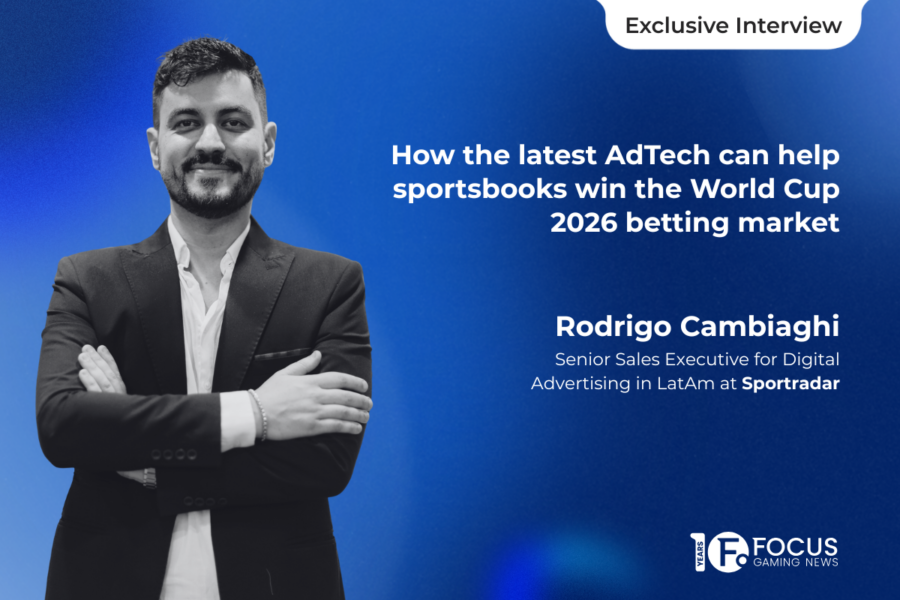
Sportradar’s Senior Sales Executive for Digital Advertising in LatAm discusses with Focus Gaming News how AI, real-time sports data and hyper-personalised campaigns are reshaping sportsbook marketing ahead of the 2026 FIFA World Cup.
Exclusive interview.- As the betting industry prepares for the 2026 World Cup, operators are facing what many expect to be the most competitive and expensive customer acquisition environment ever seen in sports betting. With an estimated global betting handle of US$50bn and an expanded tournament format featuring more matches and longer engagement cycles, the event is set to redefine how sportsbooks approach marketing and fan engagement.
In an interview with Focus Gaming News, Rodrigo Cambiaghi, senior sales executive for digital advertising in LatAm at Sportradar, explained how operators can use AI-driven personalisation, programmatic advertising and real-time sports data to stand out in an increasingly saturated market. He also highlighted the strategic importance of flexibility, contextual campaigns and exclusive inventory, particularly in Brazil, where the 2026 tournament will mark the country’s first World Cup under a regulated betting market.
The 2026 World Cup is projected to become the biggest betting event in history, with an estimated $50bn in global handle. From an AdTech perspective for operators, what makes this tournament different from anything we’ve seen before?
The 2026 World Cup will be different from anything we have seen before due to a combination of scale, market maturity and timing. It will be the largest World Cup in history, with 40 more matches than previous editions, creating significantly more engagement opportunities, longer fan attention cycles and much more inventory for operators throughout the tournament.
For Brazil in particular, this tournament is especially relevant because it will be the country’s first World Cup under a regulated betting market. That creates a very different environment compared to 2022, with operators approaching the event in a more structured and competitive way.
From an AdTech perspective, the biggest shift is hypercompetition. During the World Cup, not only betting operators but brands across multiple industries compete for the same consumer attention, making media more expensive and traditional acquisition strategies less efficient.
That is why differentiation becomes critical. We believe operators that combine real-time data, AI and contextualised activation around key sports moments will be much better positioned to stand out. Success is no longer just about being present; it is about showing up at the right moment, with the right message, when fan engagement is at its highest.
“We believe operators that combine real-time data, AI and contextualised activation around key sports moments will be much better positioned to stand out.”
Rodrigo Cambiaghi, senior sales executive for Digital Advertising in LatAm at Sportradar.
Sportradar mentioned a hyper-saturated market where generic promotions are generating diminishing returns. How does Sportradar help operators break out of that “ocean of sameness” and truly differentiate themselves?
In a hypercompetitive market, one of the biggest challenges is that many operators end up looking and sounding the same, with similar welcome offers, similar promotions and similar messaging all competing for the same user attention. Over time, that naturally leads to diminishing returns and higher acquisition costs.
At Sportradar, we help operators move beyond one-size-fits-all campaigns through a combination of AI, real-time sports data and hyper-personalisation. That means not only showing the right message to the right user based on their preferences and behaviour, but also delivering it at the right moment. We call these “sports moments”: goals, momentum shifts, penalties or key match events where fan attention and emotion peak. Instead of generic promotions, operators can activate more contextualised campaigns that feel timely, relevant and more engaging.
In an event like the World Cup, where attention is fragmented, and competition is intense, differentiation increasingly comes from personalisation, timing and relevance rather than simply spending more.
Real-time data is a key part of Sportradar’s offering. In practice, how does activating dynamic creatives based on match moments, such as a goal or a shift in momentum, work?
Real-time data is really at the core of how we think about marketing activation. In practice, what that means is turning live match events, such as a goal, a penalty, a momentum shift, or even a period of sustained pressure from one team, into immediate marketing opportunities.
For example, if a goal is scored, an operator can instantly activate a more relevant creative: updating odds messaging, promoting an in-play betting market or delivering personalised content based on a fan’s preferences, favourite team or betting behaviour. The same applies to moments of high tension in a match, when engagement and purchase intent tend to increase naturally.
What makes this powerful is timing. Not every minute of a game has the same emotional value, and fan attention peaks around specific moments. Instead of relying on static campaigns that treat every moment equally, operators can synchronise messaging with the emotional pulse of the match.
We often describe this as moving from advertising “placements” to advertising “moments” using real-time sports data and AI to make campaigns more contextual, personalised, and ultimately more effective.
Copa América and UEFA Euro 2024 served as a testing ground. What were the most concrete learnings from those tournaments that are now being applied to the World Cup strategy?
One of the clearest learnings from the 2024 Euro and Copa América is that flexibility matters much more than rigid planning during major tournaments. Consumer behaviour shifts quickly, storylines change overnight, and operators that were able to adapt to campaigns in real time generally performed better than those relying on static acquisition strategies.
Another key takeaway was the importance of contextual and personalised advertising. During both tournaments, we saw significantly stronger results when operators aligned campaigns with live match moments and fan behaviour rather than relying on generic promotions. Relevance became a major driver of efficiency, particularly in a highly competitive environment where media costs naturally increase.
Finally, we saw the value of balancing performance with brand investment. The operators that performed best were not only focused on short-term acquisition but also used the tournament to strengthen brand recognition and long-term customer value. For an event like the World Cup, which is expected to be the biggest betting moment in history, that balance becomes even more important.
“Flexibility matters much more than rigid planning during major tournaments”.
Rodrigo Cambiaghi, senior sales executive for Digital Advertising in LatAm at Sportradar.
Rigid marketing plans clearly do not work in a 39-day tournament full of surprises. How do you build a framework that can truly adapt in real time to everything that happens throughout the competition?
The reality is that rigid marketing plans rarely work during a tournament like the World Cup because consumer attention shifts constantly. A team overperforms, a favourite gets eliminated, a player goes viral, and suddenly the entire conversation changes. Operators need a framework that is flexible by design.
In practice, that starts with real-time optimisation. Instead of locking budgets and creatives upfront, operators should be able to adjust campaigns dynamically based on live match events, fan behaviour, and performance signals. That means reallocating spending between channels, adapting messaging and activating campaigns around moments that are driving the highest engagement.
Technology plays a key role here. Through programmatic advertising, AI and real-time sports data, operators can move faster and make campaigns more responsive. Ultimately, the goal is simple: getting the right message to the right audience at the right moment, while staying flexible enough to follow how the tournament evolves.
Exclusive, high-visibility inventory increasingly seems to be a requirement. What does Sportradar offer in this area that traditional digital channels cannot?
Traditional digital channels are important, but they are often broad and highly competitive. The challenge is that everyone is buying from the same ecosystems and competing for the same audiences, which can limit differentiation and drive costs higher, especially during a major event like the World Cup.
What makes Sportradar different is the combination of exclusive sports inventory, proprietary technology and real-time sports data. Through our partnerships and sports ecosystem, we can activate campaigns closer to the moments that matter most to fans, across premium sports environments and highly engaged audiences.
We also go beyond traditional media buying by combining exclusive inventory with programmatic capabilities, AI and live data signals. That allows operators not only to reach audiences at scale, but to do so in a more contextual and personalised way, synchronising campaigns with what is actually happening in the game, rather than relying on static placements alone.
In a tournament where attention is extremely fragmented, exclusivity, timing, and relevance become key differentiators.
What is Sportradar’s strategy for LatAm ahead of the World Cup and in the coming years? How is the company positioning itself in such a diverse region, with markets at different stages of regulation?
Latin America is one of the most dynamic regions for the betting industry today, but it is also one of the most diverse. You have markets at very different stages of maturity and regulation, from more established environments to countries that are still evolving their frameworks. Because of that, there is no one-size-fits-all strategy.
For Sportradar, our focus is on helping operators and partners navigate that complexity through technology, data, and local and global expertise. We see strong long-term growth potential across the region, particularly as regulation advances and operators become more focused on sustainable growth, customer retention and product sophistication.
Ahead of the World Cup and in the years beyond, our strategy is centred around supporting operators with solutions that improve efficiency and engagement, whether through real-time data, AI-driven personalisation, marketing services or integrity solutions. At the same time, we are positioning Sportradar as a long-term technology partner for the ecosystem, helping markets grow in a more mature, responsible and data-driven way.
“Latin America is one of the most dynamic regions for the betting industry today, but it is also one of the most diverse.”
Rodrigo Cambiaghi, senior sales executive for Digital Advertising in LatAm at Sportradar.
Brazil, in particular, is a market that has only recently become regulated and is approaching the World Cup at a unique moment. What specific opportunities do you see for Brazilian operators, and how is Sportradar supporting them at this stage?
Brazil is in a unique position heading into the tournament because this will be the first World Cup under a regulated betting market. That creates a very different environment compared to 2022, when the market was still largely unregulated and considerably smaller.
For operators, one of the biggest opportunities is customer acquisition at scale, but more importantly, acquiring the right customers, players with long-term value rather than purely bonus-driven behaviour. The World Cup naturally drives spikes in registrations and engagement, but the challenge is turning short-term activity into sustainable growth.
We also expect a much more competitive environment. Media costs will likely increase, consumer attention will be heavily disputed, and differentiation will become critical. That is where technology, real-time data and personalisation can make a real difference.
At Sportradar, we support operators through a combination of live data, AI-driven personalisation, marketing services, and performance solutions designed to help them engage users more effectively during key sporting moments. The focus is not only on helping operators grow during the tournament, but also on building stronger customer relationships that continue well beyond the World Cup, both in Brazil and across other regulated markets.
By Focus Gaming News Editorial Team