


Kateryna Pozdnysheva, GR8_TECH: “We aim to help operators get more value from the same wave of World Cup traffic”

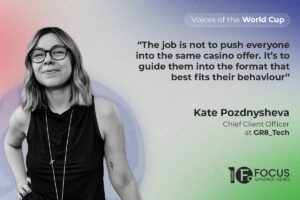
In the fourth instalment of “Voices of the World Cup”, Focus Gaming News spoke with Kateryna Pozdnysheva, Chief Client Officer at GR8_TECH, about the company’s multi-vertical product preparations and retention strategies ahead of the World Cup.
Exclusive interview.- As operators prepare for the biggest sporting event in the calendar, attracting World Cup traffic is no longer the main challenge; the real challenge lies in turning that surge of attention into sustainable growth. As players move seamlessly between the sportsbook, the casino and emerging payment channels, operators are under increasing pressure to provide personalised experiences, frictionless journeys and long-term retention strategies that will continue long after the final whistle has blown.
In this exclusive Focus Gaming News interview, the fourth in the “Voices of the World Cup” series, Kateryna Pozdnysheva, chief client officer at GR8_TECH, discusses how the company is preparing for the FIFA World Cup 2026 across its sportsbook, casino and crypto verticals. She also shares insights into the operational demands of handling tournament-scale traffic, the importance of geo-specific configurations, the evolving role of crypto players, and why retention, rather than acquisition alone, will ultimately determine which operators maximise the commercial opportunity of the tournament.
GR8_TECH has been preparing for the World Cup across three product verticals simultaneously: sportsbook, casino and crypto. What does that level of preparation actually look like internally? At what point did the World Cup roadmap start, and how do you prioritise across three very different product areas at once?
Internally, we are asking: where do operators win or lose value when traffic surges? Usually that comes down to acquisition, conversion, retention, VIP handling, and long-term player value. So sportsbook, casino, and crypto are aligned around those outcomes, not developed in isolation.
The roadmap starts well before the tournament. We treat the World Cup as a growth moment and a stress test, so planning begins early around the areas that have the biggest impact under pressure: event discovery, campaign visibility, bonus mechanics, segmentation, payment flow, VIP treatment, and risk handling. By the time the tournament gets closer, the focus is on refining and executing.
Across the three areas,we prioritise by commercial impact. In sportsbook, that means discoverability, bet-building, and margin-supporting tools. In casino, it means loyalty, bonus flexibility, and segmentation. In crypto, it means reducing payment friction and improving player handling from the first interaction. We aim to help operators get more value from the same wave of World Cup traffic.
You’ve said publicly that “World Cup traffic by itself does not guarantee better results. What matters is how well operators convert that attention into acquisition, conversion, retention and long-term player value.” What are operators actually getting wrong when they treat the World Cup as a traffic event rather than a product moment?
Operators often focus too much on acquisition and not enough on what happens after the first bet. The biggest miss is usually retention, and sometimes platform reliability too. If players come for one or two matches and run into friction or a weak product experience, the operator may still get traffic, but not much long-term growth. That usually leads to three mistakes.
First, they focus too much on individual matches instead of designing one connected tournament experience. They run short promotions around big fixtures, get a burst of activity, and then lose the player until the next headline game.
Second, they underestimate the operational side. World Cup traffic is not normal traffic. It comes in repeated surges around kickoffs, live betting, cashouts, and bet-builder activity. If the platform slows down, if payments lag, or if support is not ready, the value of that traffic drops immediately.
Third, they do not plan for what happens after the final. They spend heavily to acquire players during the tournament, but without a clear post-World Cup retention plan, a large share of those users disappear as quickly as they arrived.
So the mistake is thinking the event is about volume, which is not the case. Focus on how well you turn attention into daily engagement, how smoothly the platform performs under pressure, and how much player value you keep after the tournament ends.
The World Cup is a football event — almost every bettor arrives through the sportsbook door. But casino is where the long-term margin lives. How do you design a product experience that naturally moves a World Cup bettor from their first in-play bet to a casino session, without it feeling forced or intrusive?
The key is to make the move from sportsbook to casino feel natural. If you hit bettors with a generic casino promo at the wrong moment, it feels intrusive. The better approach is to catch the natural break in the session—after a bet settles, between matches, or once the game is over—and give them an easy next step.
That next step also has to feel relevant. Some players are more likely to move into live casino, others into slots, instant games, or mini-game formats. So the job is not to push everyone into the same casino offer. It’s to guide them into the format that best fits their behaviour.
That is why we have been preparing the casino side for the World Cup with more flexible bonuses, stronger tournament mechanics, broader content coverage, and faster provider integrations. Sportsbook may bring the player in, but casino is where you extend the session and build more long-term value (if the transition is timed well and feels smooth).
GR8_TECH works with more than 200 casino providers. During a World Cup, when the entire platform is under peak load and operator attention is focused on football, how do you keep the casino product competitive and visible, without it being overshadowed by the tournament?
A big part of that is content readiness. We keep expanding integrations so operators can maintain broad, competitive content coverage while traffic is peaking elsewhere on the platform. Speed matters here too. New provider-specific content delivery solutions can be implemented in about one to two weeks, which gives operators a much faster way to strengthen or refresh the casino lobby when timing is crucial.
The other part is activation. During the World Cup, casino needs stronger mechanics around it. That is why we have been improving bonus flexibility, tournament settings, and provider feature coverage. Operators can now target bonuses more precisely by product type, run parallel tournaments around the same game, and build more segment-specific campaigns without splitting their best content.
You’ve introduced geo-specific configurations as a key part of your World Cup strategy. Can you give a concrete example of how a Brazilian operator and a Mexican operator might need to configure their platform differently for the same World Cup match?
Yes, a concrete example would be around the same match, but configured very differently for each audience.
For a Brazilian operator, the setup would usually be more football-led: stronger visibility for Brazil-specific markets, quicker access to bet builders and player markets, and bonuses or loyalty mechanics tied closely to repeat sportsbook activity. The payment flow and messaging would also reflect local habits and a highly football-engaged audience.
For a Mexican operator, the same match might be positioned in a broader way. It could be connected more clearly to other tournament content, with different bonus logic and more focus on segmentation and cross-sell rather than treating it as a pure football spike. The game is the same, but the surrounding experience—offers, lobby structure, payment flow, and post-match engagement—may need to be quite different.
That is really what we mean by geo-specific configuration. It’s definitely not only translating the interface or changing the currency, but rather adjusting how the same event is presented, promoted, and monetised based on the market, the player behaviour, and the operator’s goals in that region. The more high-profile the event, the more important those differences become.
GR8_TECH is one of the few platform providers actively building crypto capabilities into its World Cup strategy. Who is the crypto bettor during a World Cup, and why does that audience require a fundamentally different product approach?
The crypto bettor during a World Cup is usually one of two profiles.
The first is a crypto-native player who already uses wallets, expects instant transfers, and has very little patience for slow or clunky payment flows. If that user has to copy addresses, switch apps, or wait too long, you lose them quickly.
The second is a newer crypto user who may be interested in using crypto, but still needs a simple way in. During the World Cup, a lot of players are coming in for the first time, so if the journey feels too technical, they drop off before they even place a bet.
That is why the product approach has to be different. With crypto, the challenge is removing friction from the first interaction. For newcomers, that means being able to buy crypto and deposit in one flow. For experienced users, it means direct wallet connectivity and fast top-ups without interrupting the session.
With crypto players, operators need to understand player value much earlier. In traditional setups, you can wait and learn from betting history over time. In crypto, that is riskier because some high-value players may look small at first (for example, they might make a low first deposit but actually control much larger assets in their connected wallets). If the operator waits too long to recognise that, they may miss the chance to engage, segment, or retain that player properly from the start.
That is why crypto needs its own strategy around the World Cup. It’s a high-speed, high-intent audience, but only if the platform is built for that behaviour. If the flow is smooth, the upside is broader reach, faster deposits, and better access to valuable players.
“During the World Cup, a lot of players are coming in for the first time, so if the journey feels too technical, they drop off before they even place a bet.”
Kateryna Pozdnysheva, chief client officer at GR8 Tech.
After the World Cup ends, what does your data typically tell you about which players stayed and which ones disappeared? And what does the platform need to have done during the tournament — not after — to influence that outcome?
It’s pretty consistent: the players who stay are the ones who were given a reason to come back before the tournament ended. The ones who disappear are usually the players who came for one big match, had one or two betting sessions, and never got pulled into a broader journey. In most cases, churn happens when the player experience stays too transactional—deposit, bet, settle, leave.
The players who tend to remain active are usually the ones who saw value early and often. That can come from visible loyalty progress, relevant bonuses, smoother payment and deposit flows, better segmentation, or timely engagement after a losing streak. On the other side, the players who disappear are often the ones who hit friction early, got generic offers, lost a few bets with no reaction from the platform, or never saw a reason to move from match-by-match activity into a habit.
The platform needs to be doing a few things well: making loyalty value visible, triggering automated rewards when churn risk spikes, letting players choose bonuses more flexibly, segmenting users early, and keeping engagement going across the whole event instead of around isolated matches. The operators who keep more players are usually the ones who treat retention as part of the World Cup product from day one.
“The operators who keep more players are usually the ones who treat retention as part of the World Cup product from day one.”
Kateryna Pozdnysheva, chief client officer at GR8 Tech.
You’ve prepared for 104 matches across sportsbook, casino and crypto. If there’s one product moment or player behaviour during World Cup 2026 that you’re most curious to see play out in real time, something you’ve built for but can’t fully predict until it happens, what is it?
I’m most curious about the first break after an in-play session. A player has placed a few live bets, maybe used cashout, and now decides whether to leave, keep betting, move into casino, or top up through crypto. That is where the World Cup starts becoming a retention test. We’ve built a lot around that moment, but you still can’t fully predict in advance which trigger will convert short-term excitement into longer-term behaviour until the event is live.
This is the fourth instalment of Voices of the World Cup, an exclusive interview series exploring how the sports betting and igaming industry is preparing for the FIFA World Cup 2026™. Over the coming weeks, Focus Gaming News will speak with the most influential leaders in the sector on AI-driven trading, platform stability, Bet Builder innovation, next-gen retention and crypto integration.
Follow the series at focusgn.com
By Focus Gaming News Editorial Team