



Galaxsys on Brazil’s igaming boom: adaptation, not just entry, will define success
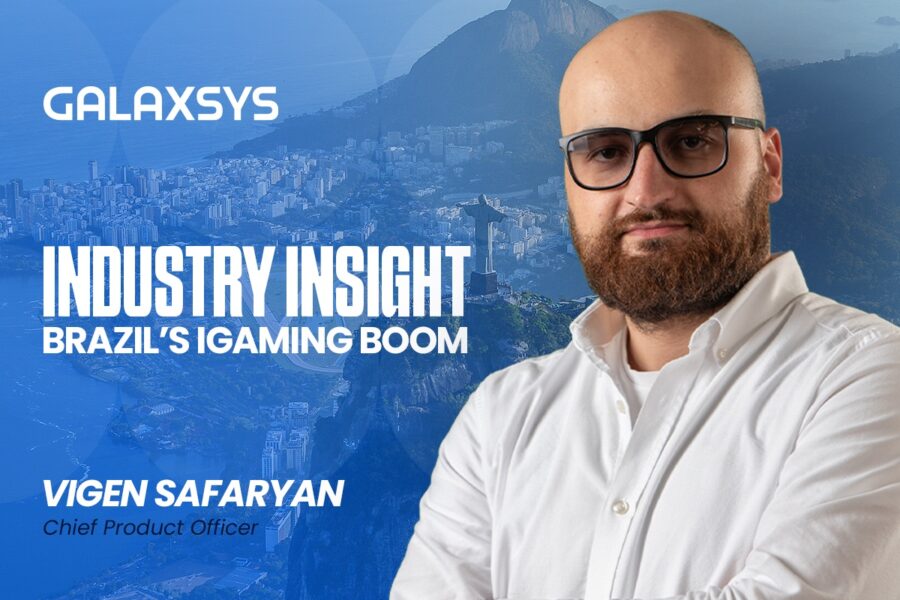

As Brazil transitions from an unregulated frontier to a global powerhouse, Galaxsys CPO Vigen Safaryan explores why technical optimisation and cultural resonance are the true keys to capturing Latin America’s largest gaming audience.
Opinion.- The transformation of Brazil’s igaming landscape from a “market of potential” to a regulated global contender has forced international operators to rethink their expansion playbooks. In this exclusive insight, Vigen Safaryan, CPO at Galaxsys, examines the critical intersection of regulation and product delivery. As the country moves into a fully licensed era, Safaryan argues that the winners will not be those who simply show up, but those who fundamentally re-engineer their offerings to meet the unique technical and cultural demands of the Brazilian player.
Brazil has become the most talked-about market in igaming – and for good reason. This is not just growth; it is a structural shift in how global operators and game studios approach expansion.
For years, Latin America was viewed as a market of potential. Today, Brazil alone is turning that potential into a measurable, large-scale reality. With regulation in place and millions of players entering the ecosystem, the market is no longer a question mark; it is a priority.
From a product perspective, Brazil represents both an opportunity and a challenge. The difference between the two lies entirely in how well companies adapt.
From grey market to global contender
Brazil’s regulatory overhaul is among the most significant industry developments in recent years. Law 14.790, enacted in 2023, followed by the rollout of federal licensing in 2025, transformed the country from an unregulated frontier into a controlled, structured market. Operators must now pay around R$30m (US$6m) for a five-year licence, establish a local entity, and comply with strict player verification, including CPF registration and real-time transaction monitoring.
“Brazil didn’t just regulate the market; it elevated it. The bar is now significantly higher, and that benefits everyone,” says Vigen Safaryan.
A market defined by scale and accessibility
Brazil’s numbers speak for themselves. With over 213 million people, it is Latin America’s largest economy. In 2025, gross gaming revenue reached R$37bn (US$7bn), and around 25 million Brazilians (12 per cent of adults) placed bets on regulated platforms.
“In Brazil, scale matters more than individual spend. You’re not building for a niche audience – you’re building for millions,” Safaryan explains.
This requires studios to prioritise accessibility, retention, and mass appeal over targeting big spenders.
Mobile is a key channel
Brazilian players are overwhelmingly mobile-first. Over 90 per cent of households have internet access, and more than 80 per cent of devices are Android, often mid- to low-range.
“Performance is everything. If a game doesn’t load quickly or run smoothly on a basic device, the player is lost before the experience begins,” Safaryan notes.
Success depends on simplicity, speed, and reliability rather than flashy graphics or complex mechanics. Games optimised for European or North American devices often underperform in Brazil because they are not adapted to local hardware and connection realities.
Culture drives engagement more than features
Brazilian players respond strongly to local themes and cultural resonance. Online slots dominate engagement, but fast-paced games, including crash-style, plinko, and mine-based formats, are increasingly popular due to their immediacy.
“Players in Brazil don’t want to spend time learning a game — they want to feel it immediately,” Safaryan emphasises.
Football is deeply ingrained, with 80 per cent of sports bettors wagering on matches, while Carnival-inspired visuals, music, and local symbols boost engagement in casino games. Localisation is not just translation; it is a design philosophy.
Partnerships will define market entry
Regulatory requirements, including local presence and partial Brazilian ownership, make partnerships critical. Collaborating with established operators provides faster access to player bases and ensures smoother compliance.
“You need people on the ground who understand the nuances of the market. Without that, decisions are based on assumptions, and assumptions carry risk in Brazil,” Safaryan says.
Localisation of language, support, and marketing is equally important. Brazilian Portuguese is a trust factor, not a formality.
A market that rewards commitment
Brazil’s regulatory overhaul is among the most significant industry developments in recent years. Law 14.790, enacted in 2023, followed by the rollout of federal licensing in 2025, transformed the country from an unregulated frontier into a controlled, structured market. Operators must now pay around R$30m (US$6m) for a five-year licence, establish a local entity, and comply with strict player verification, including CPF registration and real-time transaction monitoring.
“Brazil didn’t just regulate the market; it elevated it. The bar is now significantly higher, and that benefits everyone,” says Vigen Safaryan.
Final thought
Brazil is no longer emerging — it has arrived. And in many ways, it is shaping what the next generation of igaming markets will look like. The question for game studios is no longer whether to enter Brazil. It is whether they are ready for what Brazil demands.
By Focus Gaming News Editorial Team