


Aleksandar Popov: “Bulgaria should be careful not to replace regulatory gaps with excessive regulation”
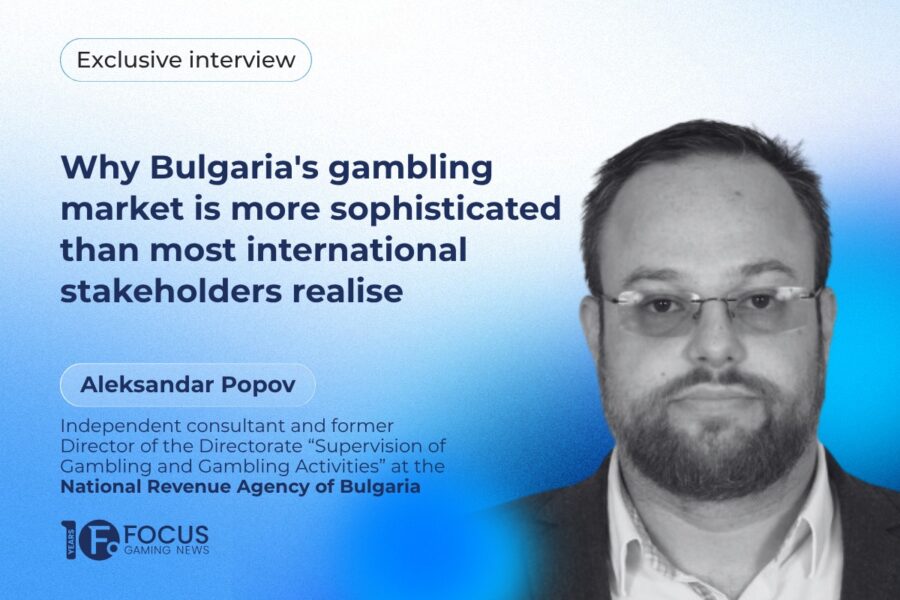

In an exclusive interview with Focus Gaming News, former Bulgarian gambling regulator Aleksandar Popov analyses recent industry reforms, stricter advertising rules, and the future consolidation of the land-based gaming market.
Key takeaways:
- Former Bulgarian regulator Aleksandar Popov says recent gambling reforms were driven partly by revenue-raising objectives.
- Bulgaria’s advertising restrictions have shifted operators’ marketing spending towards digital acquisition, affiliates and remaining legal formats.
- Popov estimates that venue restrictions could affect roughly two-thirds of existing gaming halls.
- He calls for stronger regulatory frameworks covering technology, payments, responsible gambling and land-based betting outlets.
- Popov says Bulgaria needs greater regional cooperation while avoiding excessive or poorly designed regulation that could strengthen the illegal market.
Bulgaria’s gambling market is entering another phase of regulatory change, but former regulator Aleksandar Popov warns that tighter rules could create new gaps if they are introduced without sufficient analysis. In an exclusive interview with Focus Gaming News, he examines the impact of advertising restrictions and land-based venue closures while outlining areas where the framework still needs to evolve.
Exclusive interview.- Bulgaria’s gambling market is undergoing significant regulatory change, with tighter advertising rules, restrictions on land-based venues and potential tax increases reshaping the operating environment for the sector.
In this exclusive interview with Focus Gaming News, Aleksandar Popov, independent consultant and former director of the Directorate “Supervision of Gambling and Gambling Activities” at Bulgaria’s National Revenue Agency, examines the main drivers and potential consequences of the latest reforms. He discusses advertising restrictions, the impact of venue closures on smaller communities and the regulatory gaps that remain around technology, payments and responsible gambling.
Popov also compares Bulgaria’s framework with other European markets, highlights the need for greater regional cooperation across Central and Eastern Europe and assesses what further changes could mean for the market’s structure and competitiveness over the coming years.
From your perspective, what were the main policy objectives behind the latest wave of reforms in Bulgaria’s gaming industry?
From my perspective, revenue collection has been one of the main drivers behind the latest reforms. In a difficult international and fiscal environment, gambling is an obvious target for governments seeking additional revenue. The sector is profitable, highly visible and generally perceived as socially harmful, which makes higher taxation or tighter regulation politically easier than similar measures in many other industries.
There is rarely a political party willing to defend the gambling sector openly, even where a proposed measure may be poorly designed or economically counterproductive. As a result, reforms are often presented primarily as consumer protection measures, while their fiscal effect remains an important, and sometimes dominant, consideration.
This does not mean that public-health and enforcement objectives are absent. They are legitimate concerns. However, when we look at the timing, structure and financial impact of the reforms, it is difficult to ignore the strong revenue component behind them.
“There is rarely a political party willing to defend the gambling sector openly, even where a proposed measure may be poorly designed or economically counterproductive.”
Aleksandar Popov, independent consultant and former director of the Directorate “Supervision of Gambling and Gambling Activities” at the National Revenue Agency of Bulgaria.
Latest changes have created a much stricter environment for gambling advertising across radio, television, print, online media and outdoor formats. How do you see this reshaping the relationship between operators, consumers and regulators in Bulgaria today?
If we are referring mainly to the 2024 amendments, my view is that they were adopted too quickly and without sufficient legal and economic analysis. The policy objective may be understandable, but some of the provisions are not particularly well drafted and leave room for uncertainty in both interpretation and enforcement.
The immediate effect was a major redistribution of advertising expenditure. Television channels and Bulgarian media companies lost a substantial source of revenue, while operators redirected part of their budgets towards digital customer acquisition, affiliate structures and the outdoor formats that remained legally available.
In a digital society, this does not necessarily mean that gambling messages no longer reach consumers. It changes the channels through which they are delivered. One practical consequence is that a larger share of the marketing budget now leaves the Bulgarian media market and is captured by global technology platforms such as Google and Meta.
The relationship between operators and regulators has also become more cautious. Operators need clearer guidance on the boundary between prohibited advertising, permitted corporate identification and information that must be provided to existing customers. Without consistent interpretation and enforcement, the rules may disadvantage compliant operators without materially reducing the visibility of unlicensed gambling.
There is a rule that requires land-based gambling venues in towns with fewer than 10,000 inhabitants to close within a defined transition period. Based on what you have seen so far, what impact is this having on local communities and on the market’s overall structure?
This is one of the most consequential measures for the land-based sector. Based on industry estimates, it may affect roughly two-thirds of existing gaming halls if the rule remains in its present form. The Gambling Act gives existing gaming halls and casinos a three-year period to comply with the population and location requirements.
At the same time, the transitional regime is not sufficiently detailed. It creates a number of questions that may eventually lead to litigation. One example is the treatment of licence maintenance fees that operators have already paid in advance. The transitional provision requires the activity to be brought into compliance, but it does not expressly address what happens to prepaid fees if a licence must effectively end before its original expiry date.
It is also important to be precise about the scope of the rule. The population threshold applies to gaming halls and casinos. It does not apply in the same way to land-based outlets accepting sports bets. This creates a regulatory asymmetry that deserves further consideration.
A town with fewer than 10,000 inhabitants is usually a relatively closed community. If there is sustained demand for gambling, some consumers will travel to another town, use an online operator or, in the worst case, turn to an unlicensed alternative. The restriction will therefore change the structure of the market, but it will not necessarily eliminate the underlying demand. I expect greater concentration in larger towns and a significant reduction in the number of smaller land-based operators.
Based on your experience and from your perspective, what additional legal or regulatory measures do you believe are still needed to fully consolidate Bulgaria’s gambling market?
There is still considerable room for improvement, although Bulgaria should be careful not to replace regulatory gaps with excessive regulation. Good examples exist across Europe, but they should be adapted to the structure of the Bulgarian market rather than copied mechanically.
One useful step would be the direct connection of land-based gaming machines to the National Revenue Agency. Properly designed, such a system could improve tax control, provide more reliable operational data and reduce the burden of repeated physical inspections.
The rules governing land-based sports betting outlets should also be reconsidered. At present, there are differences between the treatment of gaming halls and betting outlets that are not always supported by a clear policy rationale.
Bulgaria should also review how the mandatory responsible-gambling contributions are spent. The issue is not simply how much money is collected, but whether it finances measurable prevention, treatment, research and education programmes.
The regulatory framework must also respond more quickly to technology. Bulgarian legislation is still built largely around conventional concepts such as licensed websites and domain names. It does not provide a sufficiently clear framework for an operator that wants to offer its services through an application without relying on a conventional customer-facing domain. Likewise, Bulgaria does not currently have a workable regulatory category for VLT terminals.
If Bulgaria wants to make full use of the economic potential of the sector, the law must treat technology both as a legitimate means of doing business and as a regulatory tool. The market develops too quickly for legislation that is updated only after a new technology has already become standard elsewhere.
“If Bulgaria wants to make full use of the economic potential of the sector, the law must treat technology both as a legitimate means of doing business and as a regulatory tool.”
Aleksandar Popov, independent consultant and former director of the Directorate “Supervision of Gambling and Gambling Activities” at the National Revenue Agency of Bulgaria.
How does Bulgaria’s current regulatory model compare with other EU markets you follow closely, and what lessons do you think can be shared between regulators?
Some issues are common to almost every European gambling market and require much stronger cooperation between regulators. The clearest examples are illegal gambling, money laundering, cross-border payment flows, advertising through global technology platforms and the implementation of social-responsibility measures.
No national regulator can address these issues effectively in isolation. An illegal operator, payment intermediary, affiliate or digital advertising campaign can operate across several jurisdictions at the same time. Regulators therefore need faster information exchange, common technical standards and more effective communication with search engines, social networks, app stores and payment providers.
I deliberately separate these issues from taxation and the general availability of gambling products. Those areas remain matters for each Member State. Different countries have different social policies, market structures and levels of tolerance towards gambling, and they should remain free to decide how heavily the sector is taxed and how accessible licensed gambling should be.
The lesson Bulgaria can offer is that a comparatively open licensing model can support a competitive market and a strong technology sector. The lesson Bulgaria can take from other jurisdictions is that regulatory stability and detailed consultation are just as important as strict rules. Frequent or hurried amendments make long-term compliance and investment much more difficult.
At SBC Summit Lisbon later this month, what key messages do you plan to convey to international stakeholders about Bulgaria’s regulatory direction, and what do you think are the most common misconceptions about the country’s gambling industry?
My first message will be that Bulgaria does not merely have the potential to become a regional gambling and technology hub. In many respects, it already is one. The number and scale of the Bulgarian companies exhibiting in Lisbon provide visible evidence of that.
The Bulgarian market covers almost the entire industry value chain: gaming equipment, terminals, payment solutions, software engineering, platform development, compliance technology and related professional services. Bulgarian companies have established an international presence in each of these areas.
The regulatory framework also remains more liberal than in many other European jurisdictions. Bulgaria offers a relatively attractive environment for investment, not only because of gambling-specific taxation but also because of its general business conditions. Companies operating here benefit from comparatively low corporate taxes and labour costs, while remaining within the EU single market and having access to a well-developed technology sector.
One common misconception is that Bulgaria is simply a small, low-cost market on the edge of Europe. That overlooks the fact that many Bulgarian businesses develop products and infrastructure for international operators rather than only for the domestic market. Another misconception is that a liberal regime necessarily means weak regulation. The Bulgarian market is regulated and technically sophisticated, although the quality and predictability of legislative changes can certainly be improved.
What are the main regulatory themes or practical issues you expect to highlight for Central and Eastern European markets, and how does Bulgaria fit into that wider regional picture?
An initiative that should not be overlooked is the creation of a Balkan federation of gambling industry associations. It shows that economic operators in the region increasingly recognise the need for a common voice and more structured cooperation.
The industry is consolidating, but the regulatory framework remains highly fragmented. Neighbouring countries often face the same problems, including illegal online gambling, payment blocking, advertising through global platforms, AML compliance and the introduction of new technologies, yet they regulate them in very different ways.
Regional cooperation does not require identical national laws. Taxation, licensing conditions and product availability can remain national decisions. However, associations and regulators can still cooperate on information exchange, technical standards, enforcement against illegal operators and communication with international technology and payment companies.
Bulgaria fits naturally into this regional picture because it has both an established gambling market and a strong technology and manufacturing base. It can play a central role in moving the regional discussion from informal contacts towards practical cooperation.
Taking the Bulgarian market as it stands in late 2026, what outcomes do you realistically expect from the latest legal changes over the next few years?
It is still too early to give a firm forecast. Further amendments are expected before the end of the year, and we first need to see what Parliament ultimately adopts and how the National Revenue Agency interprets and applies the new provisions.
The current expectation is that additional advertising restrictions and further tax increases may return to the agenda, but it is not yet clear whether the reform will stop there. Changes affecting affiliates, technology, land-based venues or licensing procedures could also have a material impact on the market.
If the final result is limited to higher taxes and tighter advertising restrictions, I would expect further market concentration. Larger operators will be better placed to absorb the additional costs, while smaller businesses may reconsider their presence in Bulgaria. Advertising expenditure will continue to move away from traditional Bulgarian media, and the distinction between licensed and illegal digital marketing will become even more important.
The main risk is that regulation may reduce the visibility and competitiveness of licensed operators without reducing consumer demand. If that happens, part of the activity may migrate to unlicensed channels. The final outcome will therefore depend less on the number of restrictions adopted and more on whether they are coherent, enforceable and accompanied by effective action against the illegal market.
By Focus Gaming News Editorial Team