


Aljoša Krupenko, Spintec: “ETGs are the training ground of the future”
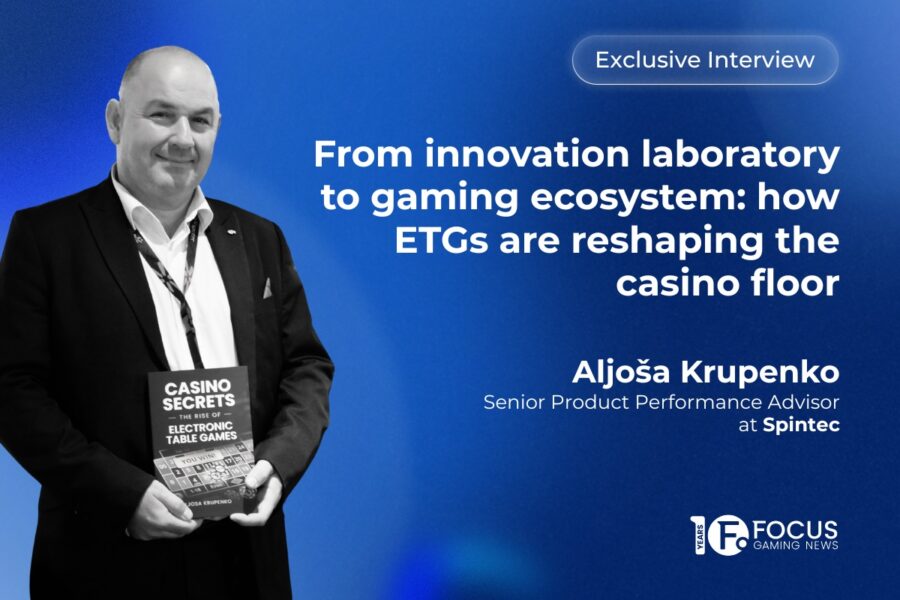
Aljoša Krupenko says to Focus Gaming News that the next phase of competition in ETGs will be decided by who best anticipates how players will behave years from now.
Exclusive interview.- Aljoša Krupenko, senior product performance advisor at Spintec, has published Casino Secrets: The Rise of Electronic Table Games, one of the first books dedicated entirely to ETGs. Drawing on his experience on both the operator and manufacturer sides of the industry, he told Focus Gaming News what inspired the book, how ETGs went from a niche innovation to a distinct casino segment, and why he believes the future lies in balancing live tables with electronic products rather than replacing one with the other.
What inspired you to write Casino Secrets: The Rise of Electronic Table Games, and why did you feel this was the right time for a book dedicated specifically to ETGs?
Two defining moments in my career inspired it. The first was when I moved from casino operations to the manufacturing side of the industry in 2008. I wanted to learn more about Electronic Table Games, so I started looking for books and educational resources on the subject. What I found was a wealth of literature on casino games, mathematics, psychology, and operations, but almost nothing dedicated specifically to ETGs. It felt like a major gap in an industry segment that was already becoming increasingly important.
The second moment happened in 2015 during a business trip with Rob Bone. We were working on product specifications and discussing ETGs in depth when he told me, “You know so much about ETGs, you should write a book.” The idea stayed with me for years.
As ETGs evolved from a niche innovation into a mainstream casino product, I realised the industry needed a resource that documented their history, explained their business impact, and shared practical insights for operators, manufacturers, and anyone interested in understanding this unique segment of the gaming industry.
The book draws on your experience and insights from across the industry. What are some of the key themes or lessons you hope readers will take away from it?
I hope readers take away three main lessons.
First, ETGs have become a distinct segment of the gaming industry rather than simply an alternative to live tables.
Second, long-term success is achieved by balancing technology, operations, and player experience, not by focusing on any single element alone.
Third, the evolution of ETGs demonstrates how innovation can reshape an entire industry when it solves real business challenges for operators while creating engaging experiences for players.
I also hope readers understand that integrating ETGs into a casino operation is not a one-time event but an ongoing journey. Success rarely comes from simply installing a product on the casino floor. It requires a clear strategy, continuous learning, performance analysis, and a willingness to adapt as player preferences evolve. Understanding how to start that journey, and how to grow and optimise an ETG operation over time, is one of the most important lessons I wanted to share.
More broadly, I hope the book helps readers understand not only where ETGs came from, but also why they have become such an important part of the casino floor and where they may be headed in the future.
ETGs have evolved considerably over the years. What do you see as the most significant developments that have shaped the category into what it is today?
ETGs have evolved dramatically over the past few decades, but many people don’t realise their development was driven by two different objectives emerging in different parts of the world.
On one side, the goal was to automate table games completely, turning them into products that could operate much like slot machines without dealers or other gaming staff. On the other side, the focus was on improving the efficiency of live table game operations by introducing electronic betting and automated payouts to speed up games and reduce operating costs.
Over time, these two approaches began to converge, creating the diverse ETG landscape we see today. What started as two separate paths eventually became one. Modern ETG products are expected to deliver the benefits of both worlds, combining the efficiency, scalability, and automation of electronic gaming with the excitement, authenticity, and social aspects traditionally associated with live table games.
Another important development was the shift from technology-driven design to player-driven design. Early ETGs focused primarily on automation and operational efficiency. Today, successful products are designed around specific player segments, different betting behaviours, varying levels of social interaction, and distinct entertainment preferences. This transformation has turned ETGs from a technological innovation into a sophisticated gaming category with its own identity.
What is driving the current adoption of ETGs, and how are operators’ attitudes towards electronic table games changing?
The adoption of ETGs today is driven by a combination of operational efficiency, increased gaming capacity, and changing player preferences. Players are more comfortable with technology than ever before, while operators are looking for flexible solutions that can maximise revenue and optimise floor performance.
What has changed most is the industry’s perception of ETGs. They are no longer viewed simply as a cost-saving tool or a replacement for live tables. Instead, they have become a distinct gaming segment that can attract new players and serve as a bridge between slots, online gaming, and traditional table games.
Several years ago, a well-known industry figure suggested that ETGs would eventually replace live table games. While some operators welcomed that idea because of potential labour savings, I believe it misses an important point. A casino without live table games is no longer truly a casino. It becomes an electronic gaming hall.
The future is not about replacing live tables, but about finding the right balance where live tables and ETGs work together to deliver the best player experience and business results.
“Players are more comfortable with technology than ever before.”
Aljoša Krupenko, senior product performance advisor at Spintec.
From an operator’s perspective, what are the biggest advantages of ETGs compared with traditional live table games, and how can the two formats complement each other?
From an operator’s perspective, ETGs offer several important advantages. They increase gaming capacity, require less operational staffing, allow for lower minimum bets, and can generate significantly more game outcomes per hour than traditional live tables. They also provide flexibility, enabling operators to offer multiple games and betting opportunities within a relatively small footprint. In addition, electronic bet collection and automated payouts can help reduce certain fraud risks, cash handling vulnerabilities, and operational errors.
At the same time, traditional live tables deliver something technology cannot fully replicate: human interaction, atmosphere, and the authentic casino experience. This is particularly important for premium players and for maintaining the identity of the casino floor.
The most successful operators recognise that ETGs and live tables serve different strategic purposes within the same gaming ecosystem. Each attracts different player behaviours, betting patterns, and expectations, making both important components of a balanced casino floor.
Looking ahead, I believe ETGs will become even more important. For many younger and newer players, traditional table games can feel intimidating or simply too expensive. ETGs provide an accessible environment where players can learn the games, build confidence, and develop their skills at their own pace. In many ways, ETGs are the training ground of the future, preparing players for what many still consider the ultimate casino experience: live table gaming.
When combined effectively, the two formats create a stronger player journey and a healthier long-term gaming ecosystem.
How are changing player preferences influencing the development of ETGs? What do today’s players expect from an electronic table-game experience?
Player preferences are shaping ETG development, but the real challenge is not understanding today’s player. It’s understanding tomorrow’s player. ETG platforms are often expected to remain on a casino floor for seven years or more, which means operators and manufacturers must look well beyond current trends and anticipate how player expectations will evolve.
Future generations are growing up in a world of instant access, digital interaction, and continuous entertainment. They expect intuitive interfaces, immediate feedback, personalisation, and freedom of choice. They are less willing to invest time learning complex processes and more likely to engage with products that are accessible from the very first interaction.
As a result, ETGs must continue evolving beyond simple game automation. The most successful products will combine authenticity with speed, offer greater flexibility, support different styles of play, and create experiences that feel natural to digitally native players. Technology will remain important, but the focus will increasingly shift toward convenience, engagement, and user experience.
What makes ETGs uniquely positioned for the future is their ability to evolve without losing the authenticity of the games themselves. The most successful products will preserve the credibility and excitement of traditional table gaming while continuously adapting to changing player expectations.
Are there particular markets or regions where you see especially strong potential for ETG growth, and what factors are driving that opportunity?
I see growth opportunities for ETGs in virtually every gaming market, but not because players everywhere want the same thing.
One of the most important lessons from the evolution of ETGs is that player preferences are highly regional. While certain trends such as digital adoption and demand for convenience are becoming more universal, game preferences, betting behaviour, and social dynamics can vary significantly from one market to another.
The world is becoming increasingly connected, and many geographical boundaries are gradually disappearing. However, demographic and cultural differences remain. Age, gaming experience, spending habits, and local attitudes towards gambling continue to influence how players interact with casino products.
In fact, one of the biggest differences between regions is how gambling itself is perceived. Outside North America, gambling is often viewed through a traditional lens, either as a long-standing cultural activity or, in some cases, as something with negative social connotations. In North America, however, casino gaming is generally more accepted as a form of entertainment and leisure activity, although individual views naturally vary.
Another important factor is that the ETG journey did not begin everywhere at the same time. Some regions have been developing and optimising ETG operations for decades, while others are still in relatively early stages of adoption. This creates very different levels of market maturity and influences how operators approach product selection, floor strategy, and player development.
As a result, I do not believe there is a single blueprint for ETG success. The biggest opportunities will belong to operators who understand both global trends and local player behaviour, and who can adapt their ETG strategy to where their market is today and how it is likely to evolve.
Looking ahead, what do you believe will be the next major evolution for ETGs? Which technologies, trends or player behaviours could have the biggest impact on the category over the next few years?
I believe the next major evolution of ETGs will not be defined by a single technology. It will be defined by how successfully the industry combines proven casino game concepts with changing consumer expectations.
For decades, table games have remained remarkably consistent because their core mechanics work. Roulette, Blackjack, Baccarat, and Craps have survived for generations because players understand them, trust them, and enjoy them. I do not believe the future is about replacing these foundations. The future is about enhancing them through smarter product design, greater flexibility, and more engaging player experiences.
What makes this challenge particularly interesting is that many leading ETG manufacturers already offer products that appear quite similar on the surface. The real difference lies in their vision of the future. Every manufacturer is making assumptions about how players will behave, how casinos will operate, and what experiences will become important in the years ahead. In many ways, the next phase of competition will be determined less by hardware and more by who best understands evolving player expectations.
I also believe we will see increasing diversification within the ETG category itself. In the future, a Blackjack game from one manufacturer may deliver a completely different player experience than a Blackjack game from another. The same may become true for Roulette, Craps, and other traditional games. The wheel, cards, or dice may simply serve as mechanisms for generating outcomes, while the player experience surrounding those outcomes becomes the true differentiator.
In many respects, ETGs could begin to evolve in a similar way to today’s video slot market, where products built around the same fundamental principles can deliver vastly different entertainment experiences. As this happens, operators will increasingly evaluate ETG products not only on financial performance, but also on player acquisition, player retention, product positioning, and their ability to serve different player segments.
Another area where ETGs have a significant advantage is game innovation. Live table games are naturally constrained by dealer procedures, training requirements, game protection standards, and operational complexity. ETGs provide a far more flexible environment for experimentation and innovation. They allow manufacturers and operators to introduce new concepts, test player acceptance, and refine game mechanics with significantly less operational risk. In many cases, ETGs can serve as an innovation laboratory for the broader table-game industry.
The future may not be limited to traditional table games alone. Dice, cards, wheels, and other randomising devices should not be viewed only as components of existing games. Dice, for example, do not have to be used exclusively for Craps. They can become the foundation for entirely new gaming concepts and entertainment experiences. Some of those concepts may remain unique to ETGs, while others could eventually mature and find their way onto live casino floors.
Just as slot machines evolved from simple mechanical devices into thousands of unique entertainment experiences, I believe ETGs have the potential to evolve from a category primarily built around traditional casino games into a platform for entirely new forms of gaming entertainment.
I also believe the industry will increasingly move away from thinking about ETGs as standalone products and toward viewing them as complete gaming ecosystems. Operators will focus not only on the performance of an individual game, but on how products support player acquisition, player progression, entertainment value, operational efficiency, and long-term floor strategy.
The next generation of players is growing up in a world shaped by personalisation, instant access, digital engagement, and unlimited entertainment choices. Simply digitising a traditional game will no longer be enough. Future ETGs must be intuitive, accessible, flexible, and capable of delivering meaningful experiences from the very first interaction.
Ultimately, I believe the biggest winners will be the companies that can balance innovation with familiarity. The challenge is not to reinvent casino gaming. The challenge is to identify what should remain timeless and what must evolve. Those who understand that balance will define the next chapter of the ETG industry.
“Future ETGs must be intuitive, accessible, flexible, and capable of delivering meaningful experiences from the very first interaction.”
Aljoša Krupenko, senior product performance advisor at Spintec.
Having worked on both the operator and manufacturer sides of the industry, how has your experience at Spintec shaped your perspective on Electronic Table Games, and what does your current role involve?
Having worked on both the operator and manufacturer sides of the industry has given me a unique perspective on Electronic Table Games.
My current role as Senior Product Performance Advisor at Spintec is focused on helping shape future products and solutions that ultimately deliver a better player experience. The knowledge I gained in casino operations, combined with years of analysing player behaviour and working closely with operators around the world, provides valuable insights into what works on the casino floor and why.
Spintec is a relatively young company compared to some industry players, yet it has already established itself as a recognised global ETG brand with a strong product portfolio and an excellent development organisation. My role is not to reinvent that structure, but to contribute an additional market perspective. I believe having another set of eyes and ears focused on operator challenges, player expectations, and emerging trends can only strengthen the product development process.
I have always been a strong advocate of innovation and the creation of new products and functionalities. Whether it is improving operational efficiency for casinos or enhancing the experience for players, I believe the best products are developed when technology, market feedback, and player needs come together.
In many ways, my role is to help ensure that future solutions are not only technically advanced, but also relevant and valuable to the people who use them every day.
By Focus Gaming News Editorial Team