


South African Bookmakers’ Association calls for Polymarket-style prediction markets to fall under gambling laws


SABA’s position paper calls for a dedicated legal framework, warning that offshore prediction markets pose integrity, consumer protection and anti-money laundering risks.
South Africa.- The South African Bookmakers’ Association (SABA) has urged regulators to bring prediction markets such as Polymarket and Kalshi under South Africa’s gambling laws, warning that unregulated platforms offering wagers on political, economic, social and sporting outcomes operate outside South Africa’s gambling framework.
In a Policy Position Paper published on July 27, the industry body said the rapid growth of offshore prediction market platforms has exposed regulatory gaps. SABA pointed to reports that more than R700,000 (US$43,000) was wagered on Johannesburg’s next mayor through Polymarket despite the absence of South African licensing, taxation, responsible gambling measures or integrity safeguards.
“Prediction markets are, in substance, exchange betting products operating under a different label,” SABA CEO Sean Coleman said.
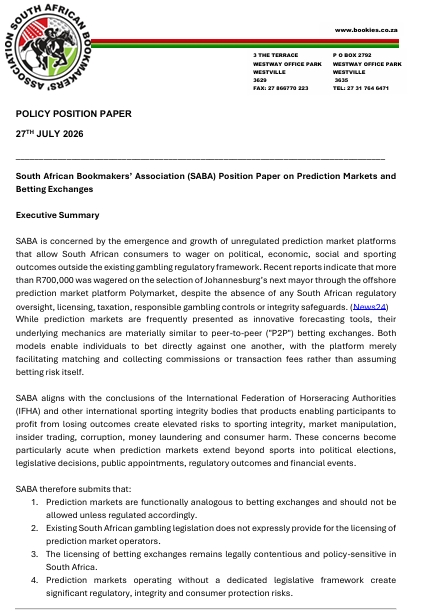
The association said prediction markets are functionally equivalent to betting exchanges, fall outside South Africa’s current licensing framework and called for a dedicated legislative framework before any future authorisation is considered. It said the licensing of betting exchanges remains legally contentious and that unregulated prediction markets create significant integrity, consumer protection and regulatory risks.
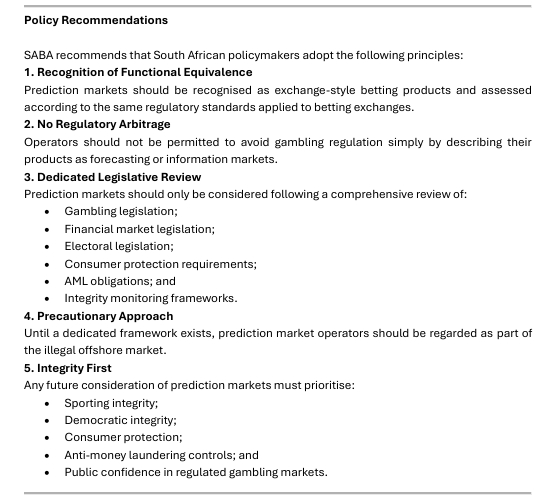
SABA also said operators should not avoid gambling regulation simply by describing their products as “forecasting” or “information markets”, while calling for a review of gambling, financial market, electoral, consumer protection and anti-money laundering legislation before such platforms are permitted to operate legally in South Africa.
SABA said any future framework should be based on five principles: treating prediction markets as functionally equivalent to betting exchanges, preventing regulatory arbitrage, undertaking a comprehensive legislative review, adopting a precautionary approach to licensing, and placing integrity and consumer protection at the centre of regulation.
SABA said prediction markets allow participants to stake money on future events, from elections and sporting contests to economic indicators, and argued they are gambling products because participants wager on uncertain outcomes for financial gain.
The association said prediction markets are structurally similar to peer-to-peer betting exchanges because users wager against one another while the platform earns commission rather than taking on betting risk. It cited betting exchange operator Betfair’s model as an example of the same structure. “The distinction is therefore largely one of branding rather than substance,” Coleman said.
The association also pointed to the long-running legal uncertainty surrounding the North West Gambling Board’s licensing of bookmaker operators to offer betting exchange products, saying the issue remains unresolved and demonstrates the need for clearer legislation.
Coleman said: “The emergence of unregulated prediction markets in South Africa, including markets on political outcomes, highlights the urgent need for regulatory clarity.”
Integrity and consumer protection
The position paper also echoes concerns raised by the International Federation of Horseracing Authorities (IFHA) in an April 2026 despatch warning that products allowing participants to profit from losing outcomes increase the risk of match-fixing, insider manipulation and criminal exploitation while undermining public confidence in sporting integrity. SABA said these concerns also extend beyond sport.
The association cautioned that prediction markets covering elections, cabinet appointments, legislative votes and government contracts could create financial incentives to influence democratic processes. It added that South Africa lacks an equivalent monitoring framework to detect or prevent manipulation linked to such markets.
SABA also argued that, until South Africa introduces a dedicated legislative framework, offshore prediction markets should be regarded as part of the illegal offshore gambling market. The association warned that these platforms present anti-money laundering and consumer protection concerns, noting that many facilitate cross-border peer-to-peer transactions and frequently involve crypto-assets. It added that South African consumers lack local safeguards such as responsible gambling measures, self-exclusion and formal dispute resolution.
The association also warned that offshore prediction markets could divert gambling revenue from South Africa, reducing tax receipts and limiting local economic benefits.
The position paper added: “Until South African Gambling Regulators have enacted a comprehensive legal framework addressing licensing, integrity monitoring, consumer protection, anti-money laundering compliance and taxation, SABA submits that betting prediction markets cannot and should not be authorised to operate in South Africa and should be treated as exchange-style betting products falling outside the scope of the current legislative framework.”