Miguel Ángel Ochoa Sánchez, AIEJA: “The World Cup 2026 is undoubtedly one of the biggest challenges facing operators in our country”
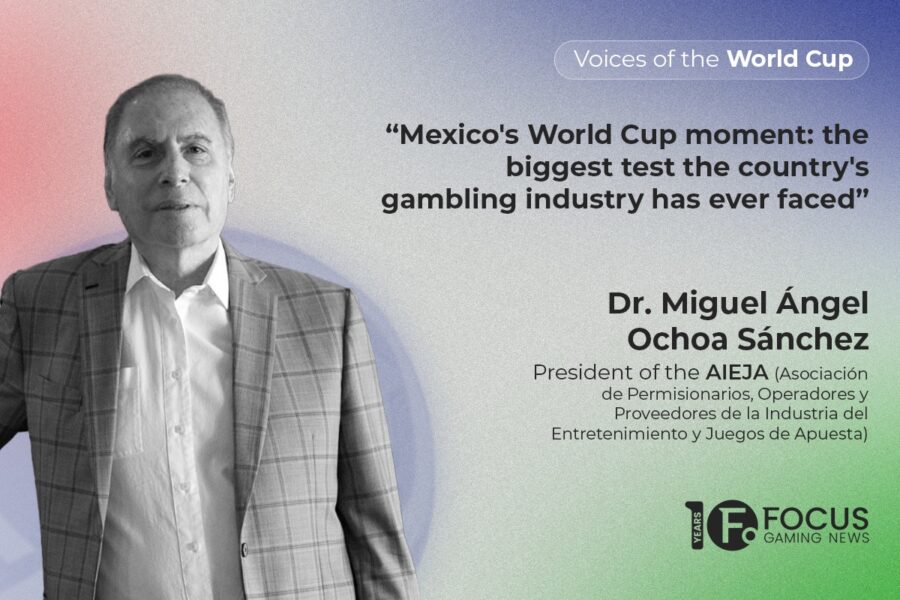

In the sixth instalment of ‘Voices of the World Cup’, Focus Gaming News spoke to Miguel Ángel Ochoa Sánchez, CEO of AIEJA, about the Mexican gambling market and how they prepared for the World Cup.
Exclusive interview.- For Mexico’s gaming and sports betting industry, the 2026 FIFA World Cup represents far more than a month-long sporting spectacle. As one of the tournament’s three host nations, the country is preparing for an unprecedented surge in betting activity that will test operators’ platforms, payment systems, customer support capabilities, and player retention strategies. At the same time, the event arrives amid ongoing discussions about the future of gaming regulation in Mexico, adding another layer of significance to what could become a defining moment for the sector.
In this exclusive Focus Gaming News interview, the sixth in the “Voices of the World Cup” series, Miguel Ángel Ochoa Sánchez, Executive President of the Asociación de Permisionarios y Proveedores de la Industria del Entretenimiento y Juegos de Apuesta en México (AIEJA), shares his views on the opportunities and challenges that the World Cup presents for operators, the evolution of the Mexican bettor, the status of the country’s long-awaited gaming reform, and the lasting impact the tournament could have on one of Latin America’s most important gambling markets.
Mexico is co-hosting the 2026 FIFA World Cup alongside the United States and Canada. For the country’s gambling and sports betting industry, what does this tournament represent? Is it a turning point, a unique opportunity, or simply the biggest event in an industry that was already growing strongly?
From my perspective, as a representative of an association that brings together all verticals of the gaming industry, the 2026 World Cup is, without doubt, one of the greatest challenges for operators with a presence in our country. Without overlooking the enormous opportunity this sporting event represents for any company in the sector, it also generates, and will continue to generate, significant operational challenges at the moment of execution itself. Experts in the field speak of a dramatic spike in sports betting during the weeks the World Cup lasts, and this will be a baptism of fire for many.
If we factor in that, amid this avalanche of bets, a large number of first-time bettors are expected, this will put the functionality and proper operation of betting platforms to the test, as well as each company’s capacity to retain these potential customers by designing tailored marketing strategies for these new profiles. At the same time, the protection of betting integrity, the speed and security of payment processing, and personalised customer service will be what makes the difference in the midst of competition among the many brands present.
For some, this World Cup will be a great opportunity. For others, the less prepared, it will almost certainly be a difficult experience. History will tell us whether our industry was capable of capitalising on it.
Mexico has more than 30 million active digital players. How would you describe the Mexican bettor ahead of the World Cup; their profile, their preferences, the markets they consume the most? How do they differ from their European or South American counterparts?
Mexico, as you rightly note, is a country with a broad, growing digital market and a population highly receptive to the appeal that sporting activities generate in general, and football in particular. That said, describing the average Mexican bettor is complex, because their profile is not homogeneous. There are significant differences between the passions of a Mexican from the north and one from the Gulf Coast or the Caribbean. However, according to existing studies, the typical profile would be male, aged between 18 and 35, with football running through their veins.
And this World Cup, Mexico’s third as a host, holds enormous appeal for broad segments of the population. Football (soccer) both domestic and international, remains the king of sports in terms of betting. However, Mexicans also have a marked taste for boxing, baseball and basketball, not forgetting the growth that American football, tennis and, more recently, thanks to “Checo” Pérez, Formula 1 have experienced.
As for differences with other markets around the world, I would find it difficult to offer an opinion. What I can say is that the Mexican bettor has matured considerably over recent years. Today they are an informed player, with genuine sporting knowledge who bases their bets on statistics, though, at a local level, their heart leads them to bet on their club of choice rather than on hard evidence.
“Describing the average Mexican bettor is complex, because their profile is not homogeneous.”
Miguel Ángel Ochoa Sánchez, president of the AIEJA.
In the lead-up to the tournament, did you hold any dialogue with associations and regulators from the other host countries?
As AIEJA, which I represent, no. We have not had any specific engagement with counterpart organisations or regulators from the United States or Canada on the subject of the World Cup. Our industry-level dialogue is more focused on our colleagues in South America. We regularly exchange views on our respective realities and meet at the numerous sector trade fairs held across the continent and beyond.
Mexico is hosting several matches. How is the regulatory ecosystem preparing in terms of infrastructure, player protection and risk prevention during what will be unprecedented betting volumes?
Indeed, of the total matches that this great World Cup will see across North America, Mexico is hosting 13, including the opening fixture between Mexico and South Africa played on June 11. Three cities have been honoured by FIFA: Mexico City, Guadalajara and Monterrey.
As is often the case in countries where state regulation of the activity is insufficient, the industry ecosystem ends up self-regulating. And that is the case in Mexico. Our operators, many of them with operations and even headquarters in other regions of the world, have aligned their processes with the most demanding international standards that the proper functioning of the sector requires. Much of the competition between brands will, precisely, play out in terms of how companies manage to guarantee security for bets, for financial transactions, for players themselves, and in the speed with which payments are processed. And there we shall see who was prepared to handle this extraordinary peak in activity and who was not.
You had expected the new regulatory framework to reach Congress before the legislative session closed in April. That window has now closed. The World Cup begins in June; how would you describe this moment?
That is correct. Following the process we went through in the first quarter of 2025, in the working groups convened by the Secretariat of the Interior to draft a new Federal Gaming and Lottery Law, we had hoped that it would be debated during the first legislative session of this year. However, the national political circumstances appear to have decided otherwise. And at the time of answering these questions, I would not venture to suggest a new potential date.
I believe this is unfortunate for the sector and for the country. It was a great opportunity to present to the world a Mexico with a modern law that guaranteed the sound functioning of a highly dynamic economic activity, one that not only generates employment and attracts foreign investment, but also contributes generously to the public treasury. The absence of a precise framework to regulate, above all, digital activity will allow a broad range of illegal operators to continue operating, letting far from negligible tax revenues slip through the net, while leaving investors, who are waiting precisely for a formal decision to determine whether or not it is worth betting on Mexico, in a state of uncertainty.
How does the 2026 FIFA World Cup accelerate or complicate the implementation of sports betting reforms?
At this stage, I would say it neither accelerates nor complicates anything. In all sincerity, I would hope that following the conclusion of the World Cup, our authorities carry out a serious evaluation of the results, and that those results serve to reinforce the positions that would be favourable to the drafting and subsequent enactment of a new gaming law for our country. Not doing so would not change much. The Mexican market is a regulated market that functions. But making the decision to act could project our industry to another level entirely and make it an even more dynamic engine of the national economy.
Mexican football has a very particular relationship with the national team. How does Mexico’s performance in the tournament affect the behaviour of local bettors? What happens to the market if the national team reaches the latter stages, or if they are eliminated in the group phase?
That is true. The national team inspires a passion among the Mexican public that is hard to match. And whilst I do not have precise data on the subject, I do not think I would be wrong in saying that if Mexico is eliminated in the early stages, there would be a substantial drop in the projections that operators may have built into their business plans, and vice versa. However, both specialists and artificial intelligence tools consider it unlikely that Mexico will progress beyond the quarter-finals, at best. History will tell us.
Mexico shares the hosting duties with two countries that have very different gaming markets: the United States, with 38 regulated states, and Canada, with Ontario as a continental benchmark. What can the Mexican industry learn from its two co-hosts, and what does Mexico have that the other two do not?
The differences between our markets do not lend themselves to straightforward comparison. In the case of the United States, it is the individual states that regulate gaming; in Mexico, it is the Federal Executive. Canada has a population of just over 40 million, while Mexico has 130 million and a highly uneven GDP per capita. Personally, I do not believe our regulatory authorities have a great deal to learn from one another.
At the industry level, however, numerous platforms operating in Mexico already have operations in the other two countries. These are markets they know very well, and they have almost certainly already incorporated the best of each into their own local offerings, without forgetting the necessary localisation of their products.
Beyond betting volumes, what concrete legacy could the World Cup leave for the gaming industry in Mexico? Are there products, markets or betting habits that this tournament could establish permanently among Mexican bettors?
Given the magnitude of the event and the projections specialists are making regarding the volume of bets that will be processed, the World Cup will leave many lessons and learnings; not only for operators in Mexico, but also for those in the United States, Canada and elsewhere. I hope that each of these operators will know how to capitalise on the experience in order to strengthen and/or restructure their businesses. As for products or habits, we are already seeing the advance of the controversial prediction markets, which are beginning to make their presence felt ahead of this World Cup. Combined with artificial intelligence tools, this could genuinely have an impact on the way sports betting is perceived in our country. We shall be watching closely.
This is the sixth instalment of Voices of the World Cup, an exclusive interview series exploring how the sports betting and igaming industry prepared for the FIFA World Cup 2026™. Over the last weeks, Focus Gaming News spoke with the most influential leaders in the sector on AI-driven trading, platform stability, Bet Builder innovation, next-gen retention and crypto integration.
Follow the series at focusgn.com
By Focus Gaming News Editorial Team