LatAm igaming 2025: rise of local operators reshapes market

A report by Blask for Focus Gaming News finds that following strong growth in 2025, the Latin American igaming market is consolidating a new competitive order dominated by local operators.
Special report.- During 2025, the igaming market in Latin America underwent a structural shift that is changing the rules of competition in the region. What was until recently fertile ground for the expansion of global brands is beginning to consolidate into an ecosystem dominated by local and regional operators, with advantages that are increasingly difficult to replicate.
The analysis comes from the latest report by Blask for Focus Gaming News, based on its Blask Index, a metric that measures the real volume of demand from normalised search data. Unlike other metrics, the index does not reflect declared revenue or indirect estimates but rather effective user interest, making it a particularly useful tool for understanding competitive dynamics in markets where information is limited or fragmented.
Along with the Blask Index, the report uses BAP (Brand’s Accumulated Power), which measures each brand’s share of total demand in a given country. Based on these two variables, the study identifies a consistent trend across the seven markets analysed: El Salvador, Venezuela, Bolivia, Costa Rica, Mexico, Peru and Chile. Demand is growing but concentrating rapidly, and that concentration mainly favours players with strong local roots.
In most cases, the top three operators account for between 74 per cent and 86 per cent of total demand. This level of concentration not only reduces the competitive space but also significantly raises the barriers to entry. At the same time, the report highlights a cross-cutting phenomenon that is redefining the industry’s positioning in the region: global brands such as Bet365 and Stake are losing market share across multiple markets, while the operators that are growing are those operating with a local logic, particularly in payments, marketing and knowledge of the user.
Three growth trajectories, one direction
Although all seven markets registered growth during 2025, they did not all do so in the same way. The report distinguishes three trajectories that explain the evolution of the sector in the region but which, despite their differences, lead to the same result: the consolidation of local leadership.
In emerging markets such as El Salvador, Venezuela, Bolivia and Costa Rica, growth is not a response to a redistribution of existing demand but to the creation of new demand. In these countries, the Blask Index doubled or even tripled over the course of a year, creating scenarios of rapid expansion where competition is defined in very short periods.
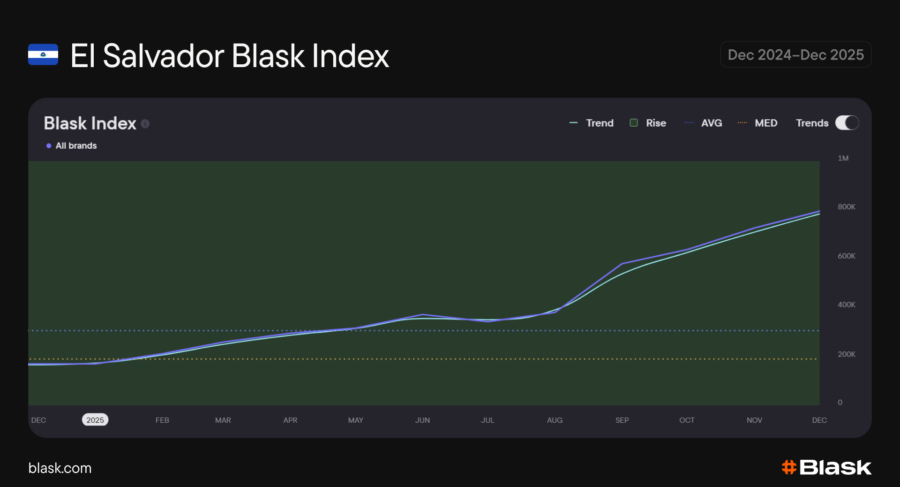
The case of El Salvador is paradigmatic. Growth was sustained throughout the year and was accompanied by a profound change in market structure. The state-owned platform Dale, which started as the leader, lost most of its market share, while private operators such as GanaPlay and DoradoBet captured the bulk of demand. More than a simple change of positions, the data reflects a transition to a model where the speed of execution, investment and product iteration are decisive.
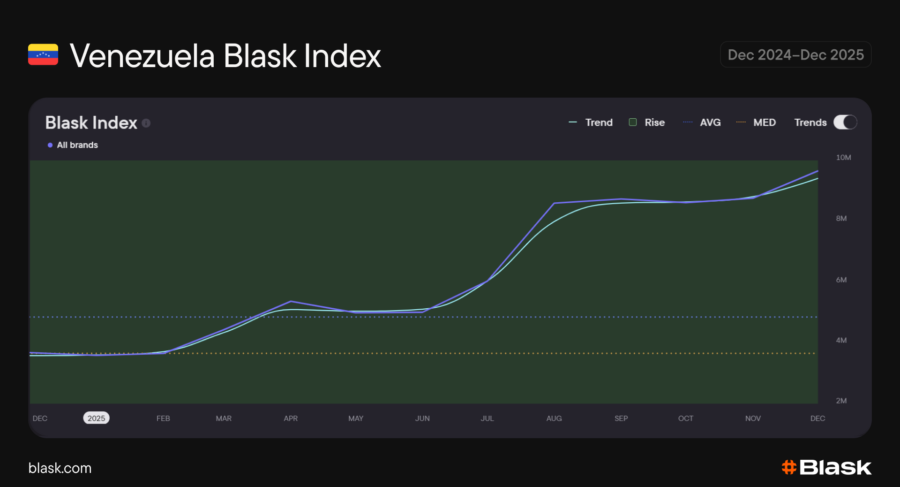
Venezuela shows a different dynamic, with no significant changes in the first half of the year and a marked acceleration in the second half. In this context, Triunfo Bet extended its lead and, together with two other operators, captured most of the market. This phenomenon raises a relevant question about the sustainability of these leadership positions and the relative weight of factors such as product quality versus investment capacity in acquisition.
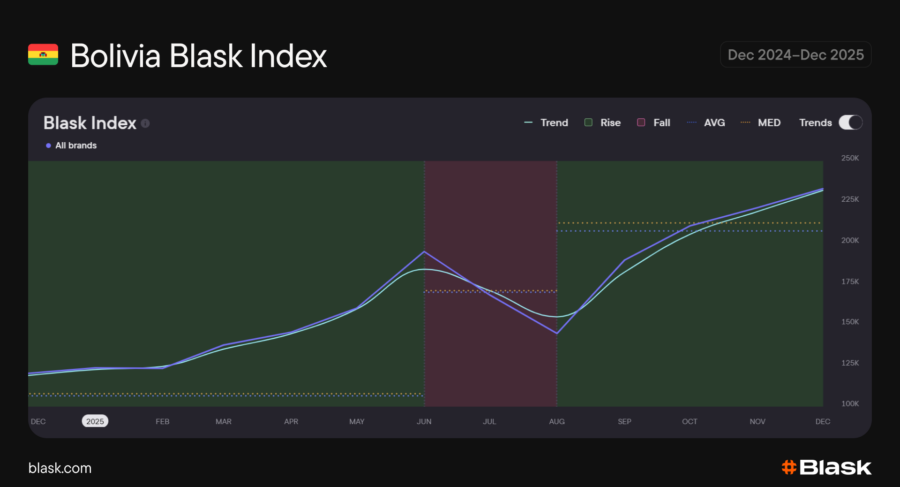
Bolivia follows a similar pattern, with a local operator extending its lead while international brands retreat. Costa Rica, meanwhile, represents the most extreme case, with a level of concentration close to a monopoly around a single operator. The reasons behind this phenomenon are not conclusive, although the report suggests possible factors such as the integration of local payments, economies of scale in marketing or certain regulatory conditions.
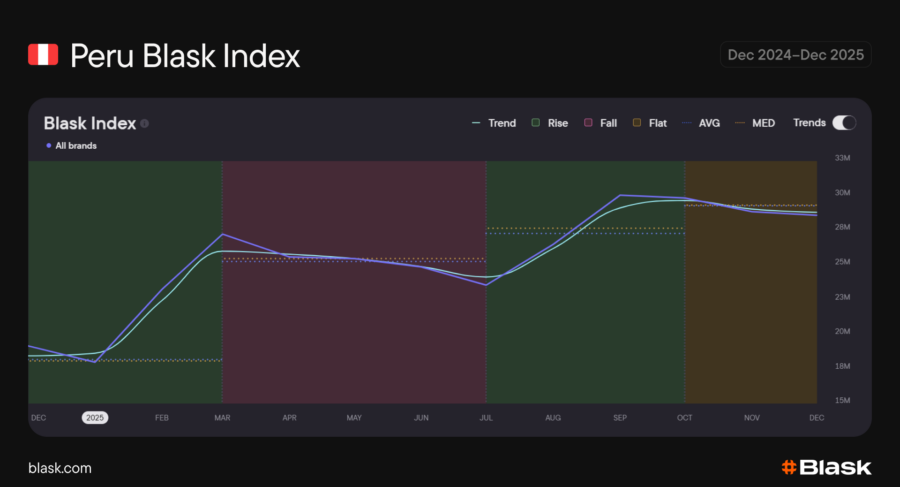
In contrast, the more developed markets, such as Mexico and Peru, exhibit a more stable dynamic. Growth is smaller in relative terms, but it occurs on much broader bases, where small variations in market share have significant economic impacts.
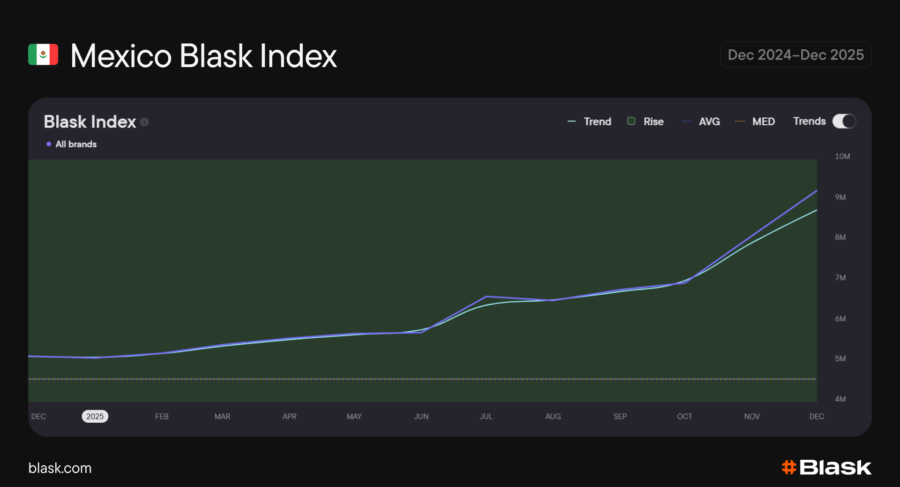
Mexico shows almost linear expansion throughout the year, without major disruptions, which reinforces the position of its leading operator, Caliente. In this type of environment, consolidation does not depend on isolated upheavals but on the ability to sustain competitive advantages over time. Peru, for its part, shows more fragmented behaviour, with variations throughout the year that reflect the influence of seasonal factors. There, the leadership remains stable, but there are notable movements further down the rankings, in particular the growth of Betano — one of the few international brands to have expanded in the region through a strategy clearly adapted to the local context.
The third pattern identified by the report is seen in Chile, which combines more moderate growth with an alteration in the competitive structure. After a phase of expansion, the market enters a correction towards the end of the year, which could be interpreted as an early sign of saturation. In this scenario, the leading operator loses market share to a direct competitor, giving way to a more balanced configuration at the top of the market. This is the only case in which the leadership is significantly challenged by a single player.
A more closed and demanding market
Beyond the particularities of each country, the report converges on a clear conclusion. Latin America is moving towards a market model that is more concentrated, more competitive and less permeable to new entrants.
The operators that managed to position themselves early have built structural advantages in key areas such as payment systems, user acquisition and retention. These advantages not only explain their growth during 2025 but also anticipate a scenario in which competing will require increasingly high investment and a deep knowledge of each market.
In this context, global scale is no longer a guarantee of success. The evidence suggests that the decisive factor is the ability to operate in close proximity to the user, adapting product, communication and channels to local particularities. The trajectory of international brands losing market share across multiple markets reinforces this reading and points to a paradigm shift in regional expansion strategy.
The scenario emerging for 2026 is that of a region where the opportunity no longer lies in opening new markets but in the depth of execution within them. In this new equilibrium, proximity is no longer a competitive advantage but a prerequisite to endure over time.
By Focus Gaming News Editorial Team