Eduardo Lobato, Sportradar: “The FIFA World Cup 2026 will set a new benchmark for real-time sports data”
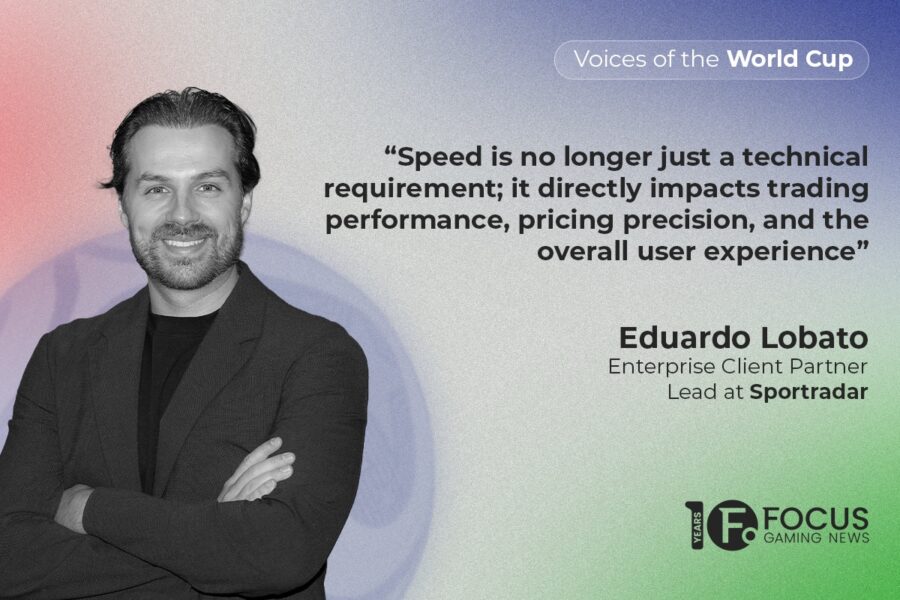

In the fifth instalment of “Voices of the World Cup”, Eduardo Lobato, Enterprise Client Partner Lead at Sportradar, discusses feed latency and scaling micro betting for the 2026 World Cup.
Exclusive interview.- As the sports betting industry prepares for the 2026 FIFA World Cup, operators are facing a new reality where speed, data accuracy and infrastructure resilience will be just as important as odds and marketing strategies. With 104 matches, multiple simultaneous kick-offs across three host nations, and an expected surge in micro betting activity, the tournament is set to push sportsbook technology to its limits.
In this exclusive Focus Gaming News interview, the fifth in the “Voices of the World Cup” series, Eduardo Lobato, enterprise client partner lead at Sportradar, explains why feed latency is becoming one of the most critical competitive advantages in modern sports betting. He discusses the infrastructure challenges behind delivering real-time football data at global scale, the growing importance of micro markets, and how innovations in AI, trading technology and personalisation are shaping the future of in-play betting ahead of the industry’s biggest event.
The World Cup 2026 is expected to generate a record-breaking in-play micro betting volume. How does feed latency become the defining competitive factor for operators?
The FIFA World Cup 2026 will set a new benchmark for real-time sports data, with in-play and micro betting volumes reaching unprecedented levels. In this environment, latency becomes a critical competitive factor, as operators must reflect the live state of the match with maximum accuracy. Speed is no longer just a technical requirement; it directly impacts trading performance, pricing precision, and the overall user experience.
At Sportradar, we address this through our Live Data ecosystem, where end-to-end processing is optimised specifically for micro-markets. At this scale, the convergence of data and streaming is equally important. Sportradar’s synchronised delivery of live data and audiovisual content allows operators to make quicker, more informed decisions while maintaining consistency across platforms. Ultimately, those backed by the fastest and most reliable infrastructure will be best positioned to scale micro betting, manage risk, and maximise in-play engagement.
“Sportradar’s synchronised delivery of live data and audiovisual content allows operators to make quicker, more informed decisions while maintaining consistency across platforms.”
Eduardo Lobato, enterprise client partner lead at Sportradar.
Where are the biggest bottlenecks in live football data delivery?
The biggest bottlenecks typically occur across three stages: data capture, transmission, and synchronisation. Capturing events in real time requires highly accurate collection, while global distribution depends on infrastructure capable of delivering data reliably at speed and at scale.
We mitigate these bottlenecks by leveraging advanced Computer Vision technology and our extensive global network to ensure high-fidelity data capture. As event volumes increase during the World Cup, the challenge shifts from pure speed to coordination. Data, odds, and video must be precisely aligned. Sportradar’s fully integrated, low-latency ecosystem enables operators to deliver consistent real-time performance across markets and platforms, even under the extreme peak demand scenarios we expect in 2026.
Next-goalscorers, corners-per-minute, player shots—how does a 100ms latency difference impact pricing accuracy in these micro-markets?
In micro betting markets, pricing models rely on high-frequency, event-driven inputs, making them extremely sensitive to latency. Even a 100-millisecond difference can affect how quickly models process new data—such as possession changes or attacking sequences—and adjust probabilities. Reacting with minimal delay is essential to maintaining accurate and responsive pricing.
From a trading perspective, this is where Sportradar’s Alpha Odds and Managed Trading Services (MTS) provide a decisive edge. By utilising advanced mathematical models that process inputs in milliseconds, we allow operators to recalibrate markets faster, maintain tighter spreads, and deliver a more stable in-play environment. At the scale of the World Cup, this level of precision is the key differentiator in supporting high-frequency trading while ensuring a seamless user experience.
“Reacting with minimal delay is essential to maintaining accurate and responsive pricing.”
Eduardo Lobato, enterprise client partner lead at Sportradar.
The World Cup 2026 means 104 matches, up to six played simultaneously, across three countries and multiple time zones. From an infrastructure standpoint, what does that scale demand that a standard club football season simply doesn’t?
The scale of the World Cup introduces a level of complexity regarding concurrency and geographic distribution that standard seasons rarely match. With up to six matches running simultaneously, infrastructure must be fully elastic, capable of scaling instantly to handle massive spikes in data processing and trading activity without performance degradation.
This requires highly resilient, cloud-based architecture. Drawing from our experience managing massive data volumes for major leagues like the NBA and NHL, Sportradar has built an architecture with advanced load balancing and automated resiliency mechanisms. The ability to manage this level of parallel processing – ensuring that data, odds, and streaming remain perfectly aligned across all 104 matches- is what differentiates world-class infrastructure from standard setups.
Micro betting is growing fast. What is the latency ceiling for these markets to function properly?
Micro betting operates in an ultra-high-frequency environment, so rather than a fixed ceiling, there is continuous performance expectation. Because micro markets are built around short-lived events, often lasting only seconds, even minor delays can limit an operator’s ability to offer and settle bets efficiently.
In practice, the focus is on maintaining ultra-low and consistent latency across the entire pipeline. Sportradar’s technology allows models to process hundreds of thousands of data points per match, generating continuous betting opportunities. This level of responsiveness allows operators to scale micro markets effectively, supporting high volumes of short-duration bets while unlocking the full commercial potential of the “snackable” betting experience that modern fans crave.
If you had to identify the single infrastructure challenge that will define whether micro betting at the World Cup scale succeeds or fails in 2026, what is it?
The defining challenge will be maintaining consistent, ultra-low-latency across the entire data and trading ecosystem at peak scale. Success depends on the ability to process, distribute, and synchronise high-frequency data streams across multiple simultaneous matches without any lag.
This requires a “full-stack” approach. Operators need a fully integrated, cloud-based infrastructure where data, trading engines, and front-end distribution work in total harmony. At Sportradar, we provide this stability under peak load. It is not just about raw speed; it’s about the reliability of the entire chain. Operators that achieve this level of integration will scale micro betting effectively and offer their customers a seamless experience throughout the tournament.
Looking ahead to World Cup 2026, what new technology or betting innovation excites you most for this tournament?
The most exciting development is the convergence of real-time data, AI-driven personalisation, and high-frequency products like micro markets. Together, these are shifting the fan experience from static to dynamic, event-driven engagement.
At Sportradar, we are particularly excited about how AI is unlocking new levels of automation and fan interaction. For 2026, we see a future where AI-powered personalisation tools and context-aware Bet Builders suggest tailored opportunities based on live match events in real time. This combination of speed, intelligence, and hyper-personalisation will define the next generation of sports betting, making the World Cup 2026 a pivotal milestone in how fans experience the world’s biggest sporting event and sport moving forward.
This is the fifth instalment of Voices of the World Cup, an exclusive interview series exploring how the sports betting and igaming industry is preparing for the FIFA World Cup 2026™. Over the coming weeks, Focus Gaming News will speak with the most influential leaders in the sector on AI-driven trading, platform stability, Bet Builder innovation, next-gen retention and crypto integration.
Follow the series at focusgn.com
By Focus Gaming News Editorial Team