


Dmitry Starostenkov, EvenBet Gaming: “If we don’t fill the player’s immediate 2-minute downtime, TikTok or Netflix will”
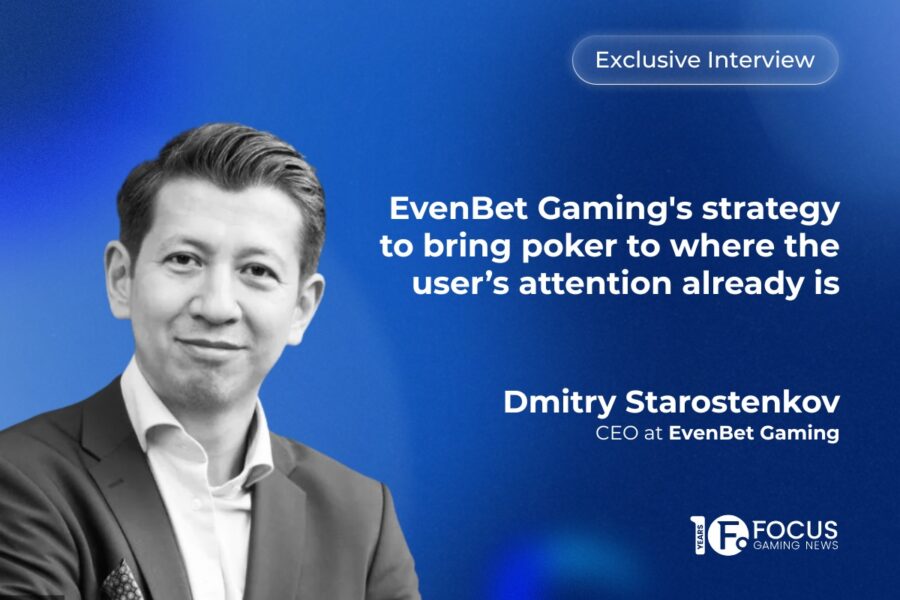
Dmitry Starostenkov, the CEO of EvenBet Gaming, spoke to Focus Gaming News about how poker products must innovate in order to capture the attention of the modern casual player.
Exclusive interview.- As player attention becomes one of the most valuable commodities in digital entertainment, the igaming industry is increasingly being forced to rethink how products fit into modern consumption habits. Few verticals face that challenge more directly than poker, a product traditionally built around long sessions, deep engagement, and dedicated communities.
In this exclusive interview with Focus Gaming News, Dmitry Starostenkov, CEO of EvenBet Gaming, discusses why poker must evolve from a standalone destination into what he describes as a “micro-moment engine,” how operators can monetise idle moments between sportsbook and casino activity, and why the industry’s biggest challenge may not be technological but cultural. He also shares his vision for a future in which poker becomes a frictionless engagement tool embedded throughout the wider igaming ecosystem.
During your keynote, you argued that operators are no longer competing only against other gaming brands, but against attention itself. That’s a powerful shift in thinking. At what point did you realise poker needed to adapt to the attention economy rather than expect players to adapt to poker?
The realisation came from observing general consumer behaviour. Think about how we use apps like Uber or Amazon. We expect a car to arrive in 3 minutes, and we buy a product in a single click. Simultaneously, the explosion of short-form content apps has conditioned the human brain to expect a dopamine hit every 60 seconds.
Then I looked at the traditional poker lobby (table selection, waiting for a seat, downloading separate client software), and I understand that this architecture is perfect for a dedicated poker fan. And it just doesn’t work for a sports bettor. We were asking a sports user, who operates in an 8-second attention span, to completely break their match-watching rhythm. That’s a losing battle. The turning point was realising that if we don’t fill the player’s immediate 2-minute downtime, TikTok or Netflix will. We had to bring poker to where the user’s attention already is, rather than expecting them to come to us.
You describe traditional poker as a product designed for a different era, one built around long sessions and deep engagement. Do you believe the industry has spent too much time protecting legacy formats instead of reimagining how poker fits modern player behaviour?
For a long time, the poker vertical was trapped in a traditional mindset. The industry spent years optimising features for the top 5 per cent of ecosystem players – multi-tabling tools, complex integrations, and massive tournament structures. There was a fear that if we changed the format too much, we would lose the core community.
But in doing so, we built a wall around the game, making it inaccessible to the massive, growing audience of casual players and sports bettors. Protecting legacy formats is fine if your only goal is survival within a niche. But if you want growth, you have to innovate. Reimagining poker doesn’t mean destroying the classic game. It means creating alternative entry points that fit how people actually live and use their smartphones today.
“For a long time, the poker vertical was trapped in a traditional mindset.”
Dmitry Starostenkov, CEO of EvenBet Gaming.
One of the most interesting ideas from your presentation was reframing poker from a destination into what you called a “micro-moment engine.” If we revisit this conversation three years from now, what do you think poker products will look like if this transformation succeeds?
If we succeed, three years from now the very concept of a “poker lobby” will feel outdated for the casual market.
Poker products will be almost entirely decentralised and contextual. You won’t necessarily open a “poker” tab; instead, poker will appear as an interactive layer exactly when and where it makes sense. It will live inside live sports streams, allowing you to play a quick hand during standard match delays. It will be embedded in your bet slip, giving you a 60-second tournament option while you wait for halftime to end. The UI will be entirely portrait-first, highly personalised based on your average session length, and completely frictionless. Poker will become an invisible, high-velocity retention engine working silently across the entire igaming ecosystem.
Hyper-turbo formats, Mystery Bounties and One Click experiences are clearly designed around speed and immediacy. How do you introduce instant gratification without losing the strategic depth and social DNA that made poker successful in the first place?
This is the ultimate product challenge. If you move too far towards pure instant gratification, you just end up with a disguised slot machine, and you lose what makes poker unique.
The goal is to compress poker’s time architecture without losing its DNA. Mechanics like fast-fold and Mystery Bounties eliminate the downtime but preserve the real peer-to-peer competition, strategy, and bluffing. It’s the same psychological game against real humans, just delivered in an intense 45-second session.
“The goal is to compress poker’s time architecture without losing its DNA.”
Dmitry Starostenkov, CEO of EvenBet Gaming.
Your keynote highlights idle moments, halftime, bet settlement windows, waiting period, as untapped engagement opportunities. In your view, are operators still underestimating the commercial value hidden inside these “dead zones”?
Absolutely. Many operators still look at their metrics through a very fragmented lens, for instance, they see sportsbook volume or casino volume, but they miss the gaps between the actions.
When a sports bettor is waiting 15 minutes during halftime, or a few minutes for a live bet to settle, that is a high-risk churn window. Right now, a massive amount of potential player LTV is bleeding out into non-gaming apps during those exact minutes. If you can monetise those idle seconds at scale across hundreds of thousands of users, the cumulative impact is massive. The operators who realise that “dead zones” are actually prime real estate are the ones winning the retention war today.
Internal pilots suggest that multi-vertical players show considerably stronger retention and engagement metrics. Beyond the numbers, what surprised EvenBet the most when observing real player behaviour around instant-play poker?
What surprised us most was the sheer velocity of the re-entry loop. We expected players to treat a One Click Poker widget as a “one-and-done” distraction: to get the result and to go back to the sportsbook.
Instead, we saw a powerful “snacking” pattern. Players would enter a session, finish a fast-fold hand in 30 seconds, and immediately hit re-entry three or four times in a row while still keeping an eye on their live match tracker. The friction was so low that playing became an automated, secondary rhythm. The behavioural data showed us that when you remove the psychological weight of entering a “poker world”, players treat the game with much higher frequency and less hesitation.
You challenged operators to stop treating instant poker as a side experiment and start seeing it as a strategic lever. What organisational change do you think is actually the hardest: technology, mindset, KPIs, or culture?
Without a doubt, it’s a mix of mindset and KPIs.
Technology is just engineering; we have already built the APIs, the stateless session provisioning, and the responsive widgets. The real bottleneck is how executive teams measure success. If a product director is still evaluated purely on traditional vertical-specific KPIs, they will always treat cross-vertical instant play as a secondary, distracting experiment.
The hardest shift is getting leadership to add cross-vertical metrics, like short-session LTV and micro-session retention, to their main executive dashboards. It requires moving away from siloed product thinking and adopting a holistic view of the user’s total time spent on the platform.
Looking at the broader igaming landscape, do you think we are witnessing the beginning of a larger industry shift where every product, not only poker, will need to become shorter, faster and frictionless? Or is there still room for long-form gaming experiences?
We are witnessing an irreversible shift towards shorter, frictionless experiences driven by the broader digital world. Every igaming product team must learn to operate in milliseconds. However, long-form experiences won’t vanish. There will always be a place for deep immersion, like major tournaments or sports analytics. The future isn’t about choosing one over the other, but it’s about offering the right format at the right moment, seamlessly transitioning a player from a 2-minute lunch break session to a deep Friday evening game.
By Focus Gaming News Editorial Team