



David Forman, AGA: “The US gaming industry has built strong public trust over the years”


David Forman, VP of research at the American Gaming Association, looks at the gaming industry’s performance over the past few years and shares his views on the challenges facing the sector in the years ahead.
Exclusive interview.- In February, the American Gaming Association‘s (AGA) Commercial Gaming Revenue Tracker revealed that commercial gaming revenue reached an annual record of $71.92bn in 2024.
The total was 7.5 per cent higher than the $66.5bn generated in 2023, marking the fourth year of growth for the industry.
To find out more about the outstanding figures the industry has achieved in recent years, Focus Gaming News spoke to David Forman, vice president, research at the AGA.
What were the key factors driving the record-breaking revenue in 2024, and do you expect this upward trend to continue?
2024 was a record year for commercial gaming revenue, reaching approximately $72bn. That’s nearly an 8 per cent increase from the previous year, which itself was a record. When we factor in tribal gaming revenue, which we don’t have exact figures yet, we anticipate the total U.S. gaming revenue will be around $115bn for the year.
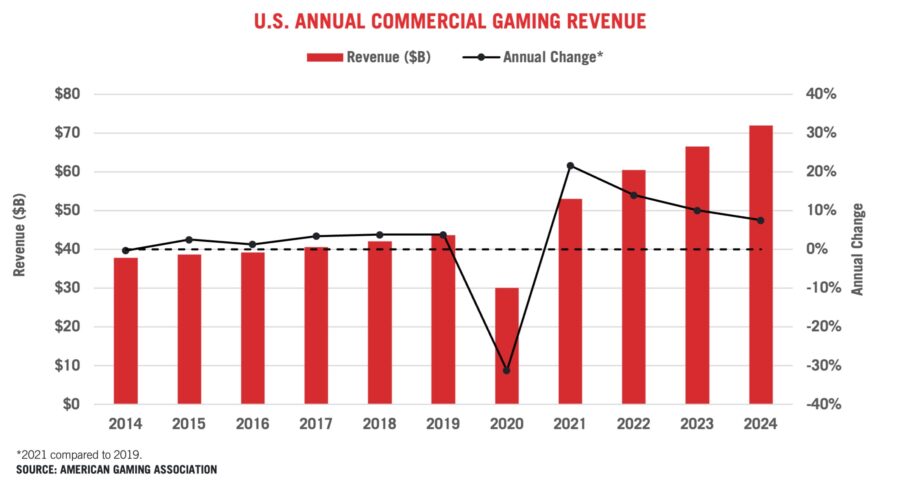
Brick-and-mortar casinos still grew, albeit modestly, by nearly a percentage point, and they continue to dominate the industry. However, much of last year’s growth came from sports betting and igaming. While we did see a new market open in Rhode Island, even well-established markets like New Jersey, Pennsylvania, and Michigan continued to experience significant growth.
Sports betting also expanded into new states, but even in states where it has been legal for a while, we’re still seeing strong organic growth. More consumers are engaging with sports betting, and existing users are increasing their activity. So, while brick-and-mortar casinos remain the largest sector, digital gaming is driving a significant portion of growth.
“When we factor in tribal gaming revenue, which we don’t have exact figures yet, we anticipate the total U.S. gaming revenue will be around $115bn for the year.”
David Forman, vice president, research at the American Gaming Association.
How do you see the balance between land-based and online gaming evolving? Are there any specific areas where digital gaming is having the biggest impact?
As sports betting and igaming expand, they are naturally becoming a larger part of the overall revenue. Currently, they make up about 30 per cent of the total commercial gaming market. These options provide consumers with greater accessibility—they don’t have to visit a casino to place a sports bet; they can do it from their couch or at a bar with friends.
That said, millions of people still visit casinos, and an interesting trend we’ve seen since Covid-19 is a drop in the average age of casino-goers. While some older players haven’t returned at the same levels, younger people have rediscovered casinos and are engaging more with in-person gambling. Innovations in games and casino environments are playing a role in keeping brick-and-mortar gaming relevant.
With more states considering legalising sports betting and online gaming, what regulatory trends or challenges do you anticipate in the near future?
Sports betting is now legal in most states, but there are still a few key states, like Texas, California, and Oklahoma, where discussions are ongoing. One of the major trends we expect to see is continued debate on how to regulate and introduce sports betting in these remaining markets.
Public support for legalisation is strong, and lawmakers in these states are working to determine how best to structure their regulatory frameworks. I anticipate that these discussions will continue this year and into next year as states look to expand legal access to gaming.
Inflation and economic uncertainty have impacted many industries. How resilient do you think the gaming sector is to these external pressures?
Historically, gaming has been quite resilient to economic trends. While it’s not completely immune, it has held up well over time. If you look back over the decades, the only significant downturn we have seen in gaming revenue was during the global financial crisis in 2008.
Following Covid-19, there were concerns that the end of stimulus payments, rising gas prices, and higher interest rates might impact consumer spending on gaming. However, none of these factors have significantly affected demand. People continue to allocate a share of their entertainment budgets to gaming, whether at casinos or online.
Blockchain is increasingly being discussed in the gaming industry, not just in the U.S. but globally. How do you see it playing a role in the sector’s continued growth?
Blockchain, cryptocurrency, and AI are all areas of innovation that gaming companies are exploring. These technologies offer opportunities for digital payments, responsible gaming tools, and increased consumer trust.
Operators—whether online gaming platforms or brick-and-mortar casinos—are actively looking at how to integrate these technologies to enhance user experiences and improve operational efficiency.
Looking ahead, what do you think will be the biggest opportunities and challenges for the US gaming industry over the next years?
One of the biggest opportunities is the strong public trust the industry has built over the years. In the U.S., gaming enjoys broad public acceptance as a mainstream form of entertainment, which is not always the case in other markets. The industry has worked hard to maintain this positive reputation.
However, challenges remain. Continued regulatory debates, ensuring responsible gaming, and adapting to technological advancements will all be key areas of focus. Additionally, as the market matures, sustaining the same level of growth will require innovation and diversification.
“In the U.S., gaming enjoys broad public acceptance as a mainstream form of entertainment, which is not always the case in other markets.”
David Forman, vice president, research at the American Gaming Association.
Well, considering that revenue has grown over the past four years, the future looks promising.
Yeah, it does. You know, January numbers for revenue are coming in from a lot of places, and 2025 is off to a really strong start across the country. I saw a really strong start in Nevada on the Strip. So despite all the uncertainty people read about on the front page of the newspaper, I think in their personal lives, they’re carrying on and continuing to engage with gaming products.
By Focus Gaming News Editorial Team