


New South Wales lacks targets on gambling harm, audit office says
According to the audit, there are weaknesses in data about compliance and enforcement activities.
Australia.- A report by the Audit Office New South Wales has concluded that the Independent Liquor and Gaming Authority (ILGA) and the Department of Creative Industries, Tourism, Hospitality and Sport (the department) regulate gaming machines in a structured and consistent manner but are not supporting harm minimisation outcomes effectively.
The audit found that authorities have a clear regulatory strategy and shares information with stakeholders. However, the strategy does not focus enough on high-risk areas for gambling harm and lacks specific targets for reducing harm related to gaming machines. It also says gaming machine losses and the social costs of gambling harm continue to be disproportionately concentrated in socio-economically disadvantaged communities.
According to the audit, there are weaknesses in data about compliance and enforcement activities with a clack of clear data on current gambling harm levels and no targets for reducing harm linked to machines.
“There have been no evaluations of its compliance programs to measure their impact on harm minimisation outcomes. As a result, the department does not know whether its regulatory strategy is effective in minimising gambling harm,” the audit says.
The report adds that ILGA only reviews licence conditions for venues with gaming machines when a venue makes an application to change its operations. an while the regulator has the power to impose conditions on venues with a licence to operate gaming machines at any time, most of the venues that have the largest number of gaming machines have not had their licence conditions reviewed for at least the past five years because they have not applied for changes.
The report made several recommendations, including increasing the focus of the department regulatory strategy on improving harm minimisation outcomes and ensuring that the gaming machine forfeiture scheme achieves its objectives. It also recommended that ILGA start conducting regular reviews of licence conditions for venues and that it increase the clarity of its decisions.
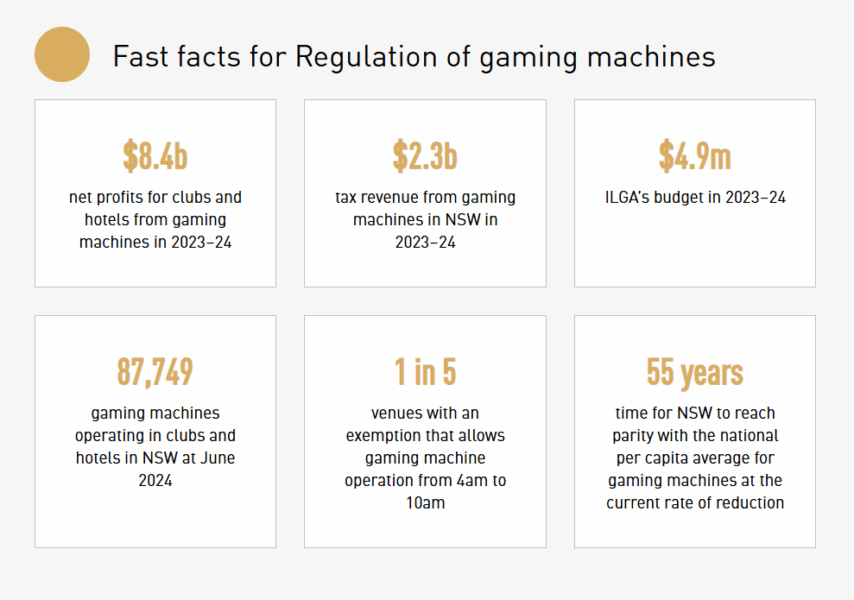
A law to reduce the number of gaming machines has been in place since 2001, but the report says the number has actually increased since 2021–22. There are currently 87,789 gaming machines across clubs, hotels and the Star Casino in Sydney – more than half of all of the gaming machines in Australia. In March, the government dropped its plan to phase out 9,500 gaming machines following recommendations from an independent panel on gambling policy, which included representatives from Clubs NSW and the Australian Hotels Association and stakeholders in harm minimisation.