


Antonio Giuliani, ADM: “With the launch of the new licences for the collection of online gaming, a very complex process was completed”
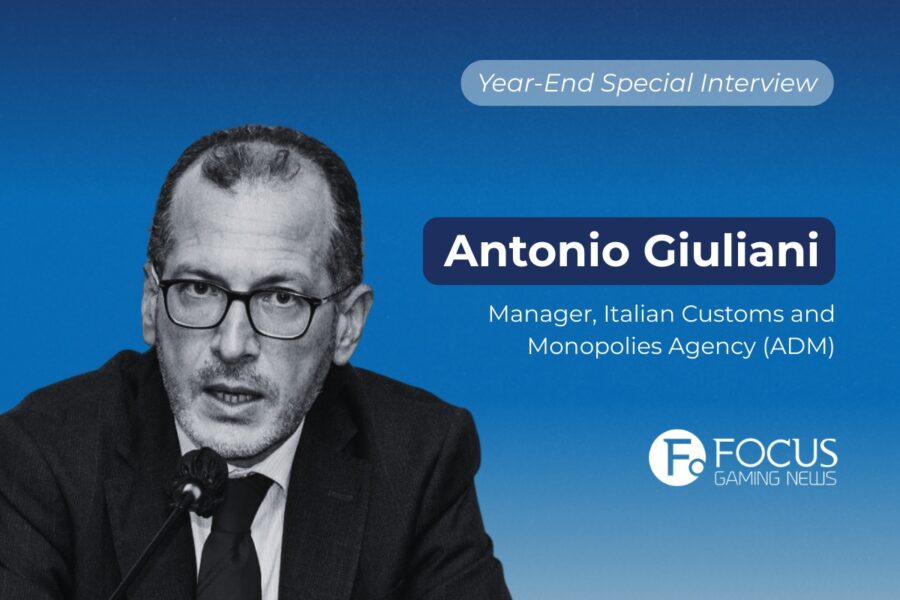
Antonio Giuliani, Manager of the Italian Customs and Monopolies Agency (ADM), has shared insights about the development of the market.
Exclusive interview.- The Italian gaming market reached a milestone in 2025 as a new regime began for online gambling. To learn more about the development of the industry, Focus Gaming News spoke to Antonio Giuliani, manager of the Italian Customs and Monopolies Agency (ADM).
He also shared details about the strategies ADM is adopting to counter illegal operators, responsible gaming policies, the reorganisation of land-based gaming, and the priorities for the online gaming sector in 2026.
Over the course of 2025, ADM completed the granting of new online gaming licences to 46 operators. What were the main criteria that attracted these operators, and how do you think they will influence the development of the market in the coming years?
On November 13, with the launch of the new licences for the collection of online gaming, a very complex process was completed. It lasted more than a year and a half and began with the approval of Legislative Decree No. 41 of March 25, 2024, on the reorganisation of online gaming and, subsequently, the drafting of the implementing technical regulations that led to the tender being issued and the granting of 52 licences to 46 operators.
The requirements for operators were demanding: technical expertise, personal integrity and good repute, strong capitalisation, and substantial economic and financial capacity.
The market’s response was significant: most of the existing operators took part, as well as many major international players who placed their trust in our system and in Italy’s ability to put forward clear regulation, investment certainty, robust action against illegal gambling and a strong focus on player health.
All these aspects influenced not only the decision to take part in the tender, but will also enable our market to continue to grow within a framework of legality, security and protection of health, ensuring significant revenues for the Treasury and operators in line with the investments required.
One of the main challenges remains tackling the black market. What strategies is ADM adopting to counter illegal operators, and how do you think European cooperation – in particular through coordination on cross-cutting issues such as match fixing – can amplify the effectiveness of these actions?
Italy is at the forefront in Europe in strengthening cooperation in the fight against illegal gambling. In online gaming, it is simply not possible to rely solely on national action – vital though that is – but rather it is necessary to identify supranational strategies.
Over the years, the Agency has blocked thousands of illegal websites, but it is an unequal struggle, because for every one site shut down, another ten appear. This is why we advocate the need for reciprocal data exchange and sharing of best practices with other countries, not only in Europe but also beyond, in order to allow for effective and, above all, immediate action to remove illegal offers from the web.
Match fixing is certainly a prime example. As an Agency, we play an active role in implementing the Macolin Convention on the manipulation of sports competitions, and our betting system, which requires the registration of all bets on a single national totalisator, enables a form of monitoring that is unique in the world. It is a system that other countries view with interest and which allows Italy, in this area as well, to be among the leading and driving nations.
“Italy is at the forefront in Europe in strengthening cooperation in the fight against illegal gambling.”
Antonio Giuliani, manager, ADM.
Director Roberto Alesse strongly believes in international cooperation and in strengthening tools to combat match fixing and has therefore instructed the Gaming Directorate to expand its monitoring activities, consolidating the analytical function and enhancing the exchange of information with the other institutions involved (first and foremost the Ministry of the Interior), as well as with the sports world, starting from the Office of the Prosecutor General of CONI.
About responsible gambling policies, what concrete initiatives is ADM pursuing in 2025 to expand and strengthen player protection measures?
In Legislative Decree No. 41 of 25 March 2024 and in the technical and administrative regulations drawn up for the new online gaming licences, responsible gambling and the tools for player protection take on a central and highly significant role.
In particular, the Technical Rules and the Licence Agreement for remote gaming set out in detail specific measures that must be adopted by licensees.
By way of example, I would mention the obligation to provide tools for self-limitation of play in terms of time, expenditure and losses; restrictions based on the amounts deposited in each player’s gaming account over a predefined period of time; and the introduction of automatic messages that appear on the screen while playing and show how much the player has wagered, displaying in real time how much has been spent, or issuing an alert when a given pre-set limit has been exceeded.
There is also the option for players to self-exclude from gambling, including on a preventive basis, either for a predetermined period of up to 90 days or for an indefinite period, as well as the possibility of self-excluding from one or more games or from all types of games.
Moreover, the new Licence Agreement provides for two compulsory and innovative instruments in the field of responsible gambling: the adoption of an Investment Plan relating, among other things, to combating problem gambling and to developing responsible gambling policies, with mandatory annual investment levels; and an obligation to adopt specific minimum measures indicated by the Agency.
The adoption of Investment Plans and responsible gambling policies will enable ADM to activate procedures to monitor the risk levels associated with each licensed game, verifying the actual presence of tools that allow the licensee to exercise greater control over the degree of participation in gaming by those players most exposed to the risk of problem gambling.
In addition, the Remote Gaming and Betting Office, drawing on the reports prepared by licensees on their responsible gambling policies and on the Investment Plans, will identify existing best practices and the most effective prevention and harm-reduction tools available to counter problem gambling, also through the use of artificial intelligence, predictive analytics and behavioural science. The aim is to adopt national Guidelines on responsible gambling, to which licensees will have to align their own policies. These Guidelines will be submitted to stakeholder review and a broad-based consultation process and will be subject to periodic implementation and revision.
Lastly, it should be noted that there is an obligation to invest annually an amount equal to 0.2 per cent of net revenues, and in any case no more than €1,000,000 per year, in information campaigns or responsible communication initiatives on topics established annually by a government committee set up at the Presidency of the Council of Ministers.
The reorganisation of land-based gaming is a priority for ADM in the near future. What are the main objectives of this measure, and how does it fit into the overall strategy for regulating the sector?
The reorganisation of land-based gaming is a crucial step in completing the reform of public gaming. The Agency is working in close coordination with the offices of the Deputy Minister of Finance to draw up a comprehensive regulatory framework capable of reconciling the various demands and interests at stake, both at local level and in terms of the different areas concerned. It is necessary to strike a balance between, on the one hand, the right to free enterprise of State concessionaires operating in an activity that is not only lawful but also carried out under State concession and, on the other, the protection of public health, taking into account the important role played by regions and local authorities, without neglecting compliance with budgetary obligations given the revenues generated by the sector.
The Agency is playing its part by providing technical support and expertise with the aim of establishing a single regulatory framework across the national territory that will allow tenders for land-based gaming concessions to be launched as soon as possible, after far too long a period in which such concessions have been repeatedly extended.
“The reorganisation of land-based gaming is a crucial step in completing the reform of public gaming.”
Antonio Giuliani, manager, ADM.
Looking ahead to 2026, what are ADM’s strategic priorities for the online gaming sector, and what regulatory or legislative changes do you foresee for next year?
In 2026, the goal is to consolidate what has been done, to implement all the regulatory innovations that have been introduced, and to provide operators with all the directives, guidance and guidelines they need in order to operate with full regulatory certainty.
It will be necessary to revise some gaming regulations that require adjustment following the innovations introduced with the new tender and to clarify more fully certain developments regarding the certification of gaming systems.
This is a complex and highly technologically advanced sector, in which any innovation has to be very carefully weighed and accompanied by strong impetus and robust support.
It will be the year in which the foundations are laid for the new licensing cycle, with the aim of making the online gaming ecosystem increasingly sustainable, transparent, clear and responsible.
By Focus Gaming News Editorial Team