


Anton Eshtokin, Boomerang Partners: “Affiliate programmes are gradually evolving from traffic suppliers into long-term business partners”
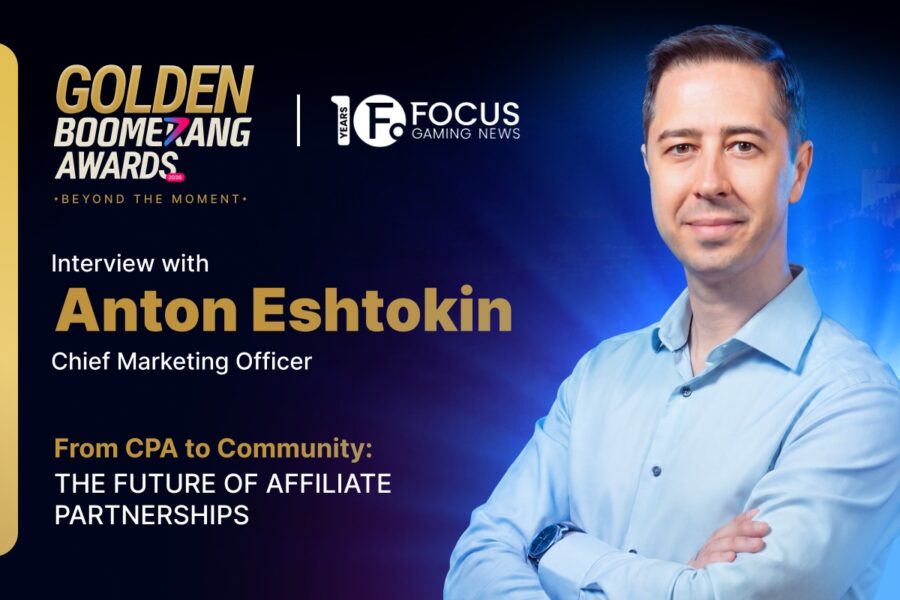
Anton Eshtokin, Chief Marketing Officer at Boomerang Partners, spoke to Focus Gaming News about the evolution of affiliate programmes and the use of gamification in sports marketing.
Exclusive interview.- As competition intensifies across the affiliate marketing landscape, partnerships are increasingly being shaped by factors that extend well beyond CPA rates and revenue-share agreements. Recognition, engagement, networking opportunities and long-term collaboration are becoming key differentiators for affiliate programmes seeking to build lasting relationships with partners.
In this exclusive interview with Focus Gaming News, Anton Eshtokin, chief marketing officer at Boomerang Partners, discusses how affiliate expectations are evolving, the role of gamification and major sporting events in strengthening partner engagement, and the lessons learnt from previous editions of the Golden Boomerang Awards. He also shares his perspective on the future of affiliate marketing and why the industry’s most successful programmes will be those that provide value far beyond financial incentives.
Affiliate partnerships have traditionally been built around CPA models and revenue-share agreements. Do you see the relationship between programmes and affiliates evolving beyond purely transactional structures?
Affiliate partnerships are definitely becoming less transactional than they used to be.
A few years ago, strong commercial terms were often enough to attract and retain affiliates. Today, that is much harder. Traffic acquisition has become more expensive, regulations change frequently, and affiliates have to be much more careful about where they invest their time and resources.
Because of that, affiliates are looking beyond CPA rates or revenue-share percentages. They want partners they can rely on when the market changes. They want expertise, quick communication, useful insights, and confidence that a programme is thinking beyond the next month’s results.
We see this clearly in our own partner network. The strongest relationships are usually built around ongoing cooperation rather than individual deals. Affiliates value access to market knowledge, support from experienced managers, industry networking opportunities, and initiatives that help them grow their business.
That is why affiliate programmes are gradually evolving from traffic suppliers into long-term business partners. Commercial terms still matter, of course, but they are no longer the only reason affiliates choose to stay.
In your view, are affiliates increasingly looking for more than financial incentives? How important are recognition, engagement, and long-term relationship building today?
It would be unrealistic to say that financial incentives no longer matter in affiliate marketing. Of course they do. Revenue remains the foundation of the industry, and CPA or revenue-share models are still essential.
At the same time, money alone rarely creates loyalty anymore. Most serious programmes can offer competitive commercial terms, so affiliates increasingly look at what happens beyond the deal itself: how the programme communicates, how fast it reacts, how well it understands their business, and whether the relationship brings value beyond monthly numbers.
Recognition and engagement matter much more today because the industry has become harder to work in. Affiliates deal with expensive traffic, tighter rules, platform restrictions, and constant pressure to keep performance stable. In that environment, they value partners who recognise their work, involve them in bigger initiatives, and give them reasons to stay close to the brand.
Our partnership with AC Milan is a good example (just a reminder, Boomerang is an Official Regional Partner of the Club). Through TIME TO WIN and the Golden Boomerang Awards, we have been able to create experiences that go beyond standard bonuses or commissions, from matchday access to Milanello visits and other AC Milan-related opportunities.
For many partners, these moments are not just rewards. They become part of their own professional story: something they remember, share, and associate with the programme. That kind of connection is much harder to build through commercial mechanics alone.
“Money alone rarely creates loyalty anymore.”
Anton Eshtokin, chief marketing officer at Boomerang Partners
Major sporting events often create periods of heightened activity and attention. GBA integrates these moments into its overall structure. What inspired that approach, and what role do sporting events play within the wider concept?
Sport is a big part of how affiliates plan their year, especially in online sports betting. Major tournaments, derby weekends, finals, and long competition cycles change how players behave and where attention goes. For an affiliate programme, it would be strange to ignore that rhythm.
One of our priorities this year is to get closer to our goal – making Boomerang Partners one of the best sports-focused affiliate programmes worldwide, so we wanted the Golden Boomerang Awards 2026 to reflect the way the market actually works. Affiliates do not work with a flat calendar. Some weeks are quiet, some are overloaded, and some sporting moments can define the whole month.
That is also why we created the Sports Marketing & Betting Calendar 2026. It helps partners plan around these moments earlier, instead of reacting when traffic is already moving.
Within the Golden Boomerang Awards, sport is not just a visual theme. It shapes the competition itself. The staged format, match-based mechanics, and timing around key events follow the same rhythm affiliates face in real work: preparation, momentum, pressure, and the need to keep performing after the first peak is over.
Across many industries, we’re seeing greater use of gamification and interactive mechanics. Why do you think these elements resonate with partners, and can they support stronger long-term engagement than traditional short-term campaigns?
Gamification works because affiliates are competitive by nature. They track numbers every day, compare results, react quickly, and look for the next opportunity. So when you build mechanics around progress, rankings, challenges, or stages, it fits the way they already think.
For us, it is not about adding game elements for entertainment. A good tournament gives partners a reason to stay involved between major campaign peaks. Instead of one short push, they see progress over time, understand what they are competing for, and have more reasons to keep interacting with the programme.
This is especially important now, because many affiliate programmes offer similar commercial terms. If the only conversation is about CPA or revenue share, the relationship can quickly become transactional. Interactive mechanics help create more contact points: tasks, leaderboards, rewards, updates, and shared moments around sports events.
But gamification only works when the rules are clear, and the mechanics are connected to real business goals. Partners should not feel that they are playing a random marketing game. They need to see how participation links to performance, recognition, and real opportunities.
When it is built this way, gamification can support long-term engagement better than a one-off campaign. It keeps partners active, gives the relationship more rhythm, and makes the programme feel more alive.
“A good tournament gives partners a reason to stay involved between major campaign peaks.”
Anton Eshtokin, chief marketing officer at Boomerang Partners
Looking back at previous GBA editions, were there any insights or lessons that genuinely surprised your team?
What surprised us most was how seriously partners took the non-financial side of the Golden Boomerang Awards. Of course, the prize matters. But recognition, status, access, and unique experiences can create a different level of motivation.
When the reward is not just money, but something partners can remember, share, or connect with their own progress, engagement feels stronger. It becomes less about “complete a campaign and move on” and more about being part of the competition.
Another lesson was that long tournaments can work if the structure gives people enough reasons to stay active. We expected a stronger drop-off over time, but participation was more stable when partners could see clear stages, milestones, and movement in the leaderboard.
We also saw that consistency is one of the hardest things to maintain. Strong teams usually get stronger over distance, while mid-table teams often need extra triggers to stay in the race. That helped us rethink GBA not as one big campaign, but as a structure with different moments of attention, pressure, and motivation.
What key lessons from earlier seasons influenced the development of GBA Season 3, and what makes this edition different?
The main lesson was that Golden Boomerang Awards works best when partners can see a clear path through the whole season, not just a set of separate campaigns.
That is why Season 3 became longer and more structured. This year, GBA runs as a five-month tournament with clear competitive stages and a match-based logic inspired by football. It gives the season a rhythm: a start, key turning points, pressure moments, and a final stretch.
We also learnt that partners need enough reasons to stay active over time. That is why we added mechanics such as boosts, which help keep the competition dynamic and give different types of participants a chance to stay in the race, including teams that join later or need a strong comeback moment.
Continuity was another important point. We did not want each season to feel disconnected from the previous one. The recognition structure remains consistent, so achievements build value over time, and partners can see progression across seasons.
The biggest difference is that Season 3 feels much more mature. Golden Boomerang Awards is no longer a format we are testing. It has become a full competitive platform with clearer rules, stronger sports logic, and higher expectations from partners and the industry.
Looking ahead, where do you see affiliate engagement evolving over the next few years?
The affiliate market is becoming harder to predict, so I think engagement will become more practical and more structured over the next few years.
Affiliates will still care about commercial terms, but that will not be enough. They will look more closely at what a programme helps them do every day: understand traffic patterns, plan around sports events, react faster to market changes, and make better decisions with their budgets.
For affiliate programmes, this means engagement cannot be limited to occasional promotions or short campaigns. Partners need a system around them: useful tools, clear communication, data, timely insights, and reasons to stay active even between major traffic peaks.
At Boomerang Partners, this is the direction we are moving in. We want partners to work in a more predictable environment, where they can plan earlier, track progress, and understand where the next opportunity may come from.
Gamification, tournaments, and engagement mechanics will be part of that, but only when they have a real purpose. They should help partners stay focused, not just entertain them. In the long run, I think the strongest programmes will be the ones that make affiliate growth feel less random and more manageable.
By Focus Gaming News Editorial Team