



Alexander Kamenetskyi, SOFTSWISS: “Preparation for a major tournament like the World Cup is not just a platform question. It is a question of the entire operational model around it”
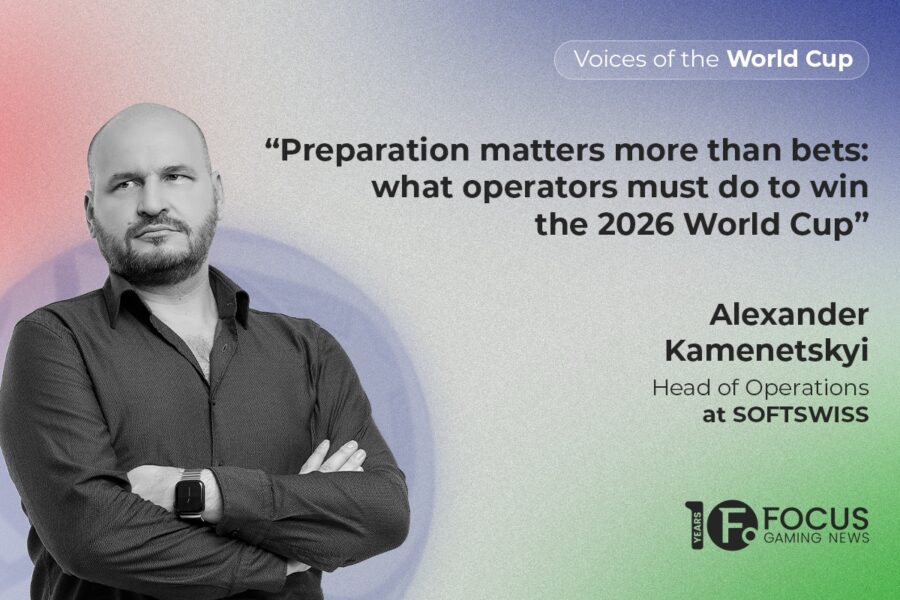

In the first instalment of “Voices of the World Cup”, Focus Gaming News spoke with Alexander Kamenetskyi, Head of Operations at SOFTSWISS Sportsbook, about platform performance, operational automation, and player retention strategies ahead of the FIFA World Cup 2026™.
Exclusive interview.- As the FIFA World Cup 2026™ approaches, operators are entering one of the most demanding periods for sportsbook projects, with more matches, markets, and pressure than ever before. Focus Gaming News spoke with Alexander Kamenetskyi, head of operations at SOFTSWISS Sportsbook, about what it really takes to handle that scale. From platform performance to player behaviour and product strategy, he explains why the real work begins long before the first whistle and how SOFTSWISS can help operators maximise the benefits of the championship.
The FIFA World Cup 2026™ is the largest event in history for sportsbooks – 104 matches, three host countries, and more simultaneous live markets than any previous tournament. From a platform perspective, what does that scale demand that you haven’t had to solve before?
The most common mistake I see is operators treating this as a traffic problem. It is not – they will get traffic anyway. The question is whether the platform holds when everything happens at once. New registrations, casino players trying sportsbook for the first time, promotions running in parallel, live bets surging, mobile load spiking, bonus activity compounding, support volumes rising, and payment processing under stress – all of this will be tested simultaneously.
These are the moments that reveal not the platform’s strengths, but all of its weak spots at once.
The SOFTSWISS Sportsbook handles up to 30,000 bets per minute across 500 simultaneous live events. But the number that actually matters is what happens in the 90th minute of a decisive group stage match – when traffic spikes, odds are moving in real time, and a slow confirmation screen costs you a bet and possibly a player. At that point, architecture, speed, and stability stop being purely technical questions. They become questions of product quality and, ultimately, revenue.
What should operators be doing right now to make sure their platform is ready for that kind of pressure?
My advice to operators is not to evaluate a platform in calm conditions. Stress-test it. Check not just load capacity, but mobile flow, live data updates, bet confirmation speed, bonus mechanics under pressure, payment scenarios, and system behaviour during peak matches. Find out where it breaks before the tournament does.
Beyond infrastructure, the operators who win this tournament will be the ones who started preparing months ago – building player habits, running cross-sport promotions, and gradually warming up their casino audience to sportsbook. A fast, stable platform helps attract attention. Preparation is what helps retain players.
That is why we are launching a dedicated World Cup page, new bonus mechanics, and an updated mobile experience before the first match, because entering the biggest tournament in the world underprepared is not a strategy.
“My advice to operators is not to evaluate a platform in calm conditions. Stress-test it.”
Alexander Kamenetskyi, head of operations at SOFTSWISS Sportsbook.
When you’re managing a platform used by multiple operators simultaneously during a peak event, where does the pressure actually come from – the volume of bets, the variety of markets, or something less obvious that most people wouldn’t anticipate?
From my experience, the pressure that actually breaks projects is not technical – it is operational. Volume is predictable. What catches operators off guard is that every manual process they tolerated in normal conditions does not scale, and it turns into a crisis during a major tournament.
In a quiet period, manual workarounds may be tolerable. During a big tournament, they break under pressure. Risk management slows down exactly when speed matters most. Bonus abuse spikes. VIP players expect immediate responses. Support queues double or triple.
I have seen projects go into a major tournament with a solid platform and weak operations – and fail under pressure. I have also seen smaller operators outperform bigger ones simply because their automation, prioritisation, and ownership were stronger.
How can operators assess whether they are genuinely ready – and where does SOFTSWISS step in?
I would look at it very pragmatically – through failure points. Who monitors live betting limits when volume spikes? What triggers an automatic response to bonus abuse? Who owns VIP communication during the tournament? How quickly are decisions made on incidents? If those answers involve a person doing it manually, that is already a scaling risk.
The reality is simple: any process that depends on manual control at peak will cost the operator money – it is only a matter of when.
This is why preparation for a major tournament is not just a platform question. It is a question of the entire operational model around it. You cannot enter a tournament hoping the team will figure it out along the way – peak events punish improvisation. By that point, automation, clear ownership, risk processes, and support structures must already be in place and tested under load.
At SOFTSWISS, we address this by removing operational uncertainty through dedicated teams – technical account managers, business account managers, and a risk management team – who work with partners before and during the event. The reason is not that operators cannot do it themselves – at this scale, execution discipline becomes the difference between growth and loss.
During a World Cup match – with live markets, in-play bets, and real-time data all moving simultaneously – what does a genuinely good mobile experience look like, and where do most platforms fall short?
The most common pain I hear from operators is this: their mobile product looks fine in demos – and fails under real conditions. Navigation slows down. Odds updates lag. A player trying to place a live bet during a goal sequence gets a spinning loader instead of a confirmation – and that lost moment is lost revenue.
That is not a feature problem. That is a stability problem – and it stays invisible until peak load exposes it.
From what I see, most platforms invest in how mobile looks rather than how it performs under load – and that trade-off becomes visible during live events. Players do not care about the design when the match is live. They want to find the market, tap once, and see the bet confirmed. Any extra step costs you that moment – and during a World Cup, those moments are your margin.
This is what drove our decision to rebuild the mobile experience this year. We looked at drop-off points, operator feedback, and performance data under peak load. Microbetting is a concrete example: players want to act on what is happening right now – the next corner, the next throw-in. If the interface cannot keep pace with that, the feature simply does not exist from a business perspective.
Over 90 per cent of GGR comes from mobile. We treat it as a primary revenue product, not a ported version of the desktop.
“Players do not care about the design when the match is live. They want to find the market, tap once, and see the bet confirmed.”
Alexander Kamenetskyi, head of operations at SOFTSWISS Sportsbook.
Your platforms support operators across more than 20 regulated markets. Based on what you’ve seen after previous major tournaments, what actually happens to player activity in the weeks after the final whistle?
There is always a drop. That is expected. The real problem is operators who are surprised by it, because they treated the World Cup as a short-term campaign instead of a long-term player lifecycle stage.
What I consistently see: operators who ran coherent retention throughout the tournament – active bonuses, loyalty mechanics, personalised communication – experience a much smaller post-event decline. Those who focused almost entirely on acquisition feel the drop sharply. They got the players. They just did not convert them into repeat behaviour.
Habit formation matters more than operators realise – it is what defines post-event revenue. My recommendation is always the same: before the World Cup, introduce your players to other sports. Cricket, tennis, basketball, hockey. Not aggressively, but consistently: keep those events visible, run lightweight promotions, and make them part of the routine. When football stops, those players do not disappear – they either switch sports or churn. They have already learned that there is always something to bet on.
The operators who call us in August asking how to re-engage their player base are usually the ones who ignored this in April and May. The calendar does not have to be a cliff – but without preparation, it always becomes one. And this happens when operators plan for the event and not for what comes after.
July 2026 will generate enormous acquisition numbers for operators. But what does a platform need in place before the tournament starts to ensure those players are still active in August? Is retention a product problem or a marketing problem?
Retention is both, and operators who try to separate retention into “product” or “marketing” usually expose a deeper execution problem.
But I would reframe the question more directly. The gap I see most often is not between product and marketing. The real gap lies between operators looking for a sportsbook product and operators looking for a sportsbook partner. The first group gets a platform. The second gets a partner who helps them understand why player activity slows down by week three – and what to do before that happens.
What we consistently observe: projects sitting at 3–5 per cent sportsbook share and those reaching 30–40 per cent often operate with comparable traffic volumes. The difference is engagement depth – segmentation quality, bonus relevance, and communication consistency. That is not just a platform feature. It is an operational capability that has to be built in advance.
We can get a project live in 14 days from contract signing to first bet, and I am proud of that speed. But a fast launch is only a starting position, not a retention strategy. The operators who will still have those July players active in August are the ones who built their retention system before the tournament started – not the ones who planned to think about retention after acquisition numbers came in.
Looking ahead to the FIFA World Cup 2026™, what is the one thing you think will genuinely surprise the industry?
The scale of the casino-to-sportsbook crossover – and how much of it will remain after the tournament ends.
Our research shows that up to 20 per cent of casino players will actively seek out sports betting during the World Cup. The industry knows this happens. What the industry still underestimates is the duration effect: 104 matches across a full month means that a casino player who tries a sportsbook in June has enough time not just to test the product, but to form repeat behaviour. That is very different from a short tournament, where the window closes before the habit has time to form.
The operators who capture this are not the ones who throw up a sportsbook banner in June. They are the ones who have been preparing their casino audience for months – through mixed promotions, educational content, and low-friction entry mechanics for players who have never placed a sports bet before. Those players convert, and a meaningful share of them stay.
Operators who continue to treat casino and sportsbook as separate campaigns will see the crossover in July – and lose most of that value by September. I think that gap will become very visible this year – and it may reshape how operators think about product integration after the tournament.
This is the first instalment of Voices of the World Cup, an exclusive interview series exploring how the sports betting and igaming industry is preparing for the FIFA World Cup 2026™. Over the coming weeks, Focus Gaming News will speak with the most influential leaders in the sector on AI-driven trading, platform stability, Bet Builder innovation, next-gen retention and crypto integration.
Follow the series at focusgn.com
By Focus Gaming News Editorial Team