

Sean Coleman, SABA: “Gambling regulation is a concurrent competence in South Africa — national and provincial legislation must be harmonised”
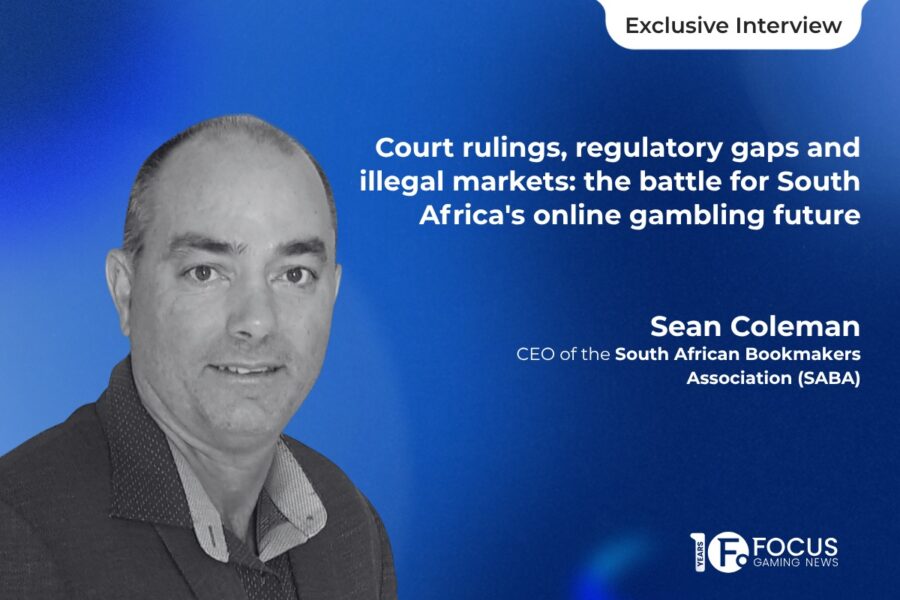

Focus Gaming News spoke with Sean Coleman, CEO of the South African Bookmakers Association, to discuss the Supreme Court of Appeal ruling on roulette and the future of igaming regulation.
Exclusive interview.- As regulatory uncertainty continues to shape South Africa’s gambling landscape, recent legal developments have sparked widespread debate around the scope of permitted online betting activities. Interpretations of court rulings, combined with fragmented provincial legislation, have created a complex environment for operators navigating compliance and market strategy.
In this context, Focus Gaming News spoke with Sean Coleman, CEO of the South African Bookmakers Association (SABA), to clarify the industry’s position. In this exclusive interview, Coleman addresses misconceptions surrounding the Supreme Court of Appeal (SCA) ruling, outlines the challenges posed by regulatory inconsistency, and shares SABA’s perspective on how South Africa can build a more coherent and sustainable framework for online gambling.
The Supreme Court of Appeal ruling last October has been widely interpreted as a ban on online casino games. SABA has argued that the reality is more nuanced. How does the association characterise what the ruling actually established and what it did not?
Last October, we issued a press release regarding this matter. Contrary to certain of the reports which have been published and the opinions which have been expressed in the media regarding the judgment, the decision of the SCA neither rules nor implies that licensed bookmakers throughout South Africa are prohibited by law from offering betting on the game of roulette, or any other casino game. In addition, nothing in the judgment of the SCA is consistent with the conclusion that these activities have been banned.
Instead, the crux of the judgment of the SCA is that licensed bookmakers in the Province of Gauteng may not legally offer betting on the game of roulette, because the Gauteng Gambling Act provides that bookmakers who are licensed by the Gauteng Gambling Board may offer betting only on sporting events, as defined in that Act. In its judgment, the SCA ruled that the game of roulette does not fall within the definition of “sporting event” in the Gauteng Gambling Act.
Because the judgment turns on the interpretation of the definition of “sporting bet” in the Gauteng Gambling Act, it does not automatically outlaw betting on roulette in particular, or casino games in general, throughout South Africa. The licensed operations of bookmakers in other provinces are governed by applicable provincial legislation, which in many cases permits them to offer betting on any contingency (which is not the case in Gauteng), provided that the contingency is not in itself unlawful.
It is equally important to address the claim that offering fixed-odds betting on casino-style games amounts to interactive gambling, which is unlawful under the National Gambling Act. That claim is incorrect. The betting offered online by licensed bookmakers is not interactive gambling, because under the National Gambling Act, a bet or wager offered by a licensed bookmaker is not a gambling game. Since a fixed-odds bet is not a gambling game, it cannot, by definition, be an interactive game or constitute interactive gambling.
The NGB has given operators a deadline of June 30 to remove unauthorised casino content. How are SABA’s members approaching that deadline, and what support is the association providing them during this transition?
No. We received no formal communication — the notices were directed at Provincial Licensing Authorities (PLAs) only, not at SABA or operators directly. Our position is clear: bookmakers are authorised in law to offer fixed-odds contingency betting, and by doing so, they are not conducting interactive gaming and are not acting illegally. Any request or communication that suggests otherwise, or that forms part of a takedown request — whether directed at PLAs or at operators — is misdirected and has no legal basis.
“Bookmakers are authorised in law to offer fixed-odds contingency betting, and by doing so, they are not conducting interactive gaming and are not acting illegally.”
Sean Coleman, CEO of the SABA.
Reports indicate that a new online casino licensing framework is expected to be put out for public consultation in Q3 2026. Has SABA been involved in those discussions, and what principles should any future framework be built around to protect both operators and players?
SABA is unaware of this proposed action and has not been consulted or involved in any discussions in this regard.
SABA has previously flagged a significant surge in illegal online gambling activity. Is there a risk that the current regulatory uncertainty pushes more players towards unlicensed operators, and what should be done to prevent that?
SABA cannot conclusively say that it pushes more players towards the illegal market, but it certainly blurs the lines of understanding when a South African consumer is engaging on a website and needs to understand the fundamental difference between a legal operator website and an illegal one. This determination should not be made based on product offerings on websites, but more specifically by performing a quick and easy analysis of the jurisdiction in which the operator is licensed.
In this regard, the landing page of the website is key. In the South African context, it is a compulsory compliance requirement to list the licensed entities’ details, the Provincial Licensing Authority (Gambling Board) that has issued the licence and the licence number. Furthermore, it must carry South African Responsible Gambling messaging. If a consumer cannot see these aspects at the bottom of the landing page of the website they are engaging on, then they should likely not proceed to entertain themselves on that website, as they would be at risk of contravening the National Gambling Act legislation.
South Africa is the largest economy on the continent and is attracting growing interest from international igaming operators. What is SABA’s message to foreign operators considering market entry at this particular moment?
There are opportunities with some of the Provincial Licensing Authorities to get legally registered in the South African market, and these gains should be considered against retaining a status of being an illegal offshore operator who operates from a pseudo licensing jurisdiction and makes no contribution to the South African economy or tax base.
Looking beyond the immediate regulatory dispute, what does SABA believe a well-functioning, sustainable online gambling framework for South Africa should look like in five years’ time?
In the main, I think all the existing gambling legislation, both nationally and provincially, has become outdated and needs to be overhauled to ensure that it can competently regulate the current and future market conditions.
Given that gambling regulation in South Africa is a concurrent competence, it is imperative that the national and provincial legislation is harmonised and national norms and standards are achieved. The inability to meet this requirement will result in continued disharmony, contradictory communication and market instability.
By Focus Gaming News Editorial Team