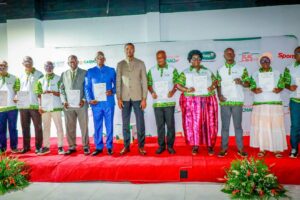


Panel assesses Francophone Africa gaming reforms at Africa Gaming Expo 2026
Discussions centred on how several Francophone jurisdictions are gradually adjusting their licensing regimes to allow for more structured market participation.
Nigeria.- Regulatory changes, tax structures and market access conditions across Francophone Africa’s gaming sector were the focus of discussion during a panel session at the recently concluded Africa Gaming Expo 2026. Panellists examined how evolving policy frameworks are shaping operator entry, compliance and long-term sustainability in the region.
Sponsored by Policy Vault Africa, the panel was moderated by Divine Afuba and featured Cisse Mamadou dit Ladji, Director General of Guinea’s Regulatory Authority for the Games and Similar Practices Sector (ARSJPA), Charles Emmanuel Tapé, Director of Operations at the National Lottery of Benin (LNB) and Moustapha Camara, Chairman of the Board of Directors of LONASE.
Other participants included Fabrice Niragira, CEO of the Burundi National Lottery and Gambling Authority, igaming attorney Franklin Njumbe and Papy-Pierre Bolia, Technical Director at the National Lottery Company (SONAL) of the Democratic Republic of the Congo.
Discussions centred on how several Francophone jurisdictions are gradually adjusting their licensing regimes to allow for more structured market participation. Panellists noted that these reforms are aimed at improving regulatory oversight while creating clearer pathways for licensed operators to enter and operate within the sector.
Speakers also addressed the impact of digital transformation across gaming systems in the region. The shift towards mobile and online platforms is influencing how regulators design compliance requirements, including monitoring tools and licensing conditions suited to digital operations.
Tax policy differences across countries were highlighted as a key determinant of market viability. Panellists explained that inconsistent tax rates and licensing fees continue to shape investment decisions, with some markets seen as more commercially sustainable than others due to more predictable fiscal frameworks.
The role of local partnerships was also emphasised, with participants noting that collaboration with domestic entities remains important for regulatory navigation and market understanding. These partnerships were described as essential for operators seeking to build a long-term presence in the region.
Country-level contributions during the session reflected uneven regulatory maturity across Francophone Africa, with some jurisdictions advancing towards clearer digital oversight systems while others continue refining basic licensing structures.
The session concluded that stronger coordination between regulators and operators, alongside more consistent licensing and tax frameworks, will be central to improving market stability and encouraging sustainable growth in French-speaking African gaming markets.