


Mauritius Gambling Regulatory Authority raises horse racing trainer licensing bar with US$64,000 guarantee
New licensing rules put greater emphasis on trainers’ financial strength, experience, stable capacity and ability to meet Mauritius’ racing and welfare standards.
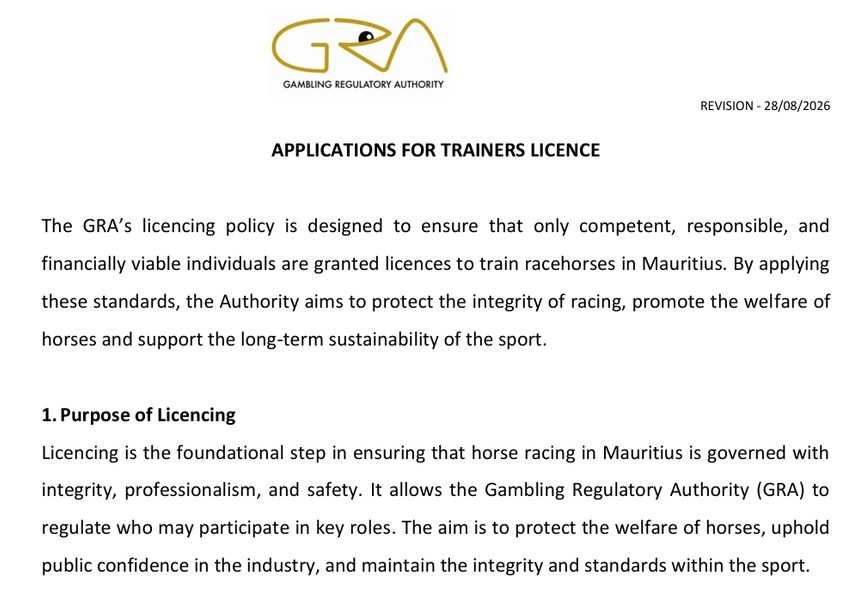
Mauritius.- The Mauritius Gambling Regulatory Authority (GRA) has revised the requirements for horse trainer licences ahead of the 2027 racing season, with applicants required to provide a MUR3m (US$64,000) bank guarantee, a three-year business plan and a list of at least 15 horses.
The requirements are set out in the GRA’s Applications for Trainers Licence – Trainer Licence Application Guidelines 2027, published on August 28 2026. The changes follow the GRA’s opening of 2027 applications to local and international trainers and stables with the deadline on November 30, 2026.
The business plan must include the applicant’s source of revenue and funds. Where a trainer is employed, the employer may provide the plan and bank guarantee. The GRA will also assess owner commitments and whether applicants have enough owners and horses to operate a sustainable and competitive stable.
First-time applicants, including former jockeys, must pass a trainer’s examination with a 70 per cent mark. They must also demonstrate knowledge of racehorse care, nutrition, veterinary care, conditioning, race planning, stable management and the Rules of Racing.
The GRA’s revised framework reads: “The licensing process is intended to ensure that only applicants who possess the necessary knowledge, practical experience, financial capability, infrastructure and commitment are entrusted with the responsibility of training racehorses in Mauritius.”
Applicants will undergo financial and integrity checks, including tax records, bank statements, a certificate of character, declarations of assets and liabilities, and disciplinary and performance records. Foreign nationals must provide an occupation permit, while clearance from a home racing authority is required where applicable.
International trainers licensed by recognised racing authorities may have their previous experience recognised if the GRA considers it equivalent to Mauritius’ standards. The Authority can nevertheless require an interview, written examination, practical assessment or induction programme on local racing rules and regulations.
Applicants must also have suitable stable facilities and horse boxes, adequate staff and the resources to cover operating costs including salaries, feed, veterinary care, transport, insurance and equipment.
The guidelines apply to applications for the current and upcoming racing season and remain in force until amended or revoked by the GRA.
The framework sets out professional experience and examination requirements alongside financial guarantees, stable capacity and detailed integrity checks for prospective trainers.